
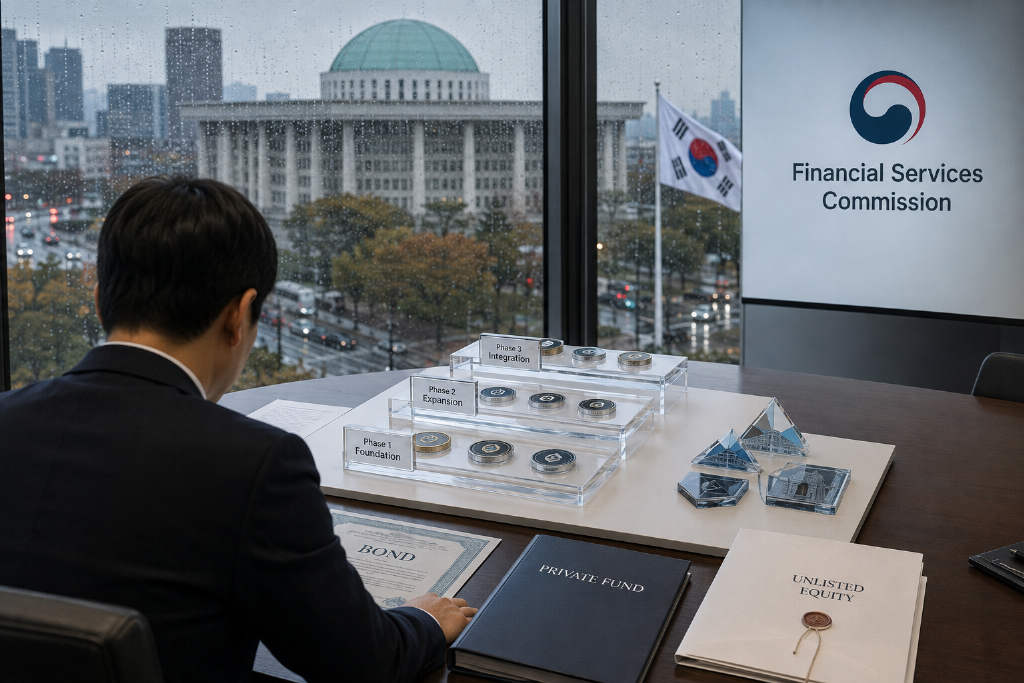
South Korea’s Financial Services Commission (FSC) on Sept. 4 unveiled a three-phase roadmap for tokenized securities at the third public-private joint council meeting on tokenized securities. Amendments to the Electronic Securities Act and the Capital Markets Act, passed on Jan. 15, 2026, are set to take effect on Feb. 4, 2027. According to the roadmap described in the source material, South Korea would then become the first major economy to use dedicated legislation to define the legal status of security tokenization, the asset classes involved and the sequence for building market infrastructure.
The document states at the outset that tokenized securities will stand alongside paper securities and electronic securities as a third issuance format. They will remain subject to existing rules on securities registration, disclosure and intermediary licensing. In other words, South Korea is folding tokenization into its current securities law regime rather than creating a separate sandbox just for the sector.
Phase one starts in February 2027 with institutions and private markets
The first phase will begin when the revised laws take effect in February 2027. The initial list of eligible assets is narrow by design.
For funds, the FSC will first allow privately placed money market funds, or Private MMFs, intended for institutional investors. For bonds, the opening category is privately placed corporate bonds. For equities, the market will begin with unlisted shares through a trust beneficiary certificate structure. Under that model, the shares remain in the existing registration system, while investors receive tokenized trust interest certificates. Fractional investment products that have already been publicly issued are also included in the first batch.
Licensing, capital and retail limits are laid out in detail
The roadmap also sets out the operating rules around distribution and trading. Securities firms and dealers that already hold licenses will be able to handle tokenized securities without obtaining an additional license.
Non-financial firms that want to operate investor accounts for their own tokenized securities must have at least KRW 4 billion in paid-in capital, about $3 million, and must employ dedicated staff for account administration, compliance and IT. OTC trading platforms must first obtain consultation approval from the Financial Supervisory Service.
Retail participation will be capped. The annual net purchase limit for retail investors on OTC platforms is KRW 100 million, or about $74,000. For fractionalized products, the per-subscription cap is KRW 30 million, or about $22,000, or 5% of the total issuance amount, whichever is lower.
On infrastructure, the Korea Securities Depository (KSD) is completing technical acceptance standards for securities firms connecting to a shared ledger. The FSC said it plans to release draft amendments to subordinate regulations by the end of September for public comment.
Phase two would extend tokenization to publicly offered securities
The FSC did not attach a fixed date to the second phase. The source material says the schedule will depend on four factors: the stability and operational efficiency of phase one, the technical maturity of market participants, interoperability across different distributed ledgers, and progress in South Korea’s stablecoin legislation.
The main policy change in this stage is the expansion of tokenization from private markets to publicly offered securities. The FSC also plans to draw on tokenization pilots at the New York Stock Exchange and Nasdaq, with the Korea Exchange (KRX) taking the lead on model verification and pilot programs for tokenized listed shares.
Phase three targets on-chain settlement with stablecoins
The final phase is designed to build on-chain settlement infrastructure so that trading in tokenized securities and the cash leg of settlement can be completed synchronously on the same ledger. The settlement instrument would be stablecoins. In the roadmap, the FSC cited BlackRock’s BUIDL tokenized fund and Hong Kong’s tokenized green bond as reference cases.
Stablecoin legislation in South Korea is being advanced separately. Under a proposal discussed in the source material, stablecoin issuers would need at least KRW 5 billion in minimum capital, roughly $3.7 million. Phase three would not begin until a legal framework for stablecoins is in place.
A contrast with the Robinhood approach
Set against this week’s broader global backdrop for security tokenization, South Korea’s route looks very different from the model described for Robinhood.
On the same day the FSC released its roadmap, AMC Entertainment CEO Adam Aron publicly denounced Robinhood’s tokenization of AMC shares as 「despicable」. The source material says traders of meme coins on Robinhood Chain had already pushed the price of tokenized AMC stock from $2 to more than $100.
That model, as described in the source, packages stocks through debt securities, places them on a permissionless blockchain and captures trading volume and users first, while leaving the legal relationship for the market to sort out later.
South Korea is moving in the opposite direction. It is first establishing the legal status of tokenized securities through legislation, then having KSD build custody and clearing infrastructure, then opening the market through institutional channels and privately placed products. Only after system stability is tested would the framework expand toward public securities, and on-chain settlement would wait until stablecoin legislation is complete. Each step has explicit prerequisites and regulatory checkpoints.
Speed versus certainty
The source material presents a clear trade-off between the two approaches. Robinhood gained speed and scale, with about $88 million in on-chain tokenized assets within two months and more than $1.5 billion in daily DEX volume. At the same time, it drew public attacks between CEOs, the prospect of SEC scrutiny, and a more basic question: what is the legal foundation of the market if the company whose stock is being tokenized does not agree to it?
South Korea’s path is unlikely to produce an “AMC-style” spectacle. The cost is time. There is a one-year gap between passage of the law and its effective date, the first phase is limited to private products, and there is still no timetable for public securities or on-chain settlement. Boston Consulting Group estimated that South Korea’s tokenized securities market could reach KRW 367 trillion, or about $249 billion, by 2030, but that figure depends on how quickly phases two and three can be implemented.
Global tokenization is still searching for a middle ground
As framed in the source material, the same week produced two opposite examples in global securities tokenization: one moved so fast that user behavior hurt the brand, while the other may move so cautiously that it risks missing the market window.
The source argues that the winning path will likely be a hybrid model: build infrastructure first, open access gradually, and still preserve DeFi composability. The European Union’s DLT Pilot Regime is described as moving in that direction, and Japan last week announced a national blockchain settlement infrastructure plan aimed at the early 2030s.
The race has only just begun, but the shape of the track is becoming easier to see.