
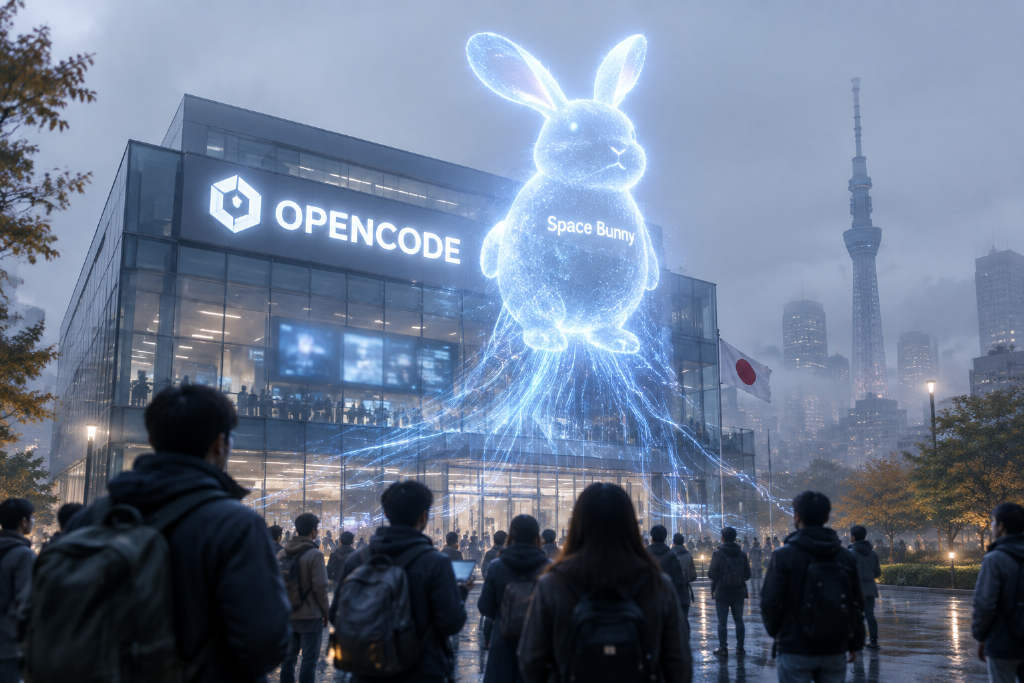
OpenCode launched an anonymous model called Space Bunny on Sept. 23 and made it free for one week. Six days after release, the model had become the most-used model on the open-source coding agent platform.
OpenCode’s public statistics page, as of Sept. 29, showed roughly 201,000 unique users and 12,307,734 completed sessions for Space Bunny. Over the past week, the model accounted for 5.3% of token usage on the platform, ranking No. 1.
Japanese tech outlet PC Watch, citing the same statistics, said the figures on Sept. 28 stood at 177,000 users and about 11.3 million sessions. One day later, the user count had risen by about 24,000, with usage still increasing before the free access window had ended.
OpenCode offered the model free for a week and listed three core specs
On Sept. 23, OpenCode said on X that Space Bunny would be available free for one week. The announcement listed three headline specifications: a 1 million-token context window, multimodal support, and zero data retention. The post has now recorded more than 1.01 million views.
Both the usage-based Zen plan and the subscription-based Go plan can access the model, and the Go plan carries no usage cap. OpenCode’s documentation says the provider does not retain data and does not use user data to train the model.
Token volume on OpenCode surpassed DeepSeek V4.1 Flash
The statistics page showed Space Bunny had processed 45 trillion tokens on OpenCode, ahead of DeepSeek V4.1 Flash at 35 trillion. On average, each session used about 3.7 million tokens, with 97% of input tokens coming from cache.
That high cache share reflects how coding agents work: each round resends earlier conversation history and file contents.
By geography, the largest share of usage came from the United States at 12%, followed by China at 9%, India at 8%, and Japan at 3%.
Space Bunny Alpha reached No. 2 on OpenRouter’s weekly chart
OpenRouter also listed the model on Sept. 23 under the name Space Bunny Alpha. Its public API page showed both input and output pricing at 0, a 1 million-token context window, and a maximum output of 524,288 tokens per request.
The model accepts text, images, and video as input. It offers five reasoning intensity levels, with the default set to the highest level.
In OpenRouter’s weekly ranking published on Sept. 29, Space Bunny Alpha processed 18.2 trillion tokens, placing second behind DeepSeek V4.1 Flash, which handled 20.8 trillion.
The two channels do not use the same data terms. OpenRouter says the provider may retain prompts and outputs, while committing not to use them for training. The OpenCode version is described as zero data retention.
Japanese users put it to work writing browser-based animation code
Japanese users on X have used Space Bunny to write animation that runs in the browser. On Sept. 24, AI animation studio operator yachimat posted that he had created an HD-2D-style animation using only Three.js, the JavaScript library for rendering 3D graphics in a browser.
The scene showed a train station on a rainy night, with pixel-art-style buildings and lighting rendered with a three-dimensional effect.
PC Watch noted that this differs from video-generation systems such as Sora and Veo, which directly produce the visuals. In these examples, Space Bunny wrote the code first, and the browser executed that code to render the imagery. To change the visuals, the source code has to be edited.
Tokenizer test pointed to MiniMax, but no identity has been confirmed
Neither OpenCode nor OpenRouter has disclosed the developer behind the model. OpenRouter’s model page says Space Bunny Alpha was developed and operated by a third party that chose to remain anonymous during the preview period, while OpenRouter only relays requests.
Model tracking site YFarmX ran a test on the day the model was listed. It sent 50 strings into Space Bunny and compared the returned token counts. All 50 matched the MiniMax family. The same token counts appeared across eight MiniMax models, from MiniMax-01 to M3. The nearest alternative was Moonshot’s Kimi K2, which matched 29 of the 50 strings.
A tokenizer defines how text is split into tokens. Matching rules can indicate that models come from the same family. YFarmX also said the test can identify a family match, but cannot determine the exact version.
By specification, Space Bunny appears close to MiniMax-M3 on OpenRouter. Both have context windows of around 1 million tokens and both accept text, image, and video inputs.
On Sept. 27, MiniMax said on X, or early Sept. 28 in Taiwan time, that its new M3.1 Flash Preview model had opened to Token Plan subscribers, with faster speed and a lighter design as the main selling points. The post did not mention Space Bunny, and MiniMax has not publicly acknowledged any relationship between the two.
The report also noted that BlockTempo covered another anonymous model, Ox Alpha, in August. The provided source text did not include further details on that point.