
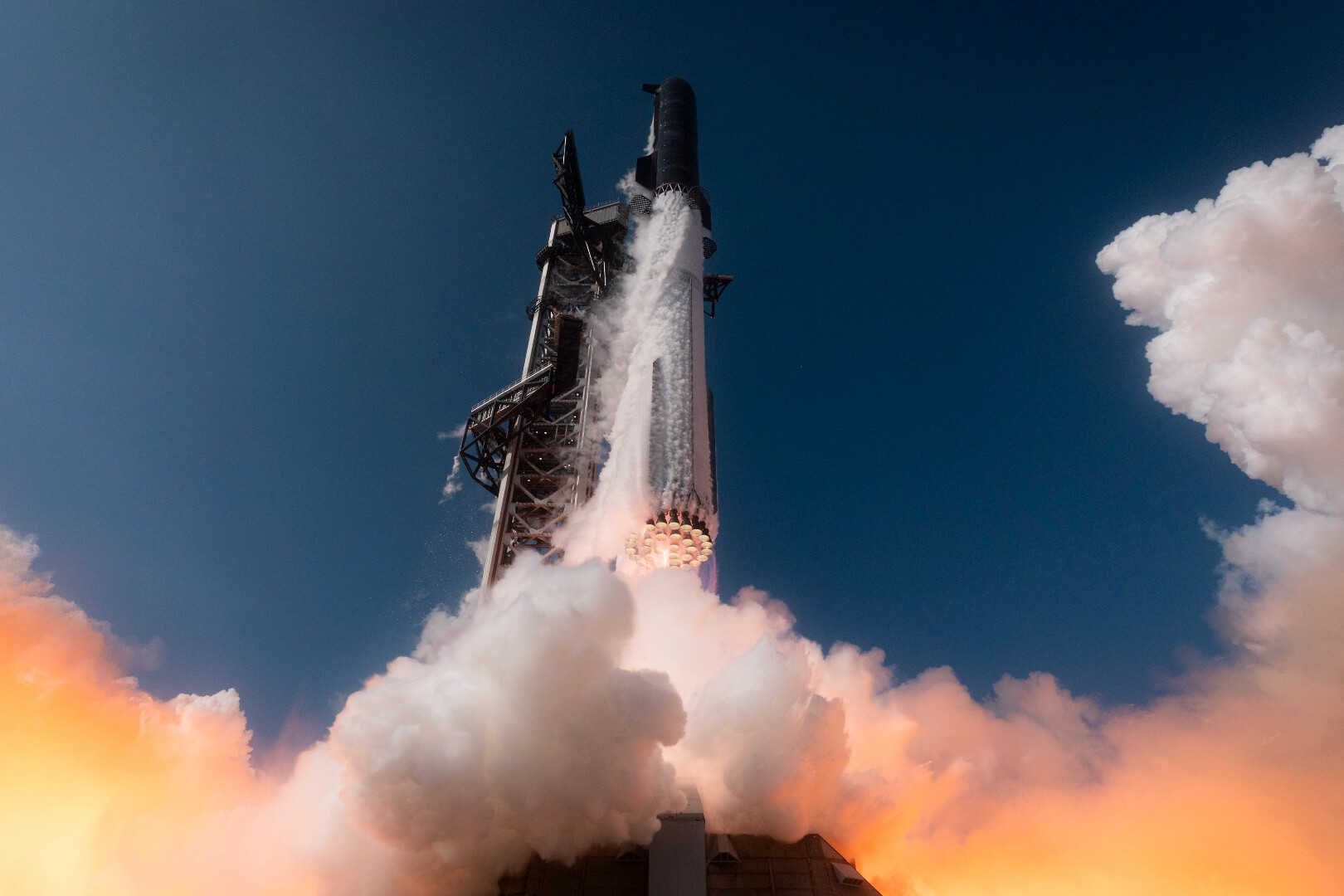
SemiAnalysis said in a report titled SpaceX 10GW in 2027 – Why It’s Real, Will Drive $300B ARR for SpaceX, and Why Microsoft Will Be the Largest Offtaker that SpaceX could approach 10GW of total AI compute capacity by the end of 2027. The report was dated Aug. 7, 2026. The Chinese article published by Odaily said it was compiled and translated by DaiDai and edited by Frank.
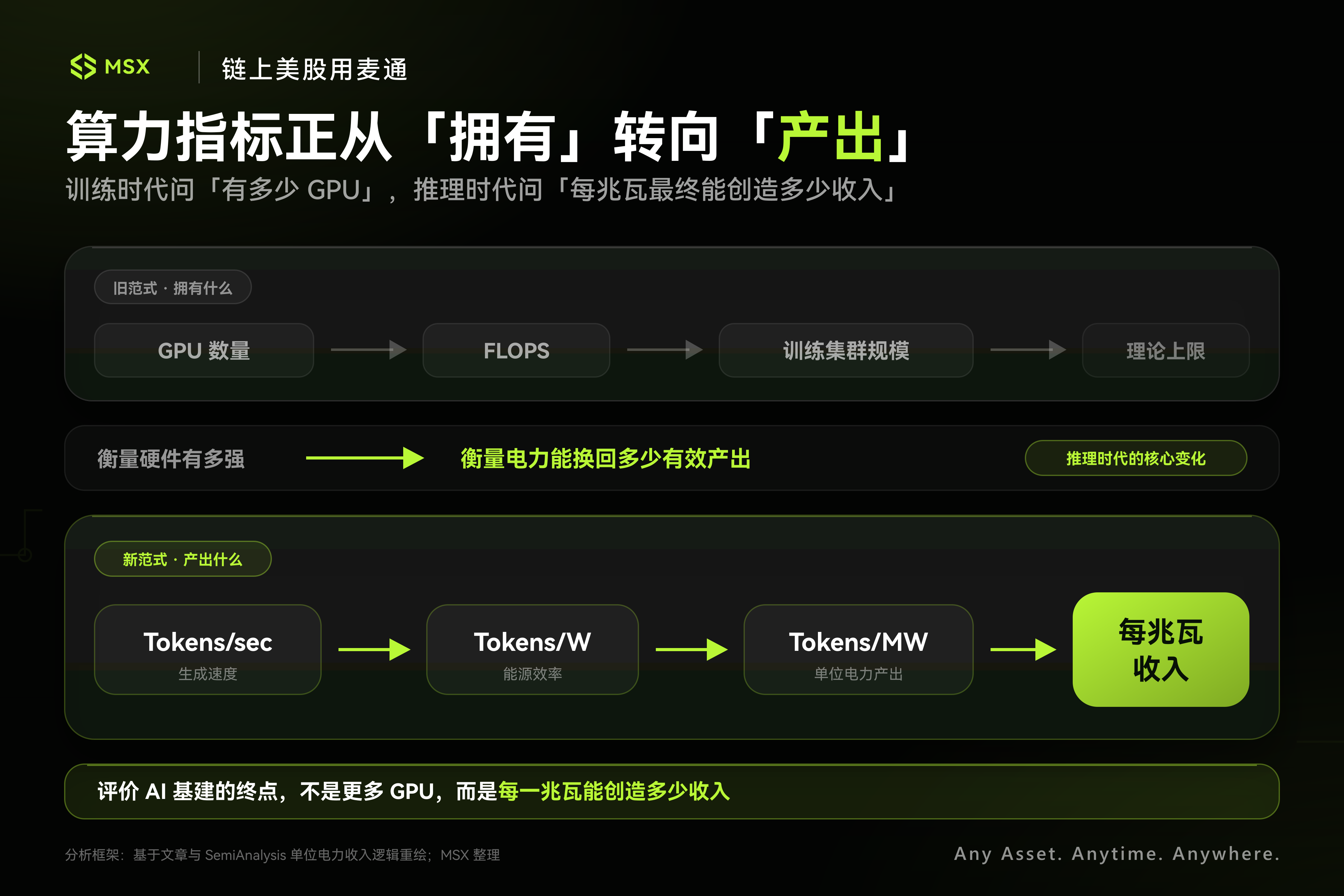
The report’s core argument is that the way the market values AI infrastructure is changing. For the past two years, investors and operators have tended to compare GPU counts, training cluster size, and access to systems such as H100 and GB200. SemiAnalysis takes a more aggressive view: the metric that may matter most over time is how many sellable tokens each megawatt of power can produce, and how much revenue those tokens can generate.
From GPU counts to revenue per megawatt
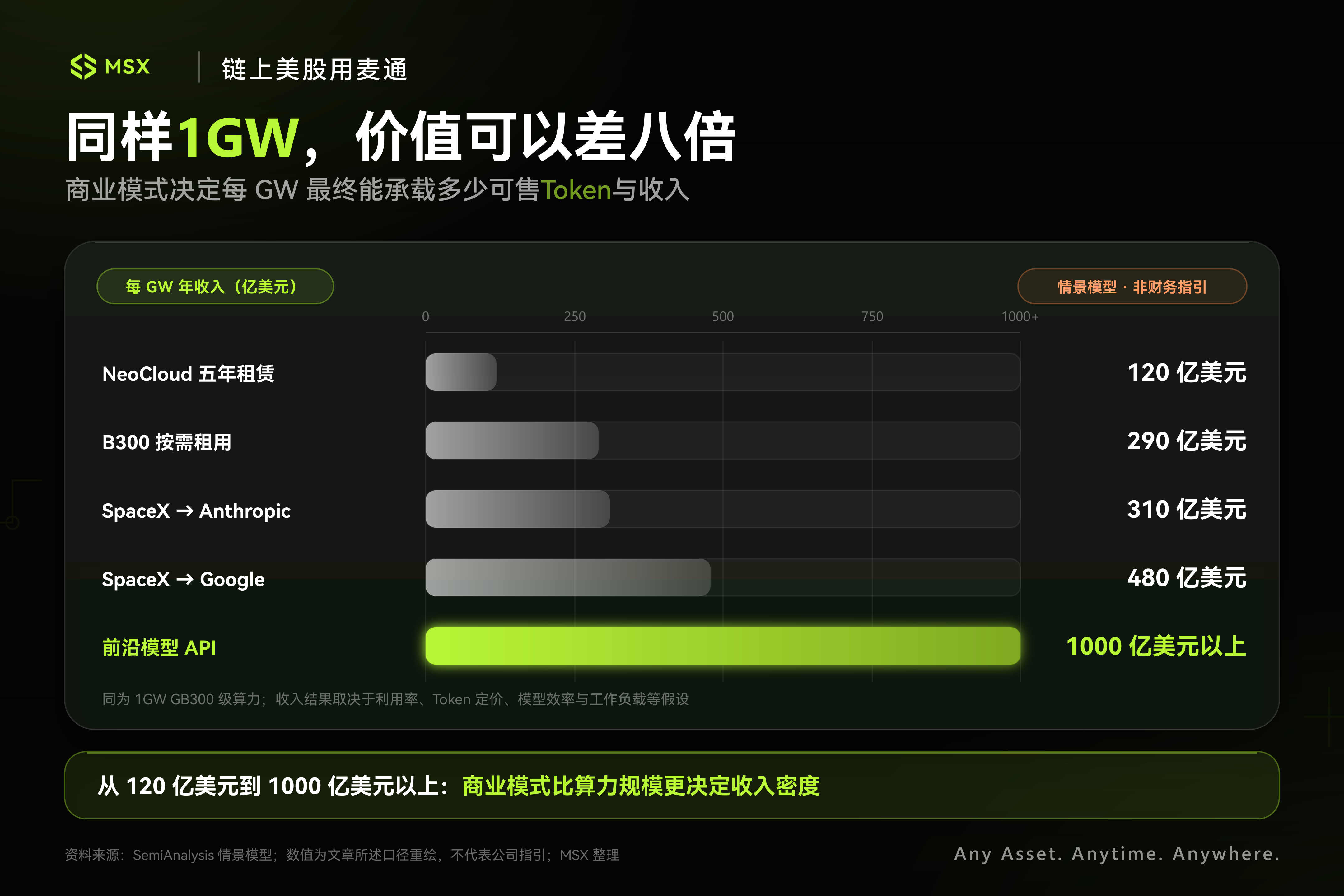
Using what it calls a Tokenomics Model and an Inference Simulator, SemiAnalysis estimated that under a specific set of assumptions covering frontier models, GB300 clusters, real agentic coding workloads, and API pricing, OpenAI and Anthropic could each see potential annual revenue of more than $100 billion from 1GW of inference compute. By comparison, the report assumes an annual cost of about $12 billion to rent a GB300 cluster at the same scale.
Those figures are described as highly aggressive and heavily dependent on model demand, token pricing, utilization, latency requirements, and software and hardware efficiency. Even so, the model helps explain a question that has become harder to ignore: why major companies are suddenly competing so intensely for power.
In the report’s framework, when frontier model API inference runs on GB300 clusters, potential revenue for OpenAI and Anthropic can exceed $100 million per MW per year, or more than $100 billion per GW per year. SemiAnalysis does not derive that by simply extrapolating theoretical GPU FLOPS. It incorporates model architecture, memory bandwidth, serving configuration, throughput, TTFT, input tokens, cache reads, cache writes, and output tokens, and it uses AgentX Trace data drawn from real agentic coding workloads.
That changes the scoring system for AI infrastructure. The first stage of the market focused on GPU counts. Then the focus moved to FLOPS and the size of training clusters. In a large-scale inference era, the more relevant measures may become tokens per second, tokens per watt, tokens per dollar, tokens per megawatt, and eventually revenue per megawatt.
That is also why, in the report’s view, GB300 is not just a faster version of GB200. In the same Fable 5 inference scenario, GB200 NVL72 is modeled at roughly $73.4 million per MW per year in potential revenue, while GB300 NVL72 rises to about $99.7 million. The value of the newer hardware, under that logic, comes from producing more high-value tokens within the same power budget.
NVIDIA has started using similar language. According to the article, the DSX platform released in May this year already lists token performance per megawatt as one of the core metrics for the AI Factory concept, extending the discussion from chips, networking, and software to power, cooling, and data center operations.
SemiAnalysis argues the shift becomes clearer as inference demand expands beyond standard chat and into agentic coding, AI workers, multi-agent coordination, and persistent workloads. Training usually has identifiable phases and cycles. Inference looks more like user count multiplied by agent count, token consumption per task, and runtime. Once agents move from answering questions to performing ongoing work, token demand may open up in a different way.
Seen from that angle, the next phase of the compute race may be less about how large training clusters can get and more about how much user-paid token output those systems can actually support.
SpaceX may be selling time, not just GPUs
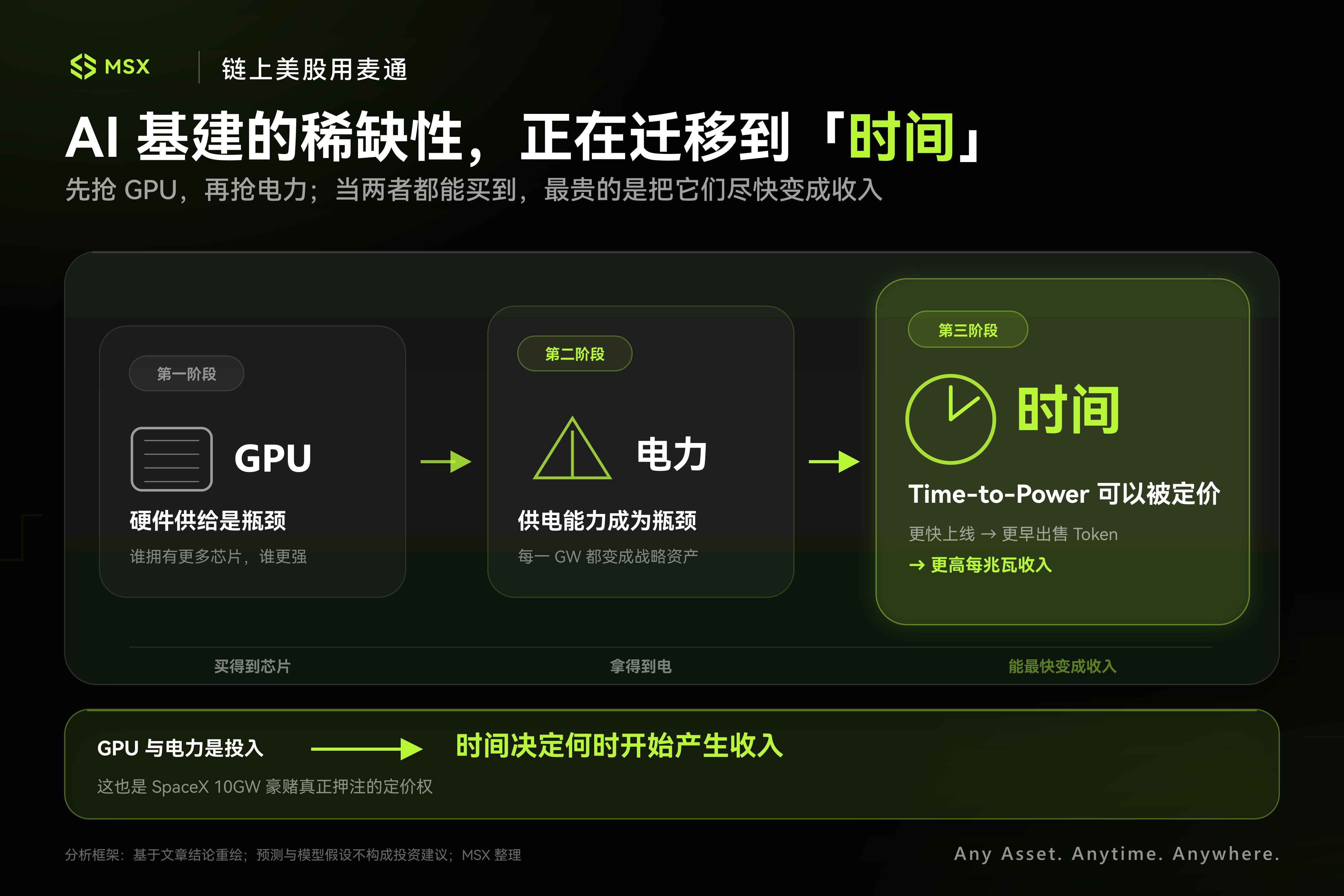
The report then turns to SpaceX. If frontier inference really can command such high revenue per megawatt, why would OpenAI, Microsoft, or Google not simply build all of this capacity themselves? SemiAnalysis argues that GPUs can be purchased, but power and time are much harder to buy.
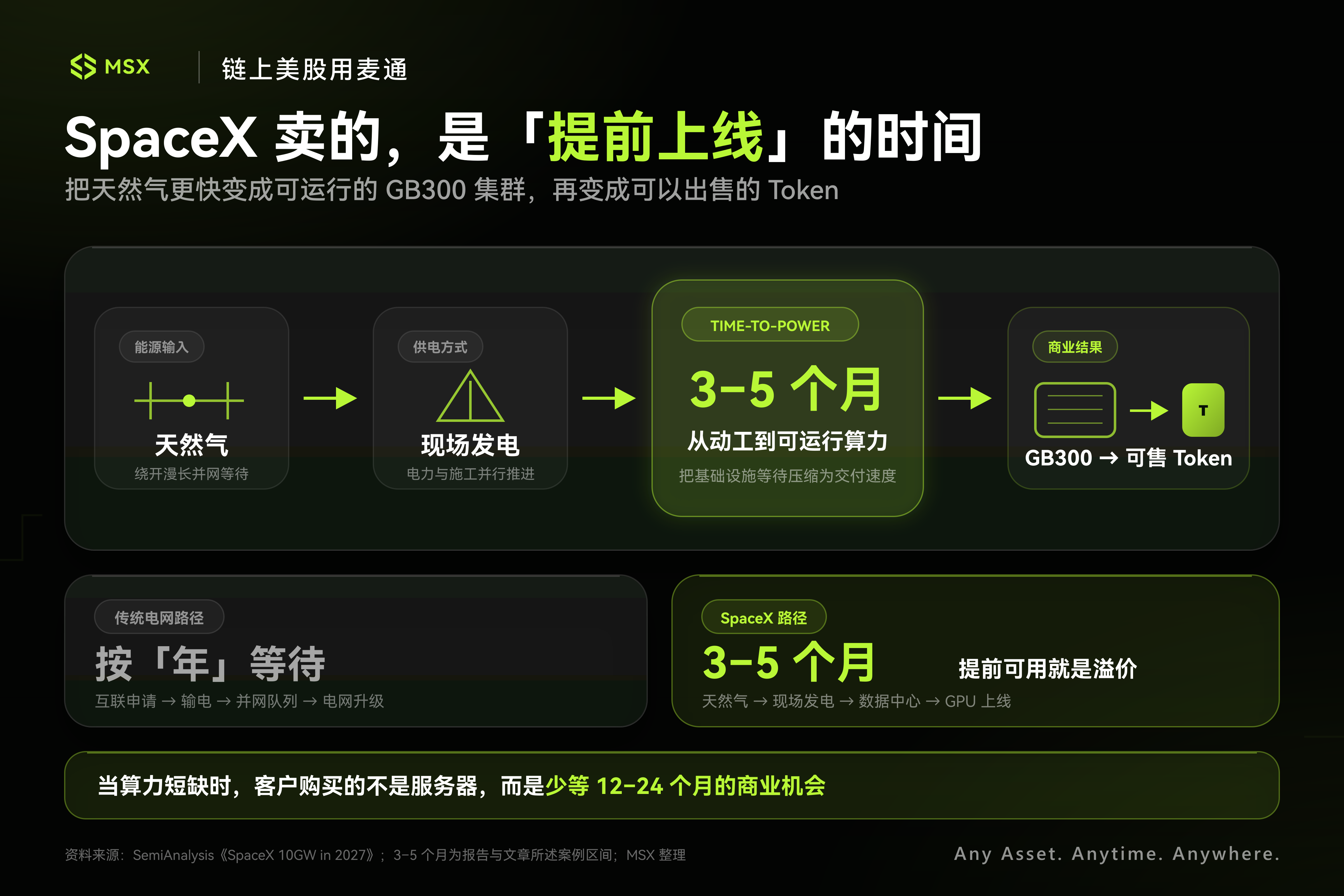
Large AI data centers have become long-cycle infrastructure projects, from site acquisition and grid connection to substations, transmission equipment, hardware delivery, and final commissioning. SemiAnalysis says the capability SpaceX and xAI have shown over the last two years is not exclusive access to GPUs. It is the ability to compress those steps sharply.
The examples cited in the article are specific. Colossus 1, at about 300MW of capacity, was built in 122 days, according to SemiAnalysis. Colossus 2, at around 200MW, took about six months. In Southaven, the report tracks on-site generation growing from 27 turbines and about 495MW in February 2026 to 69 turbines and about 1.7GW in July. Another project, MiniHard, which is described as closer to a greenfield model, entered vertical construction in March and is expected by the report to reach 450MW to 500MW in about five months.
Those projects illustrate the expansion paths SemiAnalysis is watching. Early Colossus buildouts relied heavily on retrofit work, rapidly converting old industrial buildings into AI data centers. MiniHard is presented as a test of a greenfield approach. Added to that is on-site generation. The report’s view is that SpaceX is trying to prove all three routes at once.
On-site natural gas generation stands out in that strategy. SemiAnalysis argues that if SpaceX waits entirely for traditional utility processes covering transmission, interconnection, and utility upgrades, multi-gigawatt projects will be difficult to bring online at the speed Elon Musk wants. For that reason, the report says SpaceX would need to rely heavily on on-site natural gas generation if it aims to add several gigawatts of new capacity in 2027.
This is where the commercial model starts to look different. What SpaceX may be selling is not only GPU access, but compute availability delivered in months rather than after a one- or two-year wait. SemiAnalysis estimates that the scarcity value of large-scale capacity available on short notice could allow SpaceX to charge $30 million to $50 million per MW per year for part of that capacity.
The distinction matters because it shifts pricing from a cost-plus model to a value-based one. In that case, customers are not buying a server based on what it should cost. They are paying for the business value created by getting compute earlier. Time-to-power, in that framing, becomes as important as GPU performance.
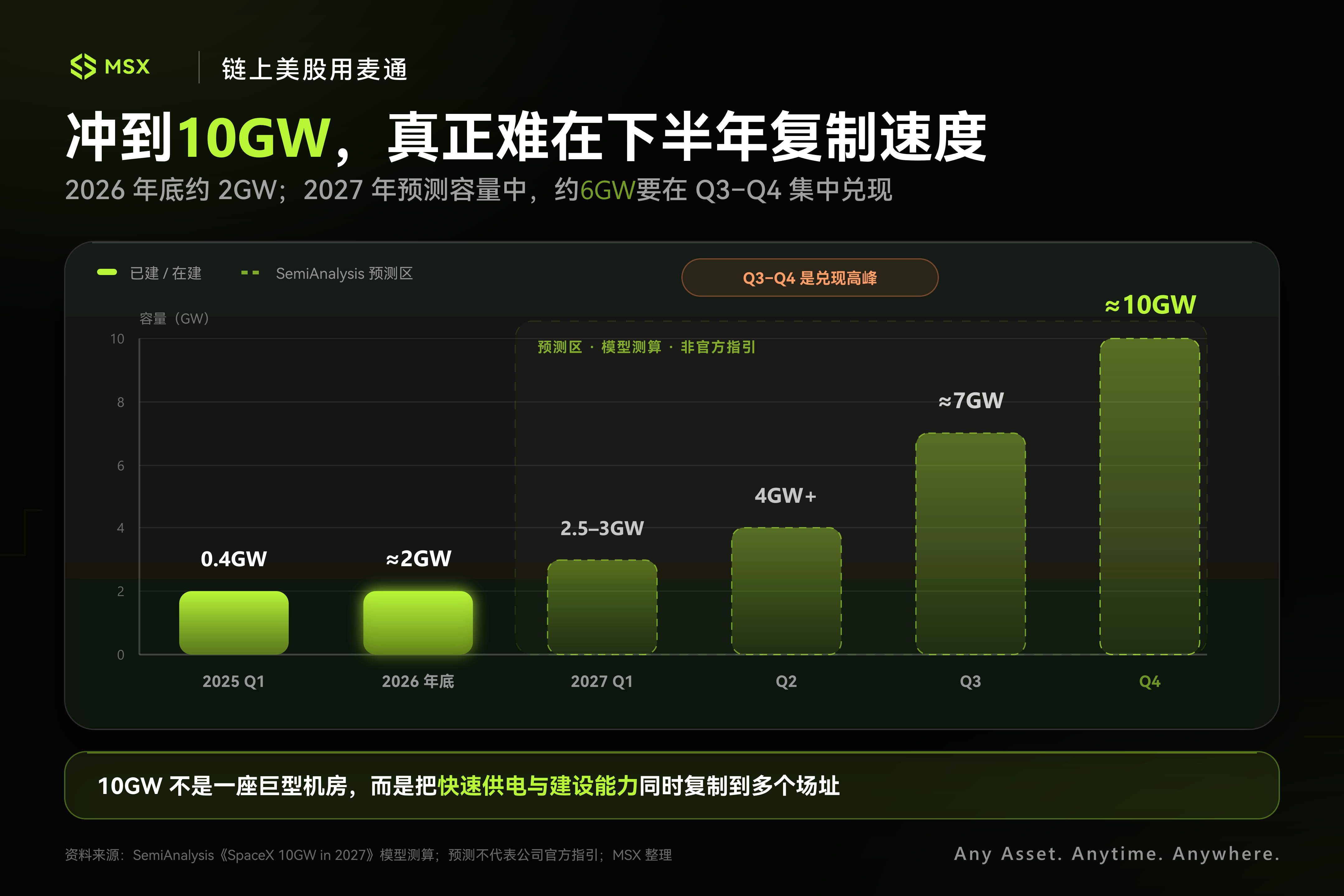
SemiAnalysis expects SpaceX to reach about 2GW of compute scale by the end of 2026, then accelerate in 2027 and approach 10GW by year-end. The central question for that year is simple: can SpaceX turn a demonstrated burst of speed into a repeatable industrial capability?
xAI integration put compute, Grok, and infrastructure under one company
The article also points to the corporate timeline behind the thesis. In February this year, SpaceX formally acquired xAI, placing Grok, Colossus, and SpaceX’s infrastructure capabilities inside the same company. Six months later, Musk said on SpaceX’s first earnings call that the company would build and deliver 6GW to 8GW of new AI compute in 2027, with upside that could reach 10GW.
SemiAnalysis goes a step further by saying total SpaceX capacity could be close to 10GW by the end of 2027. If that forecast holds, SpaceX may no longer be viewed only as a rocket maker, satellite operator, and Starlink provider. It would also be in the running to become one of the world’s largest suppliers of AI compute.
The broader point is that scarcity in AI infrastructure may be shifting from chips to power, engineering execution, and time. Early access to compute, by months or even a year, starts to acquire its own economic value. That is where the report places Musk’s advantage: compressing complex engineering schedules.
Microsoft is presented as the most likely large-scale buyer
If SpaceX can actually make several gigawatts of capacity available quickly, the next question is who would buy it. SemiAnalysis gives a direct answer: Microsoft. The report treats that link as one of its most important implications for public equities.
According to the article, Microsoft and OpenAI signed a new agreement in 2025 under which OpenAI committed to buy an additional $250 billion of Azure services. In 2026, the relationship was adjusted again. Under a new agreement disclosed by Microsoft in April, Microsoft no longer pays revenue share to OpenAI, while the revenue share OpenAI pays Microsoft continues at the existing rate through 2030, subject to a total cap. At the same time, Microsoft’s license to OpenAI model and product IP was extended to 2032.
That creates a different economic choice for Microsoft. It can provide data center capacity to OpenAI as infrastructure, or it can use its access to OpenAI models to route that compute into Azure Foundry, Copilot, APIs, and agent products. SemiAnalysis estimates that the first model yields roughly $14 million per MW per year, while the second, higher-value inference route could theoretically approach $100 million per MW per year. That implies nearly a sevenfold gap in revenue density.
That revenue gap is one reason SemiAnalysis believes Microsoft could become highly aggressive again in securing compute. Based on its Datacenter Model, which tracks leasing, self-builds, NeoCloud contracts, PPAs, and ESAs, the firm estimates that Microsoft has already locked in more than 10GW of new capacity in 2026, representing more than $300 billion of binding commitments. The article also notes that this number comes from SemiAnalysis model estimates, not from official Microsoft disclosure.
The timing matters even more. Much of that capacity may not come online until late 2027 or even 2028. In other words, the report says Microsoft’s constraint is not long-term planning. It is the lack of large-scale capacity that can be turned on now.
To show how sensitive revenue could be to additional capacity, SemiAnalysis then runs a scenario in which Microsoft secures 3GW from SpaceX and monetizes it at close to $100 million per MW per year. In that case, the model suggests roughly $300 billion of exit ARR and Azure growth moving into triple-digit territory.
The article is careful on this point. That is not Microsoft guidance, and it is not a signed SpaceX contract. It is a scenario analysis meant to illustrate the revenue elasticity of incremental compute. Microsoft’s latest disclosed FY2026 Q4 figures, as cited in the article, show Azure and other cloud services revenue growing 43% year over year, with Azure annual revenue surpassing $100 billion for the first time.
The question SemiAnalysis raises, then, is whether investors should stop asking only how much Microsoft is spending on AI capex and start asking how much revenue each additional megawatt can generate once it is online.
NVIDIA’s role may expand from hardware into infrastructure finance
NVIDIA represents a separate track in the report. SemiAnalysis says NVIDIA could use vendor financing to help SpaceX reduce the up-front cash burden associated with massive capital spending. The article also states clearly that there is no public information showing such financing has already been put in place for SpaceX, so this should be read as part of the report’s projection rather than an established fact.
Still, there was a concrete development after the report. On Aug. 10, NVIDIA announced AI Compute Infrastructure Financing Platforms with Apollo, BlackRock, Blackstone, Brookfield, Goldman Sachs, and KKR. The stated goal is to mobilize more than $500 billion of third-party capital over time and create dedicated financing pools for NVIDIA customers.
That move at least supports a broader direction outlined in the article: NVIDIA is extending its role beyond GPUs, CUDA, networking, and rack-scale systems into AI Factory design, construction, and capital formation. For AI data centers that require capital spending measured in tens of billions of dollars, future technology choices may be shaped not only by which GPU is faster, but by who can provide chips, networks, systems, software, build plans, and cheaper, deeper financing in one package.
Under that view, the AI compute race is becoming an industrial contest. Competition is spreading outward from chips to networking and storage, then to cooling and power, and then to natural gas, turbines, land, and capital. The common endpoint is the same: who can convert one megawatt of power into revenue-producing tokens with the lowest time cost.
An aggressive forecast, but a clear shift in competitive logic
The report’s headline claims are aggressive by any standard. A 10GW buildout, $300 billion-scale ARR, 3GW of Microsoft offtake, and more than $100 million per MW per year in inference revenue all depend on a chain of high-growth assumptions. The article notes that the result could diverge sharply from the model if any major variable comes in below expectations, including agent demand, API pricing, GPU utilization, construction speed, power supply, or financing conditions.
Even so, the broader point is not limited to whether SpaceX ends 2027 at 8GW, 10GW, or some other figure. The report is really describing a shift in the logic of AI infrastructure competition. First the market fought over GPUs. Then it fought over power. Once major companies are all willing to build power plants, sign PPAs, and buy natural gas and turbines, the scarcest resource may become time.
In a traditional data center buildout, getting 1GW of power a year earlier may look like a schedule difference. In the world described by SemiAnalysis, where 1GW of frontier inference compute could theoretically support annual revenue in the hundreds of billions of dollars, the economic meaning of that timing gap changes completely.
That is why the article ends by reframing the bet. If the logic holds, SpaceX’s 10GW push is not really a wager on the number 10GW itself. It is a wager that engineering speed can be turned into pricing power.