

Bernstein kept its Outperform rating and $239 price target on SpaceX after the company released its first quarterly results as a public company. According to SEC filings, Space Exploration Technologies Corp. Class A common stock now trades under the ticker SPCX on Nasdaq and Nasdaq Texas. Based on the August 4 closing price of $125.33 cited in the note, the target implies about 91% upside.
That target does not assume management fully delivers on its $1 trillion annual revenue vision. Bernstein models SpaceX revenue at $554 billion in 2031, below the company’s stated ambition, and still assumes AI compute pricing eventually falls to about $10 per watt rather than the $30 to $50 per watt range discussed by Elon Musk. In that framework, higher pricing and a more aggressive revenue trajectory sit outside the base case and represent upside to the existing valuation.
On August 5, SpaceX shares fell further to $108.27, down 13.6% on the day. The move suggested investors were weighing more than a single quarter’s earnings beat. The market was also looking at AI capital spending, share supply pressure tied to the post-listing lockup expiration, and whether Starship can move into a phase of frequent, lower-cost launches.
Revenue jumped 92% as Connectivity remained the earnings anchor
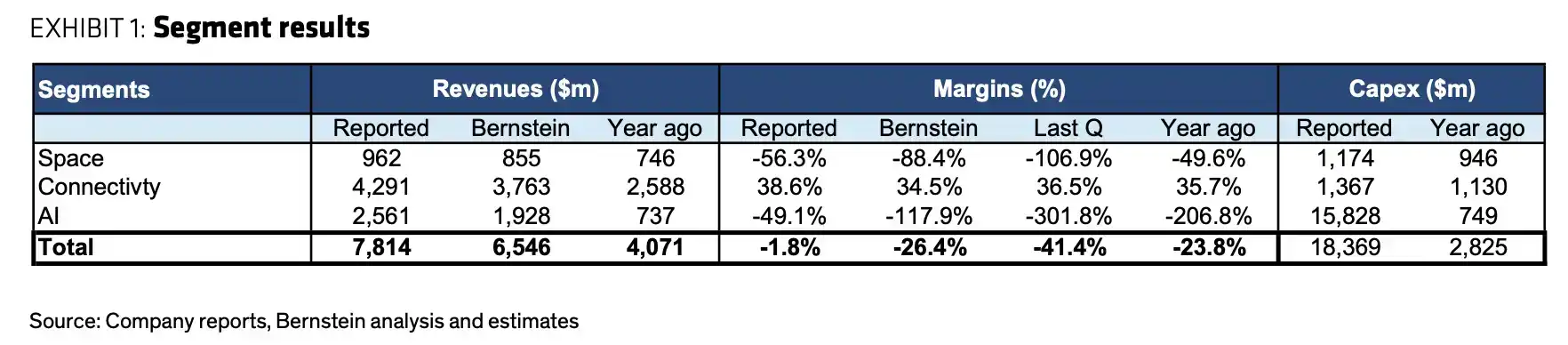
SpaceX reported second-quarter revenue of $7.814 billion, up 92% year over year. Axios cited an S&P Visible Alpha consensus of $6.9 billion, while Bernstein used a market consensus figure of $6.546 billion. The two benchmarks differ, but both point to the same result: revenue came in well ahead of expectations.
Diluted loss per share was $0.09, better than the expected loss of $0.24 per share. Combined operating loss across the company’s three business segments was $143 million, far better than the $1.73 billion market expectation cited by Bernstein. The improvement was driven mainly by narrower losses in AI and stronger-than-expected margins in Connectivity.
By segment, the most stable business remains Connectivity, centered on Starlink. Starlink users reached 12 million at the end of the second quarter, up 1.7 million from the first quarter, while average monthly revenue per user held at $66.
Connectivity generated $4.291 billion in revenue and $1.656 billion in operating profit during the quarter, for an operating margin of about 38.6%. That was above the 37% market expectation used by Bernstein. It is also the only SpaceX segment currently producing operating profit, giving the company financial support as it keeps investing in AI and Starship.
Space and AI showed different revenue profiles, while spending accelerated
The Space segment completed 38 launches in the second quarter, including 10 customer missions and 28 internal launches. Mass to Orbit reached 485 tons. Revenue for the segment was $962 million, above the $874 million market expectation, but operating loss still came to $542 million as Starship research and development spending increased.
The AI segment carried the biggest revenue upside and the biggest funding needs. SpaceX’s nominal compute capacity rose to 1.4GW by the end of the quarter, up from 1.0GW in the first quarter, and the company expects that figure to exceed 2GW by the end of 2026.
AI revenue reached $2.561 billion in the quarter, up 247% year over year. Of that total, AI solutions and infrastructure revenue was $2.194 billion. The segment posted an operating loss of $1.257 billion, equal to an operating margin of about negative 49.1%, but that was a marked improvement from the $2.469 billion operating loss recorded in the first quarter. Adjusted segment EBITDA also swung from a $609 million loss in the first quarter to a profit of $1.146 billion.
Capital spending remained one of the central issues for investors. Quarterly AI capital expenditure was $15.828 billion, up from $7.723 billion in the first quarter. Total SpaceX capital expenditure in the second quarter reached $18.369 billion. Whether that level of spending can translate into durable revenue and cash returns remains one of the market’s main questions.
AI compute pricing is the key swing factor in the revenue story
The most closely watched change from the earnings call was Musk moving the timeline for reaching $1 trillion in annual revenue from 2031 to 2030, while saying it could happen as early as 2029. Management also discussed at least $100 billion in annualized revenue run-rate, though the Bernstein summary did not specify a time tied to that number.
For SpaceX to get anywhere near that scale, Starlink subscriber growth alone would not be enough. Connectivity has to keep expanding across consumer, enterprise, and government customers. AI needs to convert large compute capacity into long-term contracts and steady revenue. Starship has to lower the cost of satellite deployment and orbital data center construction.
Among those variables, AI compute pricing stands out as the most sensitive. Musk said compute service pricing could stay in a $30 to $50 per watt range and said that view was consistent with prices in deals SpaceX reached with Anthropic and Google. Bernstein, by contrast, still assumes pricing eventually declines to about $10 per watt.

That means the $30 to $50 range is not part of the assumptions already embedded in Bernstein’s $239 target. It is closer to upside potential in the model. If SpaceX can maintain higher pricing while expanding compute capacity, long-term revenue and EBITDA could run above Bernstein’s current forecasts.
There are still open questions around whether that price range can hold over time. Contract length and cancellation terms, supply and demand in the AI compute market, semiconductor availability, and competitor capacity buildouts could all affect realized pricing.
Capacity growth targets are also aggressive. SpaceX ended the quarter at 1.4GW of nominal compute capacity and expects to exceed 2GW by the end of 2026, approach 10GW by the end of 2027, and move toward 20GW in 2028. If that timetable is met, the company’s business mix would extend well beyond launch services and satellite internet into large-scale AI infrastructure.
Starship reusability remains the long-term cost question
In Bernstein’s valuation framework, Connectivity answers whether there is a solid profit base today. AI compute answers how much faster revenue can grow. Starship answers whether long-term scale can be built at low enough cost.
If SpaceX is to approach $1 trillion in annual revenue around 2030, Starlink user growth on its own will not do the job. Starship’s launch cadence, payload capability, and level of full reusability will directly shape the cost of deploying next-generation Starlink satellites, building orbital data centers, and expanding other space businesses.
Management is still laying out an aggressive schedule. The company plans to continue Starship orbital flights and V3 satellite deployment, while attempting more complex booster and upper-stage recovery maneuvers. Its long-range goal is to approach one launch per day by the end of 2027 and operate five launch pads, with two in Texas and three in Florida.
That pace would require more than booster reuse. SpaceX would also need to solve upper-stage recovery. Bernstein said a durable heat shield is central to full upper-stage reusability. Musk said the issue may have been resolved by the 13th flight, though analysis is not complete and more flights are still needed to confirm that.

Regulatory approvals, launch pad construction, flight incidents, and review cycles could all affect how quickly Starship moves from high-frequency testing into industrial-scale operations. For Bernstein, full reusability remains the most important piece of the valuation model and also the one with the highest uncertainty.
Bernstein’s $239 target depends on three threads lining up
Bernstein based its valuation on projected 2031 EBITDA across SpaceX’s businesses, using a sum-of-the-parts approach and forward EV/EBITDA multiples to estimate 2030 enterprise value, then discounting each segment back to mid-2027. The resulting 12-month price target is $239. Connectivity and AI were discounted using late-stage venture rates of 25% and 35%, respectively.
The model still carries strong expansion assumptions, but it does not require SpaceX to fully meet every element of management’s vision. Bernstein forecasts 2031 revenue at $554 billion rather than $1 trillion, and keeps long-term compute pricing at about $10 per watt rather than Musk’s $30 to $50 per watt range.
Put simply, the $239 target depends on at least three things happening together:
- Connectivity profit continues to expand.
- AI turns heavy capital expenditure into scaled revenue.
- Starship proves full reusability on schedule.
That also helps explain why the stock fell sharply after earnings even though revenue and loss per share both beat expectations. One quarter can show that current growth remains strong. It cannot by itself remove concerns around AI investment returns, post-lockup share supply, and Starship execution risk.
If AI compute pricing stays in the $30 to $50 per watt range for longer, if full Starship reusability advances on schedule, and if Starlink keeps adding both consumer and enterprise customers, Bernstein’s current model would have room to move higher. If compute contracts, semiconductor supply, or Starship progress fall short, the $239 target itself would come under pressure.