
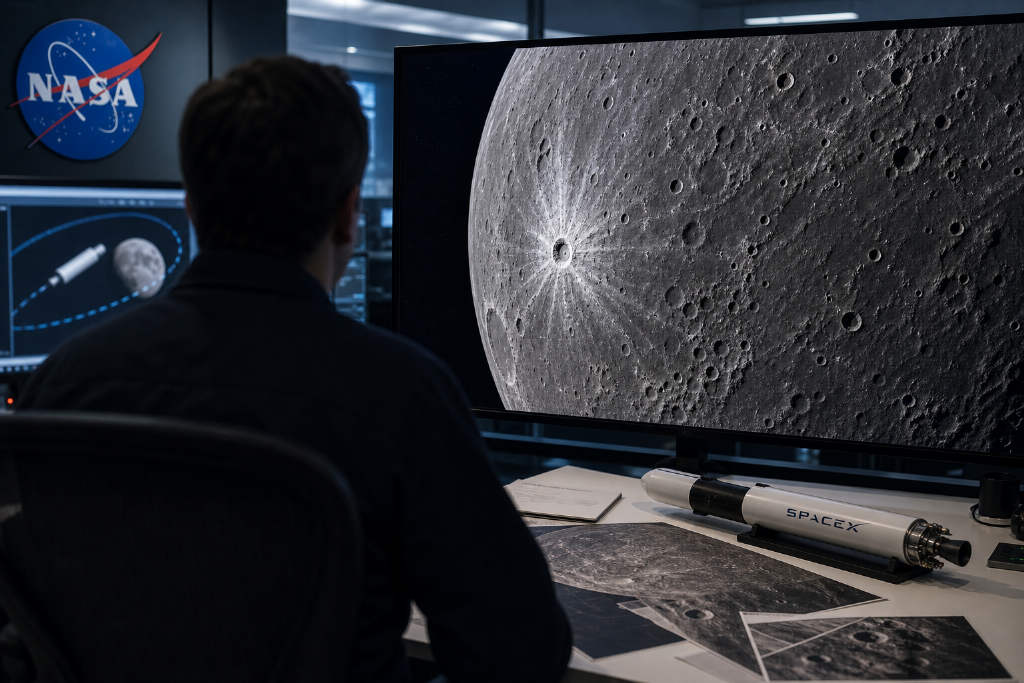
NASA has confirmed that a SpaceX Falcon 9 second stage struck the Moon on Aug. 5, 2026, at about 8,700 kilometers per hour, leaving a crater 18 meters wide and nearly 3 meters deep near the Moon’s western limb. The event is the second known unintentional human-caused impact on the lunar surface.
The object weighed about 4 metric tons. On impact, it released energy equivalent to about 3 tons of TNT, or roughly 1.3 x 10¹⁰ joules. The case has again drawn attention to the lack of clear rules governing debris in cislunar space.
NASA imaged the crater six days after impact
In its official statement, NASA said the images were taken by the Lunar Reconnaissance Orbiter, or LRO, on Aug. 11 and 12, six days after the collision.
The images show both bright and dark rays extending from the crater. NASA said the bright rays came from freshly excavated material from deeper beneath the lunar surface. The darker rays, by contrast, came from weathered material about 46 centimeters below the surface that had been altered over long periods by solar wind, galactic cosmic rays, and micrometeorite bombardment.
NASA was not the first organization to capture the new crater. South Korea’s Korea Pathfinder Lunar Orbiter, KPLO, also known as Danuri, published imagery on Aug. 6 that had been taken on Aug. 5. Using its high-resolution LUTI camera, the mission team gave an initial estimate that the crater’s maximum diameter could reach 27 meters, wider than NASA’s later 18-meter figure.
The rocket stage came from a January 2025 lunar launch
The upper stage, listed under international designation 2025-010D, launched from Kennedy Space Center on Jan. 15, 2025. It carried two lunar missions.
One was Firefly Aerospace’s Blue Ghost 1, which ultimately completed a successful soft landing. The other was ispace’s Resilience, which crashed.
After completing its mission, the stage could not perform a disposal burn because it had run out of propellant. It then spent 19 months being gradually pushed onto a lunar impact trajectory by gravity and solar radiation pressure. NASA placed the impact at 06:35 UTC on Aug. 5, 2026.
Ground-based observations also picked up the event
The Very Large Telescope, or VLT, at Paranal Observatory in Chile also detected signs after the impact. Emission lines from lithium and sodium continued to flash for as long as 10 minutes.
Scientist Carl Schmidt, who took part in the observations, said he was 「100% certain」 the signal came from this impact.
Second known accidental impact on the Moon
This was the second known unintentional lunar impact involving human-made hardware. The first involved the second stage from China’s Chang’e 5-T1 mission, identified as WE0913A, which also fell onto the far side of the Moon. At the time, there was likewise no mechanism to intervene in advance or manage the object through tracking and disposal.
Low Earth orbit, or LEO, now has a relatively established system for debris tracking and cleanup. Cislunar space, by contrast, remains largely unregulated. There are still no explicit international rules covering how spacecraft should be handled once they leave Earth orbit.
NASA and SpaceX are studying ways to avoid a repeat
SpaceX said it is working with NASA on ways to prevent similar uncontrolled lunar impacts.
The timeline is tight. NASA’s lunar base plan targets a first crewed landing in 2028 and aims to support a sustained astronaut presence at the Moon’s south pole in the 2030s. As human activity extends farther onto the Moon, the question of who regulates space debris and where it is allowed to go is becoming harder to leave unresolved.