

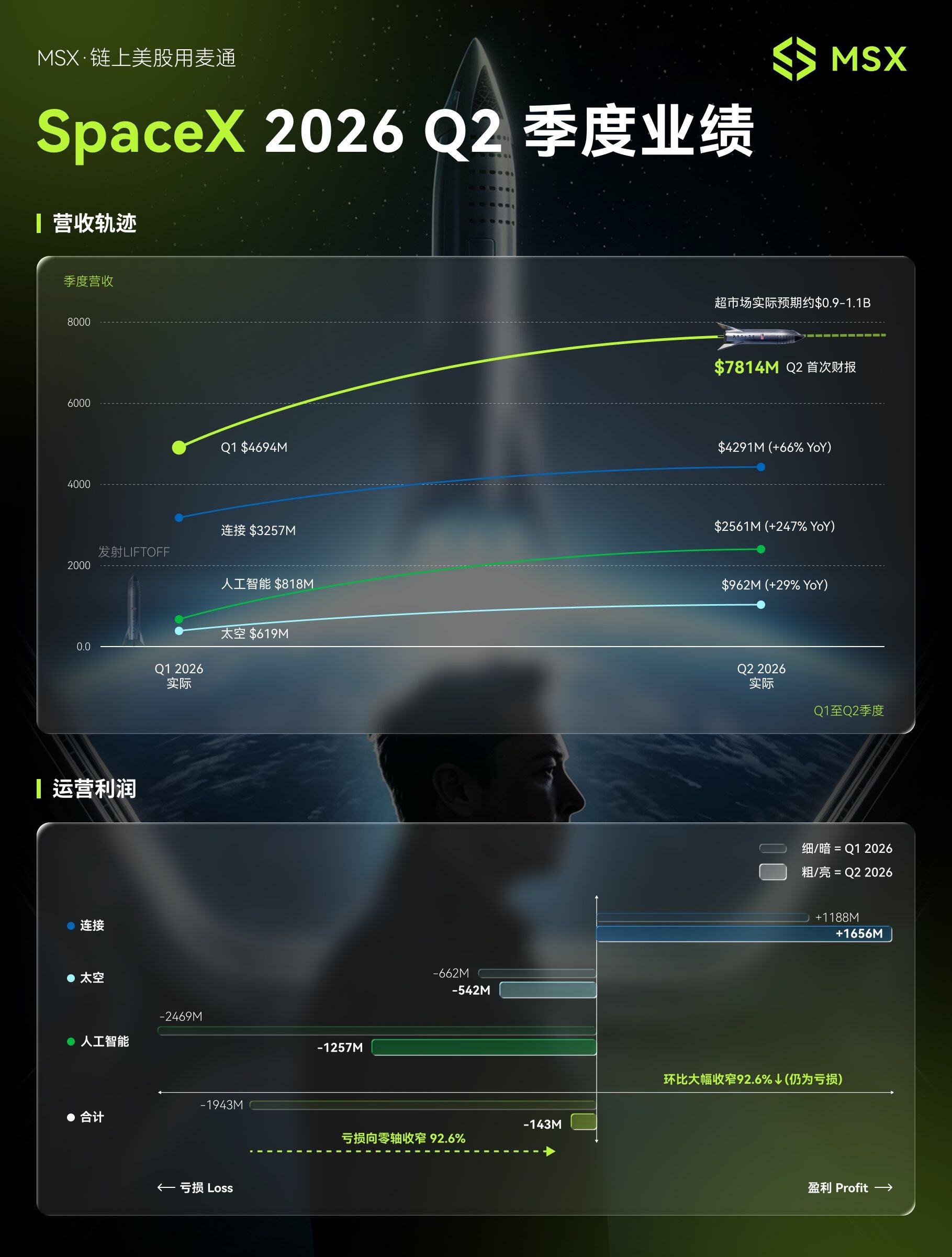
SpaceX has released its first quarterly earnings report since going public, showing revenue of $7.814 billion, up 92% year over year and nearly $900 million above market consensus. The company’s growth was led by AI compute leasing and Starlink connectivity, while the scale of AI infrastructure spending remained the main point of debate around its short-term profit trajectory.
Starlink and AI drove top-line growth
The connectivity segment, which includes Starlink, generated $4.291 billion in quarterly revenue, up 66% from a year earlier and about 32% from the previous quarter. Operating profit for the segment reached $1.656 billion, up 79%, making it the only one of SpaceX’s three main businesses to deliver steady profitability.
The artificial intelligence segment posted $2.561 billion in revenue, up 247% year over year and 212% quarter over quarter. According to the source material, the increase was mainly supported by compute leasing agreements with Anthropic and Google.
The space launch business brought in $962 million in revenue, a 29% increase from a year earlier.
Losses narrowed, but capex remained elevated
SpaceX’s overall operating loss narrowed sharply to $143 million from $1.943 billion in the prior quarter, a quarter-over-quarter improvement of about 92.6%. Within that, operating loss in the AI business narrowed from $2.469 billion to $1.257 billion.
Quarterly net loss was $541 million on an unaudited basis, improving by $467 million from the same period last year. Loss per share came in at $0.09, better than the market expectation of $0.26.
Capital expenditure for the quarter totaled about $18.37 billion, with roughly $15.83 billion directed to AI compute infrastructure. Management said capex over the next two quarters is expected to remain near the current quarter’s level.
Subscriber growth continued at Starlink
Starlink added more than 1.7 million net new consumer subscribers during the quarter. Revenue from enterprise and government customers rose 108% year over year.
MSX view on the three business lines
In the MSX View section, the report said the earnings release showed clear differences across SpaceX’s three businesses. Starlink connectivity has entered a phase of stable profitability. Space launch is still growing at a moderate pace but remains loss-making. AI compute leasing is the fastest-growing segment by revenue, while also carrying the heaviest capital burden.
The note added that the sharp narrowing in overall losses points to improving operating leverage. At the same time, AI infrastructure is still in an intensive investment cycle, and whether revenue growth can continue to translate into better profitability will be central to assessing the newly listed company’s medium-term path.
About MSX
The source also included a company introduction for MSX, describing it as an RWA trading platform focused on providing access to global financial markets. MSX said it is among the earlier on-chain U.S. stock trading platforms and offers spot and derivatives trading for nearly 400 tokenized stocks and Pre-IPO assets.
MSX said its services cover U.S. equity spot and perpetual products, crypto-to-crypto trading, Pre-IPO offerings, and research through the MSX Institute.
The report also carried a risk statement saying that macroeconomic conditions and the U.S. stock market can be highly volatile, and that the content is for academic and research observation by the MSX Institute only and does not constitute investment advice.