
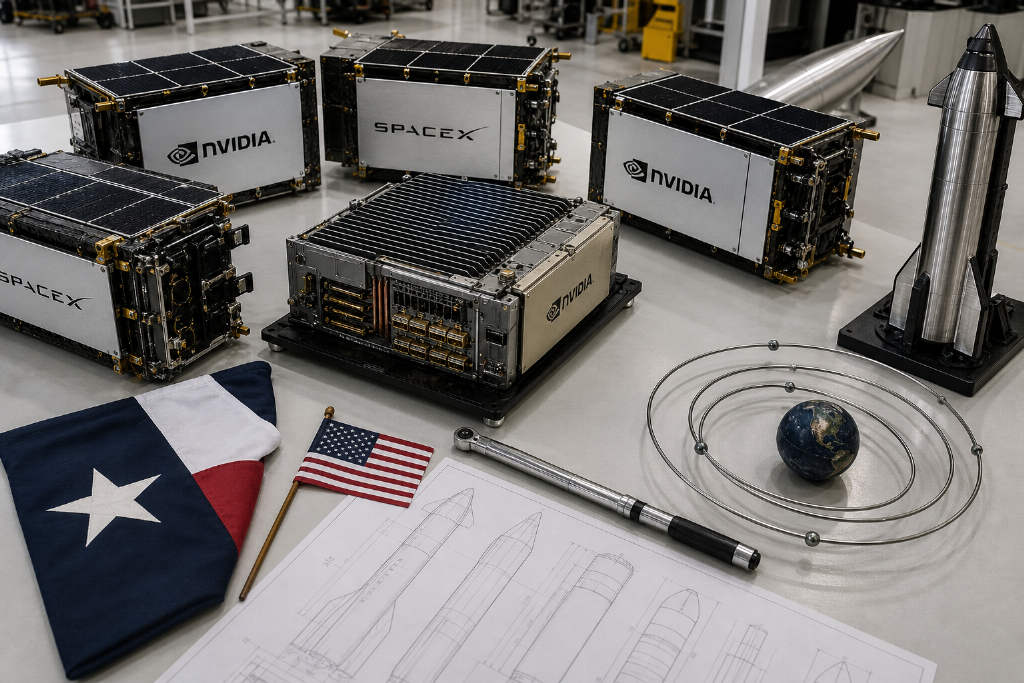
SpaceX is stepping up its work with Nvidia to push AI computing into orbit, and Elon Musk said the first Starmind AI satellites could now launch in the fourth quarter of 2027, a year earlier than a previously disclosed 2028 schedule.
In a post on X on Aug. 24, Musk said SpaceX and Nvidia had designed a space-optimized Vera Rubin NVL72 system for launch to orbit in the fourth quarter of next year, with significant scale planned in 2028.
Starmind satellites move up to Q4 2027
Musk said SpaceX plans to launch the first batch of Starmind AI satellites as early as Q4 2027 and then sharply expand deployment in 2028. According to the article, that puts the timetable one year ahead of a prior 2028 target the company had previously disclosed.
Nvidia, identified in the article as SpaceX’s sixth-largest shareholder, will also become the company’s exclusive chip supplier. Musk said SpaceX will exclusively use Nvidia chips and bring in the next-generation Vera Rubin platform to provide computing support for the Grok chatbot and other AI services.
Orbital system built around Nvidia’s Vera CPU
The space-grade computing system designed by SpaceX and Nvidia is centered on Nvidia’s newly released Vera CPU. Musk described the design on X as having a simpler structure, lower cost, higher density, and lower weight than traditional rack-based architecture.
The article said the Vera CPU carries 88 Nvidia-designed Olympus cores and delivers 1.2 TB/s of memory bandwidth. Nvidia says it completes tasks 1.8 times faster than comparable x86 processors and positions it as the first processor built specifically for AI agents. The satellites and supporting equipment are expected to be produced in Bastrop, Texas.
Compute buildout targets nearly 10 GW by end-2027
The expansion goes beyond satellite hardware. Earlier this month, Musk told investors that SpaceX expects to accumulate more than 2 GW of AI computing capacity by the end of 2026 and get close to 10 GW by the end of 2027. He also said the company expects to secure a substantial share of Nvidia’s 2027 GPU supply.
Morgan Stanley estimates that SpaceX’s AI-related capital expenditure could jump from about $53 billion in 2026 to $130 billion in 2027, highlighting the scale of spending tied to orbital AI infrastructure.
Orbital data centers could avoid ground constraints, but at a steep cost
The article said moving data centers into orbit could, in theory, bypass several constraints that affect ground-based facilities, including unstable power supply, difficulty acquiring land, regulatory review, and public opposition.
Cost remains the most immediate obstacle. Energy research firm Wood Mackenzie estimates that building a 1 GW orbital data center would cost as much as $170 billion, more than three times the cost of a conventional ground-based facility of the same size. Whether the project can balance technical feasibility with economic returns remains a central test.
Stocks show limited reaction as investors wait for Nvidia earnings
Market reaction was muted. Nvidia shares fell 2.91% in the previous session to close at $208.48, marking a seventh straight down day and the company’s longest losing streak in nearly four years. SpaceX shares also slipped 1.44% to $135.
The article said analysts see investor attention as firmly fixed on Nvidia’s quarterly earnings report due after the bell on Wednesday. Until those figures arrive, strategic announcements like this may have only limited impact on sentiment.