
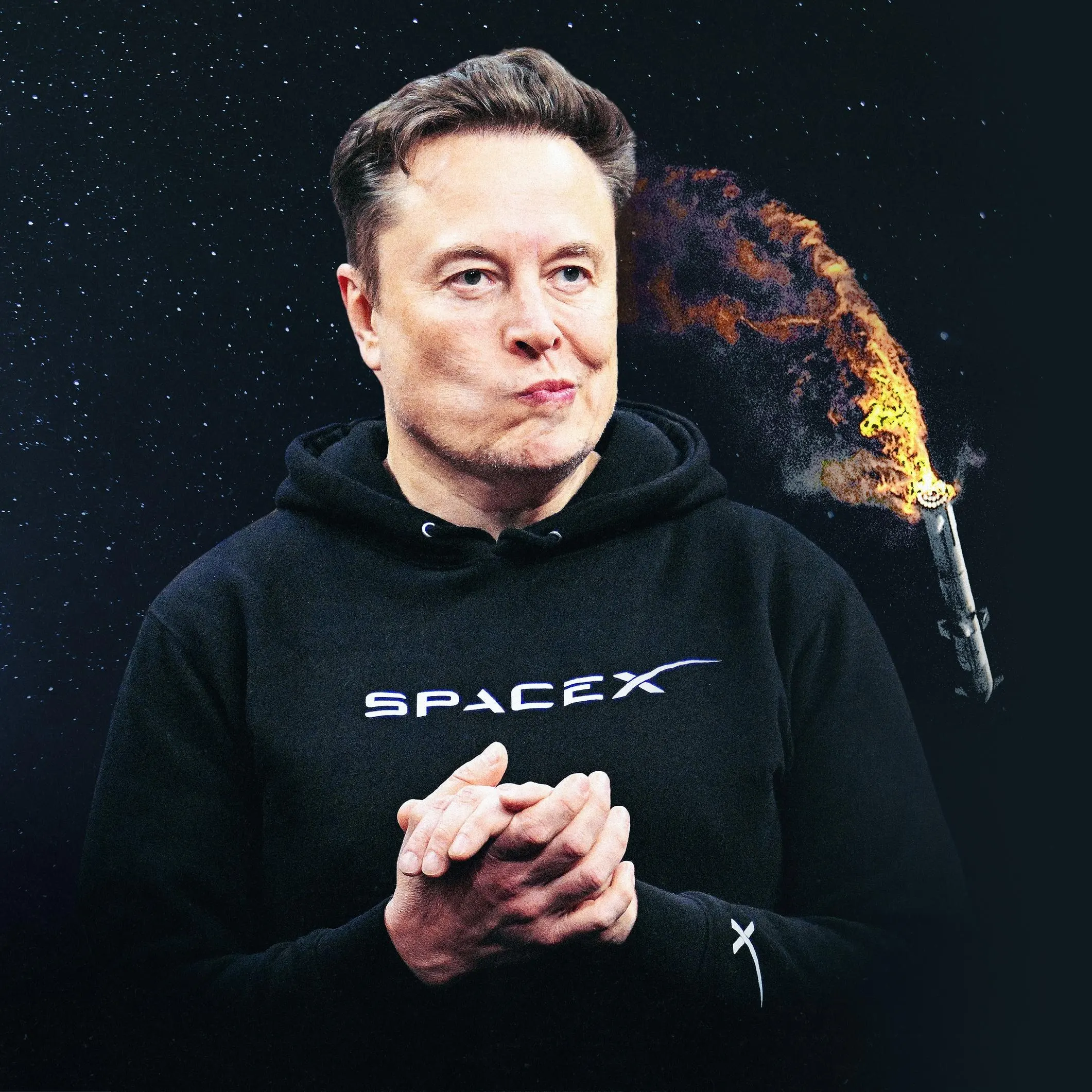
SpaceX shares fell 8% after the company released its second-quarter results, even though revenue and loss figures both came in ahead of market expectations.
The company reported Q2 revenue of $7.814 billion, up 92% year over year and above the $6.93 billion market estimate. Net loss narrowed to $541 million from $1.008 billion a year earlier. Loss per share was 9 cents, compared with the 26-cent loss expected by the market, while operating loss narrowed from $970 million to $143 million.
Starlink subscribers reached 12 million, doubling from a year earlier. Revenue in the AI segment rose 247% year over year, losses were cut in half from the previous quarter, and adjusted EBITDA turned positive at $1.146 billion. On the surface, the numbers pointed to a solid quarter.
Nvidia tie-up lifted expectations before earnings
Hours before the earnings release, SpaceX announced a partnership with Nvidia. Under the deal, Nvidia will design computing payloads for SpaceX’s Starmind AI1 satellites. Each satellite is set to carry Nvidia’s latest Rubin GPU and Vera CPU, with peak computing power rising to 250 kilowatts per satellite.
Nvidia described the business as “space computing” and said its Space-1 Vera Rubin module can deliver AI compute up to 25 times that of the H100, with volume shipments scheduled to begin this fall. The announcement pushed expectations sharply higher ahead of the report, and the stock at one point rose more than 10% before earnings.
That optimism faded once the results were out.
AI growth was driven mainly by leasing compute capacity
The company’s AI revenue surge was tied largely to compute leasing contracts rather than its own consumer AI products.
- Anthropic is paying $1.25 billion a month for all capacity at Colossus 1 through May 2029, covering about 325,000 GPUs.
- Google is paying $920 million a month through June 2029 for about 110,000 GPUs.
- Reflection AI is paying $150 million a month from July through 2029.
By contrast, SpaceX’s in-house xAI business looked much weaker. Grok had 117 million monthly active users in March, but only 1.9 million of them paid for the premium SuperGrok tier. Another 4.4 million came through bundled X social memberships.
According to the figures cited in the article, consumer-side revenue covers only 14% of infrastructure costs when spread across monthly active users. Operating margin at xAI deteriorated from -60% in 2024 to -200%, and reached an annualized -302% in the first quarter of 2026.
Space data center plan is still waiting on FCC approval
Another long-term project highlighted during the company’s IPO process was its space data center plan, but progress remains limited. The article says the company has applied for 1 million satellites and built none so far.
SpaceX has asked the Federal Communications Commission to approve deployment of as many as 1 million satellites in low Earth orbit between 500 and 2,000 kilometers. Its prospectus said orbital AI-compute satellites could begin deployment “as early as 2028.”
Elon Musk has outlined a more aggressive timeline, saying AI satellites could launch next year, scale within two years, and become cheaper than ground-based data centers within three years.
The FCC accepted the application in February this year and has yet to issue a ruling. Before that approval arrives, Starmind remains, in essence, a chip order without a license. Environmental and astronomy groups have also asked the FCC to pause such approvals until a system-wide environmental review is completed.
The article also pointed to Musk’s past timelines, including full self-driving in 2017, a crewed Mars mission in 2024, and 10,000 Optimus units by the end of 2025. Jeff Bezos has publicly said that a two- to three-year timeline sounded “a little too ambitious.”
Lunar program timeline has also slipped
The company’s lunar-base ambitions are facing delays as well. Artemis II completed its crewed lunar flyby in April this year. But in February, NASA changed Artemis III, originally planned as the first moon landing mission, into a low Earth orbit test because the lander was not ready. SpaceX’s Starship is the lander in question.
That change pushed the first crewed moon landing to Artemis IV, now targeted for early 2028.
Lock-up expiry adds another overhang
Attention is also turning to the coming lock-up expiry. The article said a brokerage has issued a rare “sell” rating with a $75 target price, implying another 35% downside from the current level.
On Aug. 6, about 911.5 million shares from the first batch of restricted stock are set to be unlocked, with a value above $100 billion. The article described it as the largest single lock-up expiry in Wall Street history.
The piece was written by C Labs Crypto Watch. PANews said the article reflects the columnist’s own views and does not constitute investment advice.