


WuBlockchain’s WhiteLine Daily outlined four developments spanning AI, data centers and semiconductor manufacturing, covering SpaceX, NextDC, Anthropic, Samsung Electronics and SK Hynix.
SpaceX reports $14.575 billion in Q3 revenue, with Super Intelligence contributing $7.56 billion
SpaceX released its third-quarter results on Oct. 20. The company posted total revenue of $14.575 billion, up 161% year over year, and net profit of $4.4 billion.
Its Super Intelligence, or SI, segment generated $7.56 billion in revenue, equal to about 52% of total revenue and up roughly 195% from $2.561 billion in the second quarter. The business includes AI compute leasing, the Grok model, the Cursor coding tool and advertising.
The SI segment recorded quarterly operating profit of $431 million. Capital expenditure reached $16.444 billion. As of the end of September, the company said its disclosed nominal compute capacity had risen to 1.7 GW.
WhiteLine Daily said SI revenue has already surpassed the connectivity business that includes Starlink, but quarterly operating profit at SI was only $431 million, well below the connectivity segment’s $2.367 billion. In its view, the larger revenue base has not yet translated into a profit advantage.
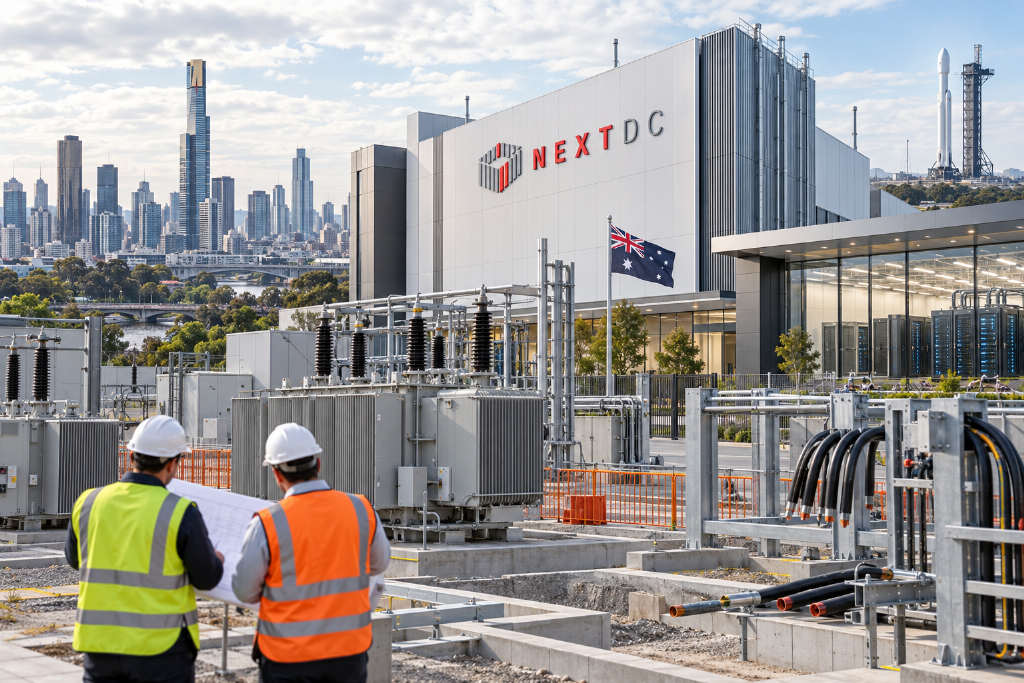
NextDC cuts fiscal 2027 guidance after Melbourne M3 power delay
Australian data center operator NextDC said on Oct. 21 that grid operator Jemena had paused part of the grid upgrade work for the Melbourne M3 data center after opposition from local residents and stakeholders. Additional power supply is now expected to be delayed until fiscal 2028.
NextDC lowered its fiscal 2027 revenue guidance to A$475 million-A$500 million from A$615 million-A$640 million. The report gave the U.S. dollar equivalents as about $333 million-$351 million, down from about $432 million-$449 million.
The company said the revised outlook excludes about A$140 million, or about $98 million, in customer contract revenue that had previously been expected from the affected project. It also cut its earnings and capital expenditure expectations. The stock closed down about 41.7% on the day.
WhiteLine Daily said the company’s full-year revenue expectation was reduced by about 22%, while the share price fell about 42% in a single session, showing investor concern had moved beyond the immediate revenue hit for that year.
Reuters-reviewed draft shows Anthropic posted an $80.7 billion first-half net loss
According to a draft IPO prospectus reviewed by Reuters, AI company Anthropic posted a net loss of $80.7 billion in the first half of 2026, compared with $13 billion in the same period a year earlier.
About $72 billion of that loss came from accounting charges tied to an increase in the fair value of convertible debt, equal to roughly 89% of the total loss. The report said this was not operating cash actually paid out.
The same draft showed spending on compute and infrastructure was close to $9 billion in the period, up from $2.3 billion a year earlier. It also said Anthropic has committed to spend at least $518 billion over the next decade on cloud services, compute and infrastructure.
The figures came from a draft reviewed by the media and not from a final public filing. WhiteLine Daily said IPO investors need to separate those accounting losses from model operating costs and future compute spending commitments.
Samsung and SK Hynix reportedly move ahead with NAND upgrades in China
Reuters, citing people familiar with the matter, reported that Samsung Electronics is upgrading its Xi’an NAND plant in China from roughly 200-layer technology to 286-layer V9 NAND, with a target of producing 40,000 wafers per month of the related products by the end of 2027. The Xi’an plant accounts for about 40% of Samsung’s global NAND output.
SK Hynix is also planning to upgrade its Dalian plant from 192 layers to 240 layers or higher, and may apply to conduct research and development on NAND technology above 300 layers.
Both companies confirmed they are in talks with the U.S. government and are moving ahead with equipment upgrades, but they did not confirm specific production targets. The scope of U.S. licensing for the relevant equipment remains unclear. Samsung said the upgrade does not involve capacity expansion or the construction of a new plant.
WhiteLine Daily said the Xi’an facility’s roughly 40% share of Samsung’s global NAND output makes the move to 286-layer V9 important for maintaining the site’s competitiveness. It added that the final scope of U.S. equipment approvals will directly affect whether that capacity can complete its upgrade on schedule.
Four separate checkpoints emerge from the day’s developments
WhiteLine Daily said the four stories point to different things to watch next. For SpaceX, the question is whether AI spending can turn into stronger profit. For NextDC, the focus is when M3 can regain power and begin billing. For Anthropic, the key is actual cash spending after excluding accounting charges. For Samsung and SK Hynix, attention is on which equipment and process upgrades the U.S. ultimately approves.