
Confirmed so far: process, not a deal
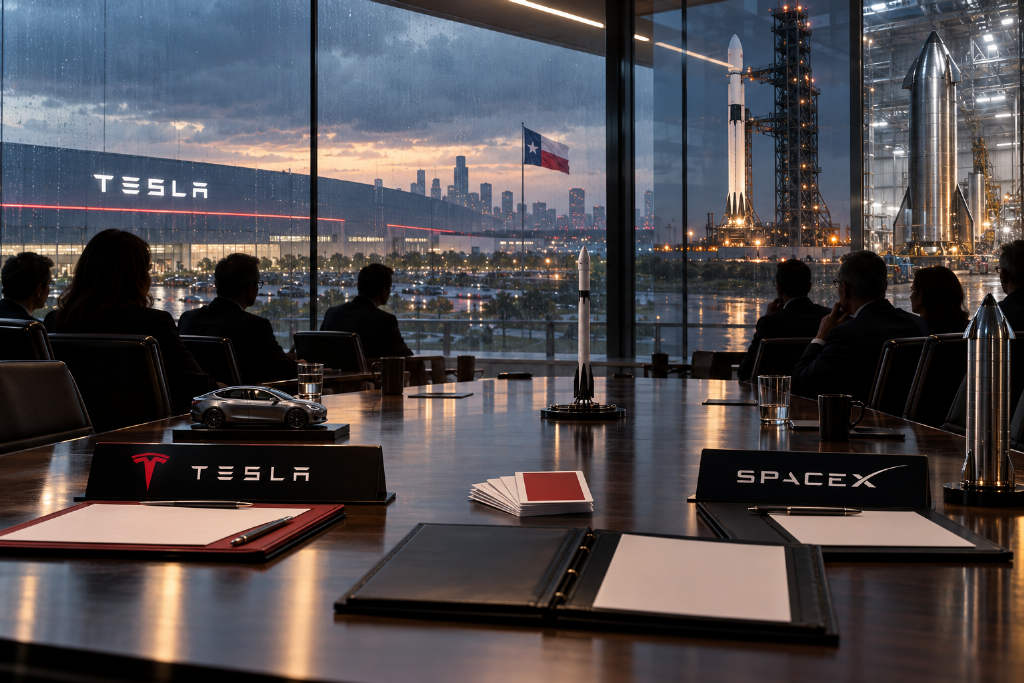
Elon Musk said on SpaceX’s Oct. 20 third-quarter earnings call that SpaceX and Tesla have each set up a special committee made up of independent directors to discuss a possible merger. According to Axios, Musk said plainly that he is a conflicted party and cannot participate in the discussions, while adding that he thinks the idea makes sense.
That distinction matters. This is an exploratory process, not an agreed transaction. Fortune reported that the committees were formed at the request of shareholders, that no deal terms have been agreed, and that there is no assurance a transaction will be reached. Musk also said some people were overstating the odds of a merger.
The article centers on three questions: what has actually been confirmed, which key terms remain blank, and where shareholders would have a real say if the process moves forward.
The $3.5 trillion figure is not a deal valuation
The widely repeated $3.5 trillion number is simply the combined market capitalization of the two companies at the Oct. 20 close, with SpaceX at about $2.01 trillion and Tesla near $1.5 trillion. It is a sum of market prices. It is not a transaction valuation, and it is not a basis for an exchange ratio.
There are several reasons. In merger negotiations, valuation is not usually the same as adding up public market values. A buyer may need to pay a control premium. The value of any synergies has to be allocated between the two sides. And in an all-stock deal, the central economic term is the exchange ratio. Once that ratio is set, later moves in either stock can change the effective value transfer, which is why adjustment mechanisms or fixed-ratio structures often become part of the negotiation.
There is also a timing problem. Tesla was scheduled to report third-quarter results after the U.S. market close on Oct. 21, with its earnings call set for 5:30 p.m. Eastern time. MarketBeat’s consensus figures cited in the article put revenue expectations at $28.06 billion and earnings per share at $0.4488, versus $28.10 billion and $0.50 a year earlier. That implies expectations for roughly flat revenue and about a 10% decline in profit. Tesla posted second-quarter EPS of $0.33, below a $0.50 consensus.
So one half of the $3.5 trillion figure was about to be repriced almost immediately. Any attempt to infer a share swap from current market values could be outdated by the next trading session.
What is confirmed, and what is still missing
The article separates confirmed facts from unconfirmed assumptions to avoid reading too much into the headline.
Five points are presented as confirmed. First, each company has formed a special committee of independent directors. Second, those committees are discussing a potential merger. Third, they were formed at shareholder request. Fourth, Musk is not taking part because he is conflicted. Fifth, Musk personally supports the concept and has pointed to possible synergies in artificial intelligence, chip design, robotics, autonomous driving, satellite communications and the planned Terafab chip factory.
What has not been confirmed covers nearly every term that would determine shareholder outcomes. There is no agreed valuation method, no exchange ratio, no transaction structure, no clarity on which entity would survive, no indication whether the consideration would be all stock or include cash, no financing plan, no timetable and no explanation of the regulatory review path. Musk described the current situation as a "weird kabuki dance" and said he felt like he was tap dancing through a minefield.
One detail says a lot about the stage of the process. Tesla’s annual proxy statement filed on Monday did not include any merger proposal. That means the issue is not headed for a vote at the next foreseeable shareholder meeting.
Market reaction was concentrated on the SpaceX side. SPCX closed at $147.79 on Oct. 20, down 0.11%, then rose as high as $159.70 after hours, up 8.06%. But the same earnings release also showed 161% year-over-year revenue growth and about 830% growth in the superintelligence business, so the after-hours move cannot be attributed to merger talk alone.
Why the special committees matter
The committees are not window dressing. Their role goes to the legal defensibility of any eventual deal.
When a controlling shareholder or senior executive has major interests on both sides of a transaction, the standard way to reduce legal risk is to let independent directors form a committee, hire their own financial and legal advisers, and negotiate on behalf of unaffiliated shareholders. The committee’s job is to bargain, not to endorse. It has to be able to say no, and it has to be able to show that it truly had that power. Without that, a fairness defense becomes harder if shareholders later sue.
Musk’s recusal follows from that logic. He is chief executive of both companies and owns large stakes in each. If he were to drive the negotiations himself, that would likely become a weak point in any later review. His statement that he cannot really participate because he is conflicted means the substance of any terms would need to come from the two committees, each acting for its own unaffiliated shareholders.
That shifts the real question. The hard part is not whether the companies should merge in theory. It is what price and structure could satisfy both sides. For unaffiliated SpaceX holders, the issue is whether Tesla’s business is worth taking on in exchange for dilution. For Tesla shareholders, the issue is what ratio would justify swapping into a company whose capital spending exceeds revenue. Those interests are naturally in tension, which is exactly why the committees exist.
The article also notes that committee discussions have no fixed deadline and no guaranteed outcome. Deepwater Asset Management’s Gene Munster estimated a roughly 95% chance of a deal within two years and said shareholders would support it, but that is an outside analyst view, not company guidance.
SpaceX’s numbers are clearer than Tesla’s for now
On the SpaceX side, the article lays out a substantial set of operating inputs. Third-quarter revenue was $14.58 billion, up 161% year over year. Adjusted EBITDA was $8.81 billion, up 306%. Net income was about $4.4 billion.
By segment, the superintelligence business generated $7.56 billion in revenue, up about 830%, and became the largest revenue contributor for the first time, though operating profit was only about $431 million. The connectivity business posted about $5.25 billion in revenue and about $2.37 billion in operating profit, remaining the main profit engine. The article notes that the publicly reported segment figures do not add up to total revenue, so they are not a full segment breakdown.
Capital spending is another key input. SpaceX spent about $19.6 billion in the third quarter, above its $14.58 billion in revenue, with about $16.4 billion directed to the superintelligence business. The article argues that this shows the company’s AI expansion is currently consuming more cash than the business itself generates.
Tesla’s side is more fluid because the market was waiting for fresh earnings. Any meaningful move in Tesla shares after the Oct. 21 report would force a reset in any market-value-based merger math.
Where the business overlap sits
Musk’s case for a combination is grouped into five areas. Some already have factual support. Others remain conceptual.
AI software and compute
This is presented as the most concrete overlap. SpaceX’s superintelligence business produced $7.56 billion in third-quarter revenue, or about 52% of total revenue. Growth came from new cloud service agreements, the completed Cursor acquisition and broader use of Grok. The same business accounted for about $16.4 billion in capital spending tied to AI compute, data centers and related infrastructure. Tesla also needs large-scale compute for autonomous driving training, creating overlap in demand and procurement.
Chip design and the planned Terafab factory
This is the second major line of overlap and one Musk highlighted directly. Autonomous driving inference chips and AI training chips can share design teams, process nodes and capacity commitments. Building in-house wafer capacity carries a very high capital threshold, which a single business may struggle to support on its own.
Robotics and autonomous driving
The two businesses share perception, planning and control stacks. The article describes this as the clearest overlap at the product level.
Satellite communications
Connectivity has direct value for vehicles operating outside mobile network coverage, and SpaceX’s connectivity business is already its main source of profit.
Financial structure
This may be the least discussed point in public, but the article treats it as one of the most important. SpaceX’s third-quarter capital spending of about $19.6 billion exceeded its $14.58 billion in revenue, while Tesla has an established manufacturing cash flow base and a balance sheet that could support larger investment needs. The two companies already have a financial link: Tesla previously invested $2 billion in SpaceX. Musk also said on social media that reaching $1 trillion in annual revenue by 2028 is no longer an impossible mission, and the article ties that ambition to the need for a larger funding base.
The real shareholder hurdle sits with Tesla
The voting structure is central to the analysis.
Fortune’s summary, as cited in the article, says Musk owns about 45% of SpaceX equity, or about 42% under a post-IPO calculation, and roughly 82% of the voting power there. That comes from a dual-class structure in which publicly sold Class A shares carry one vote each, while insider-held Class B shares carry ten votes each, and Class B shares convert to Class A when sold to outside buyers. On the Tesla side, Musk’s stake is about 20%. If a merger were completed, his ownership in the combined entity would be about one-third.
The practical result is that a shareholder vote on the SpaceX side is unlikely to be the real obstacle, while Tesla is. Musk said Tesla would need support from 50% of all outstanding shares, not merely a majority of shares voted, and called that a high bar.
The difference is substantial. Under a votes-cast standard, low turnout can let a relatively small group carry a proposal. Under an all-outstanding-shares standard, abstentions and non-votes effectively work like opposition. The article notes that the final threshold would depend on the formal transaction documents and applicable law.
Cross-directorships and existing ties raise the independence test
The governance overlap is laid out in detail. Ira Ehrenpreis serves as chair of SpaceX’s compensation and nominating committee and also sits on two Tesla committees. Tesla director James Murdoch has served since 2017, previously testified in litigation over Musk’s Tesla pay package, and has also invested in SpaceX. Tesla has already invested $2 billion in SpaceX as well.
Those facts do not by themselves establish wrongdoing. They do, however, raise the burden on the special committees to show genuine independence. In practical terms, the committees will need to identify which directors have no material interests on both sides and can therefore negotiate for unaffiliated shareholders in a credible way.
For shareholders, the article says there is only one stage where their voice becomes decisive: after the terms are fixed and formally submitted for a vote. Before that, committee discussions, synergy narratives and valuation speculation are not matters shareholders can vote on. Once terms are disclosed, the key question becomes whether the exchange ratio is fair, not whether the strategic story sounds compelling.
What to watch next
If the process advances, the article says the sequence of public signals is usually fairly standard.
Committee composition and adviser appointments. The names of independent directors and the hiring of financial and legal advisers would usually appear in formal announcements or regulatory filings. That is the first sign of whether the process is being run seriously.
Any disclosure of transaction intent. If the parties sign a non-binding letter of intent before a final agreement, disclosure rules may require it to be made public. That kind of document may offer the first valuation range or exchange-ratio framework.
The final merger agreement and the proxy statement. A merger agreement would normally spell out the exchange ratio, transaction structure, termination conditions and breakup fee. The proxy statement sent to shareholders would then describe the special committees’ decision-making process and include the financial adviser’s fairness opinion.
Meeting notice and vote results. This is the point at which Tesla’s 50%-of-outstanding-shares threshold would be tested in practice.
Regulatory review. A merger touching aerospace, communications and defense-related businesses would typically face review by multiple agencies. The current public material does not specify the path, so that part cannot be assessed until formal filings appear.
Until those milestones arrive, the article argues that the safest framing is to treat the situation as an unpriced possibility rather than a known transaction. Tesla’s third-quarter results, SpaceX’s capital spending pace and any improvement in superintelligence margins each still need to be judged on their own terms.
James Mitchell’s view: the underappreciated issue is funding demand
James Mitchell argues that the most underappreciated data point in the story is not the combined $3.5 trillion market value, but the fact that SpaceX spent $19.6 billion in capital expenditures in the third quarter against $14.58 billion in revenue. In his reading, the market is too quick to frame the merger discussion as a natural extension of technology synergies. A more direct explanation is that AI expansion now requires more funding than a single business can generate internally, while Tesla has an established manufacturing cash flow base and balance sheet.
He points to the contrast between segments: the superintelligence business generated $7.56 billion in revenue but only about $431 million in operating profit, while the connectivity business generated about $5.25 billion in revenue and about $2.37 billion in operating profit. That suggests the newer business is still in an investment phase and that profits are still coming from the older one. In his view, that helps explain why the discussion is happening now.
Mitchell also says the market is prone to two major misreadings. One is treating the market-cap sum as a valuation anchor even though control premiums, synergy allocation and exchange-ratio design all have to be negotiated. The other is overlooking the asymmetry in voting power. Musk controls about 82% of the vote at SpaceX but owns only about 20% of Tesla, which means the outcome would depend largely on Tesla’s unaffiliated shareholders. Under a 50%-of-outstanding-shares standard, abstentions and non-votes effectively count against approval.
He adds that governance deserves separate attention because it determines how fairness will be tested after the fact. The value of a special committee lies in its ability to reject a deal and prove that it had the authority to do so. Cross-directorships make that proof harder. Ira Ehrenpreis serves in key committee roles at both companies, and Tesla has already invested $2 billion in SpaceX. Those facts do not amount to a violation on their own, but they do raise the evidentiary burden on independence. For investors, Mitchell says the fairness opinion and the committee process disclosed in the final proxy will matter more than any strategic narrative.
He also draws a distinction between the two shareholder bases. For SpaceX holders, a merger would mean bringing in a mature cash-flow business to support compute-heavy investment, at the cost of dilution. For Tesla holders, it would mean using Tesla equity to buy into a business with very high growth and very high capital intensity. Both upside and risk would increase. Before terms are published, he argues, the more disciplined approach is to value each company on a standalone basis and treat the merger as an unpriced option rather than an established premise.
Frequently asked questions
Have SpaceX and Tesla already agreed to merge?
No. What has been confirmed is that each company formed a special committee of independent directors to discuss a possible merger, and that the committees were created at shareholder request. Musk said no transaction terms have been agreed, there is no guarantee they will be agreed, and some people are overstating the likelihood of a merger. Valuation, exchange ratio, structure and timing all remain unresolved, and Tesla’s annual proxy filed on Monday did not include a merger proposal.
Is $3.5 trillion the post-merger valuation?
No. It is simply the combined market capitalization of the two companies at the Oct. 20 close, with SpaceX at about $2.01 trillion and Tesla near $1.5 trillion. A merger valuation would not normally equal that sum because control premiums, synergy allocation and exchange-ratio design all have to be negotiated. Tesla’s side of the equation was also set to be repriced after its third-quarter earnings release.
Why is Musk not participating in the discussions?
Because he is chief executive of both companies and owns large stakes in each, making him a conflicted party. He said directly that he cannot really participate for that reason. In governance practice, transactions like this are handled by independent committees that hire their own advisers and negotiate for unaffiliated shareholders.
Would Tesla shareholders need to vote, and what is the threshold?
Yes. Musk said Tesla would need support from 50% of all outstanding shares, not just a majority of votes cast, and described that as a high bar. Under that standard, abstentions and non-votes effectively work against approval. The final threshold would still depend on the formal transaction documents and applicable law.
Would SpaceX shareholders be a major obstacle?
The article suggests that is less likely because of the voting structure. Fortune’s summary says Musk owns about 45% of SpaceX equity, or about 42% under a post-IPO calculation, but controls roughly 82% of the vote through a dual-class structure. That makes the real uncertainty much more concentrated on Tesla’s unaffiliated shareholders.
What is the business case for a merger?
Musk pointed to AI software, chip design, robotics and autonomous driving, satellite communications and the planned Terafab chip factory. The article also highlights financial structure as a major factor: SpaceX spent about $19.6 billion in capital expenditures in the third quarter, above its $14.58 billion in revenue, while Tesla has established manufacturing cash flow. Tesla has already invested $2 billion in SpaceX.
What should investors watch next?
The article points to five milestones: the composition of the special committees and their adviser hires; any disclosure of transaction intent; the final merger agreement and the later proxy statement; the shareholder meeting notice and vote results; and the regulatory review path for aerospace and communications-related businesses. The current public material does not yet spell out that regulatory path.
The original piece was written by the MEXC Crypto Pulse team and framed as market information and analysis based on public sources. It also states that the merger discussion remains exploratory, with no agreed terms on valuation, exchange ratio, structure or timing.



