
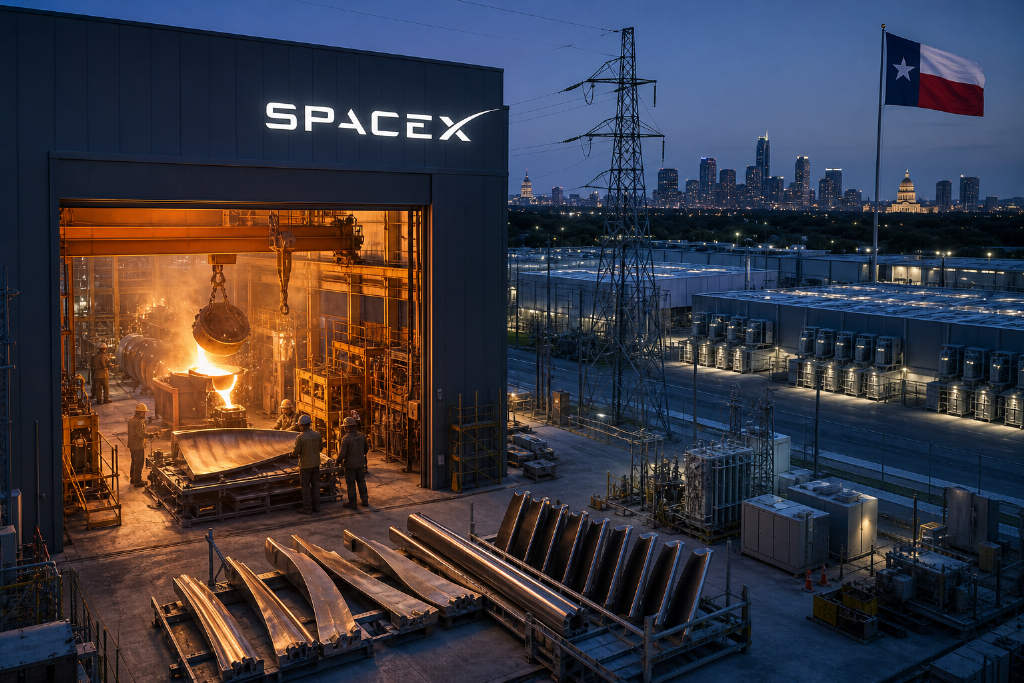
SpaceX is getting ready to set up a gas turbine blade casting plant in Texas, The Information reported, and the company has already put related job listings on its website.

After that report came out, Elon Musk answered on X and used it to make a bigger point about AI infrastructure. His claim: by 2027, roughly 15 GW of AI compute built in that year may still fail to switch on during that same year. And in his view, this is not just an electricity-supply problem. Transformers matter. Transmission lines matter. Liquid-cooling systems too.
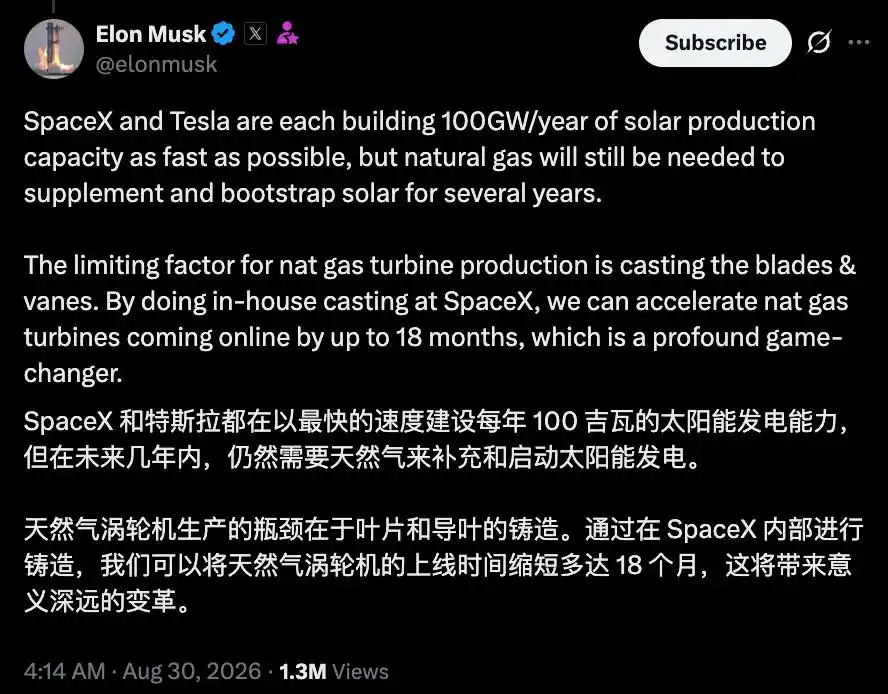
Musk said one of the main production choke points in gas-fired power generation is the casting of turbine blades and vanes.

From data centers to upstream power equipment
The thinking here goes well past stacking up server clusters. AI developers want more compute. That leads to more data center construction. Then those data centers hit power constraints, and operators go hunting for more generation capacity. Solar is framed as the longer-term fix. But for the next few years, natural gas is still expected to fill the gap and help bring solar generation online.
The source article says SpaceX and Tesla are pushing as hard as they can to build 100 GW per year of solar manufacturing capacity. Even then, the immediate problem for AI infrastructure is simple: how fast usable electricity can actually get online.
Using SpaceX’s second-quarter expectations for this year, the company expects to have more than 2 GW of compute online by the end of 2026 and nearly 10 GW by the end of 2027. To power those GPUs, SpaceX is lining up projects that together cover 20 GW of power, cooling, and electrical infrastructure.

Musk’s own estimate says that even if one quarter of those projects slips, actual generation capacity online by the end of 2027 could still come close to 15 GW.
Turbine orders are spoken for years out
Even companies ready to install gas turbines on their own are finding that buying the machines is tough.

GE Vernova said in the second quarter that gas turbine orders and reserved capacity had reached 116 GW, and it expected that figure to reach at least 125 GW by year-end. The company has already filled manufacturing slots through 2031. Its CEO had also said earlier that by the end of 2026, GE Vernova is expected to have sold out its 2030 capacity.
Set against that, Musk argued that blades are the part holding turbine output back. Other pieces needed for a complete gas turbine can often be sourced 12 to 18 months earlier than the blades and vanes.
He wrote on X: "By doing the casting inside SpaceX, we can bring gas turbines online 18 months sooner, and that would be a far-reaching change."

Why SpaceX sees an opening in precision casting
Blades and vanes sit right where the first blast of ultra-hot gas hits. They have to survive extreme temperatures and the mechanical stress that comes with high-speed rotation. So yes, the casting is hard.
Still, this is not a total leap from what SpaceX already does. The source article says the company already has experience building turbomachinery for the Raptor rocket engine, which was designed to run under extreme conditions.

Current job postings indicate that the planned Bastrop, Texas site, described as a “Blades and Vanes Foundry,” covers positions in aerospace and mechanical engineering, automation and controls, operations, machining, and materials. That suggests a wider precision-casting push, not some tiny one-part effort.
But there is still no evidence that the foundry has already started production.
AI infrastructure competition is spreading beyond GPUs
This episode shows the AI buildout spilling into more layers of industrial supply. GPUs and data centers are still at the center of it. But generation assets, grid equipment, transformers, cables, liquid cooling, chillers, and networks all shape how much compute can really be put to work.
Musk’s point was blunt: if any one of those pieces slows, token output takes a hit.
In that view, one gas turbine blade can start to matter almost as much as the newest AI chip when it comes to deciding how much compute will be available next.