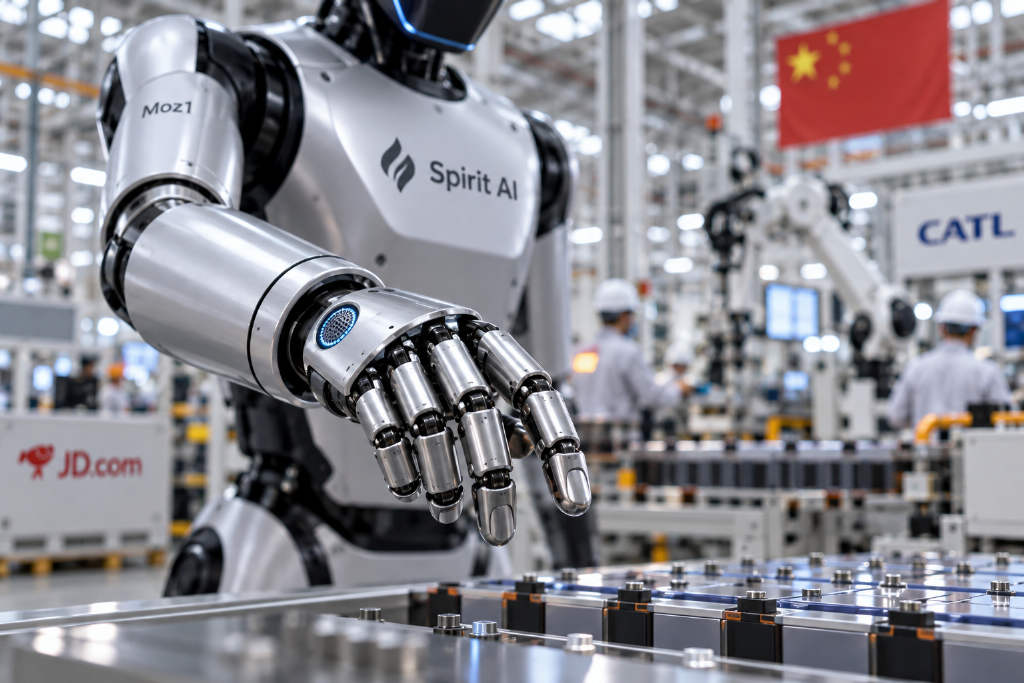
Reuters reported that Gao Yang, co-founder and chief scientist of Chinese humanoid robotics startup Spirit AI, said humanoid robots may be able to complete most general tasks based on verbal instructions as early as next year, though home adoption is still at least eight years away. He described the "brain" as the weakest part of the robotics stack and said the field could reach a GPT-3.0-like milestone by mid-2027, allowing people to speak to robots in natural language and have them attempt a sequence of physical actions to complete tasks. Spirit AI, founded in 2024, has about 300 employees and has raised $670 million in two years at a $2.9 billion valuation. The company relies mainly on real-world data, using around 1,000 contractors wearing data-collection devices at home or in factories. Its robots have reached a 90% success rate on simple tasks in a structured living-room setting. Dozens of Moz1 wheeled humanoid robots are already deployed on production lines at CATL and JD.com. Gao said the next one to two years will be an initial industrial deployment window, with simple commercial service use cases possible two years later.
Reuters reported that Gao Yang, co-founder and chief scientist of Chinese humanoid robotics startup Spirit AI, said humanoid robots could complete most general tasks from spoken instructions as early as next year, although entry into homes is still at least eight years away.
Gao said the robot "brain" remains the weakest link in the full technology stack. He expects the sector to reach a GPT-3.0-like milestone by mid-2027, at which point people could speak to robots in natural language and have them attempt a sequence of reasonable physical actions to finish a task.
Data remains the main constraint
According to Gao, high-quality data is the main bottleneck in training a robot brain. Spirit AI relies primarily on real-world data for training and has hired about 1,000 contractors who wear data-collection devices in homes or factories.
In testing, the company said its robots achieved a 90% success rate on simple tasks in a structured living-room environment.
Funding, scale and deployment
Spirit AI was founded in 2024 and has about 300 employees. Gao said the company has raised $670 million in two years and reached a $2.9 billion valuation.
Dozens of Moz1 wheeled humanoid robots are currently deployed on production lines at CATL and JD.com. Gao said the next one to two years will be the initial window for industrial applications. Two years later, robots could move into commercial service settings for simple tasks, while home use will be harder to achieve.
Safety measures
On safety, Spirit AI uses full-body force control. If the robot encounters excessive interaction force, it will automatically trigger an emergency stop.
This article was originally published by Bit.Fan. For more cryptocurrency news and market insights, visit www.bit.fan. Disclaimer:
The market information, project data, and third-party content displayed on this platform are for industry information sharing only and do not constitute any form of investment advice or return commitment.
Cryptocurrency trading carries high risks. Users should fully assess their risk tolerance and make independent decisions. All profits, losses, and legal responsibilities are borne by the users themselves.