
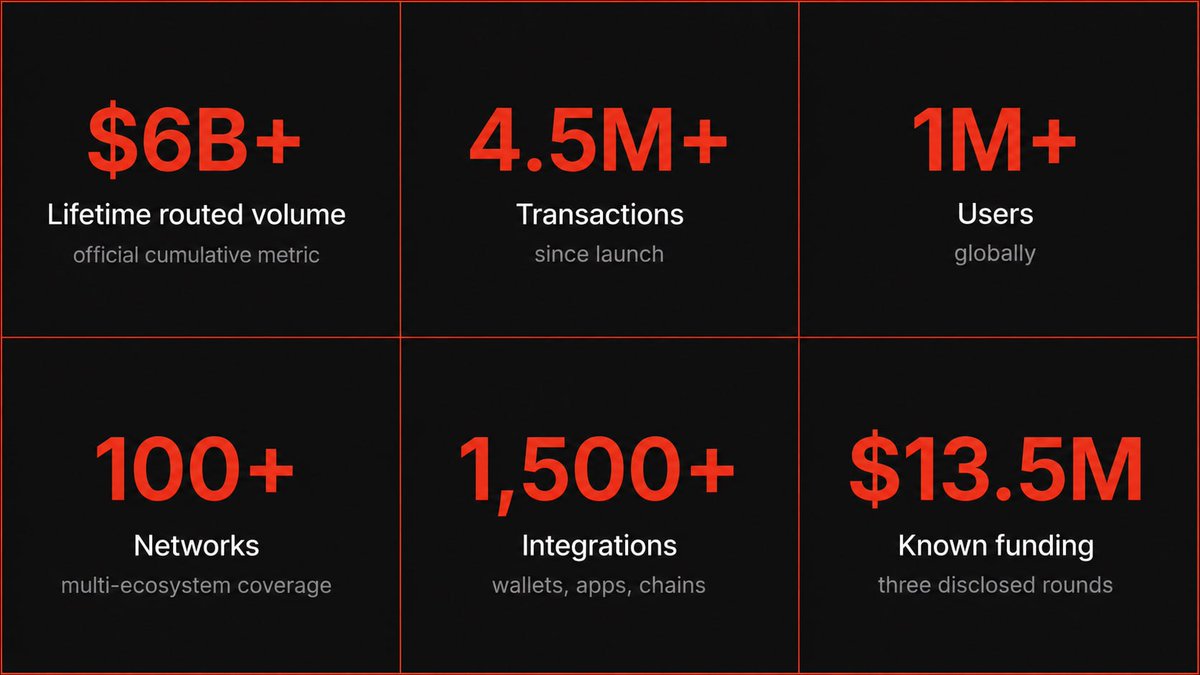
Squid spent three and a half years running on mainnet and routing more than $6 billion before it issued a token, a sequence that stands out in crypto. The rollout became more unusual after the project announced a $6 million strategic funding round, saw a third-party module exploited three days later, and then brought QUID to market 74 days after that, with Binance Alpha as the first listing venue.
On May 22, 2026, Squid said it had raised $6 million in a strategic round led by North Island Ventures with participation from Ripple and others. On May 25, a third-party module was exploited in roughly two hours, draining 86 wallets and causing losses described in the article at about $3 million. By late June, QUID’s public sale opened with a $2.25 million hard cap and ended about 11.9 times oversubscribed. On Aug. 4, 2026, at 13:00 UTC, QUID officially reached its token generation event. Binance Alpha listed the token first, followed the same day or shortly after by Kraken, Bitget, Upbit, Bithumb, and MEXC. LBank, BingX, and XT later opened trading as well.
One detail stood out in the listing wave: South Korea’s two regulated exchanges, Upbit and Bithumb, listed the same cross-chain infrastructure project on the same day. QUID started at $0.045, later reached an all-time high of $0.14, and was consolidating around $0.09 to $0.11 as of Aug. 7.
Why Squid waited years before launching a token
Squid developed in the reverse order from many crypto projects. Instead of leading with a white paper, funding, and token plans before product delivery, it ran the protocol first and considered a token later.
The timeline in the article is straightforward. In 2022, co-founders Fig, Xtina, and Koda built an early prototype at an Axelar-hosted hackathon, won recognition there, and then decided to work on Squid full time. In January 2023, the project launched on mainnet with support for 25 chains and no token. In February 2023, it closed a $3.5 million seed round led by Polychain Capital and still did not issue a token. In September 2024, Squid 2.0 went live, expanding coverage to 77 chains and more than 110 liquidity sources. In December 2024, the team launched the CORAL protocol and completed a $4 million strategic financing round. In May 2026, Squid announced the $6 million strategic raise led by North Island Ventures with Ripple participating, taking total funding to $13.5 million. In June 2026, the project finally announced QUID.
That left Squid operating for more than three years without a native token. Since its January 2023 mainnet debut, the protocol has recorded more than 1 million users, more than 4.5 million transactions, over $6 billion in routed volume, and more than 1,500 ecosystem integrations, including MetaMask, Ripple, Ledger, Brave, and Keplr.
For anyone assessing QUID, the article’s point is that the token is attached to a live business with over 40 months of operating data rather than a roadmap alone.
What Squid does
Squid describes itself as cross-chain routing infrastructure. It is not limited to bridging between two chains. Instead, it aggregates multiple cross-chain communication systems, including Axelar, CCTP, IBC, and LayerZero, so users can swap any token across chains within a single transaction.
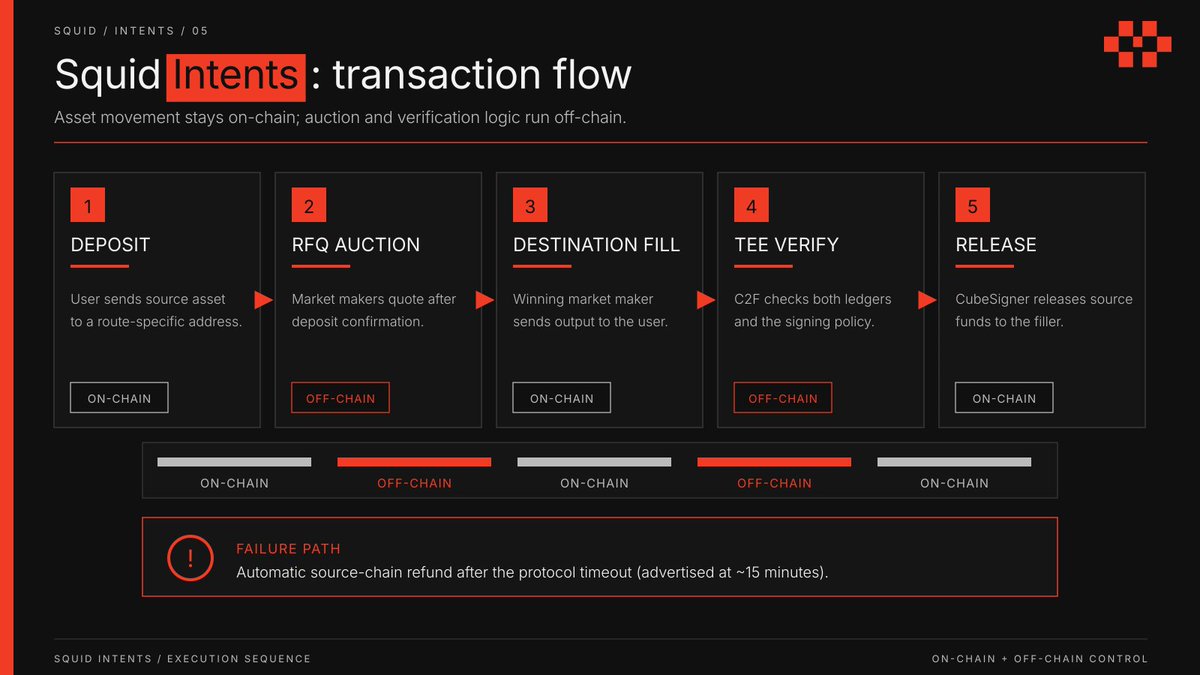
Its technical core is a mechanism called Squid Intents. Users submit an intent, independent solvers compete to execute it, and the logic is verified in a trusted execution environment. According to the project’s official claims cited in the article, cross-chain execution can be completed in as little as five seconds, gas costs can be reduced by about 90% compared with traditional AMM routing, and MEV protection is built in.
At present, Squid supports more than 100 blockchains, more than 20,000 tokens, and connections to more than 130 decentralized exchanges.
The founders and the hackathon origin
Squid began in 2022 around an Axelar ecosystem hackathon. The three co-founders came from different backgrounds.
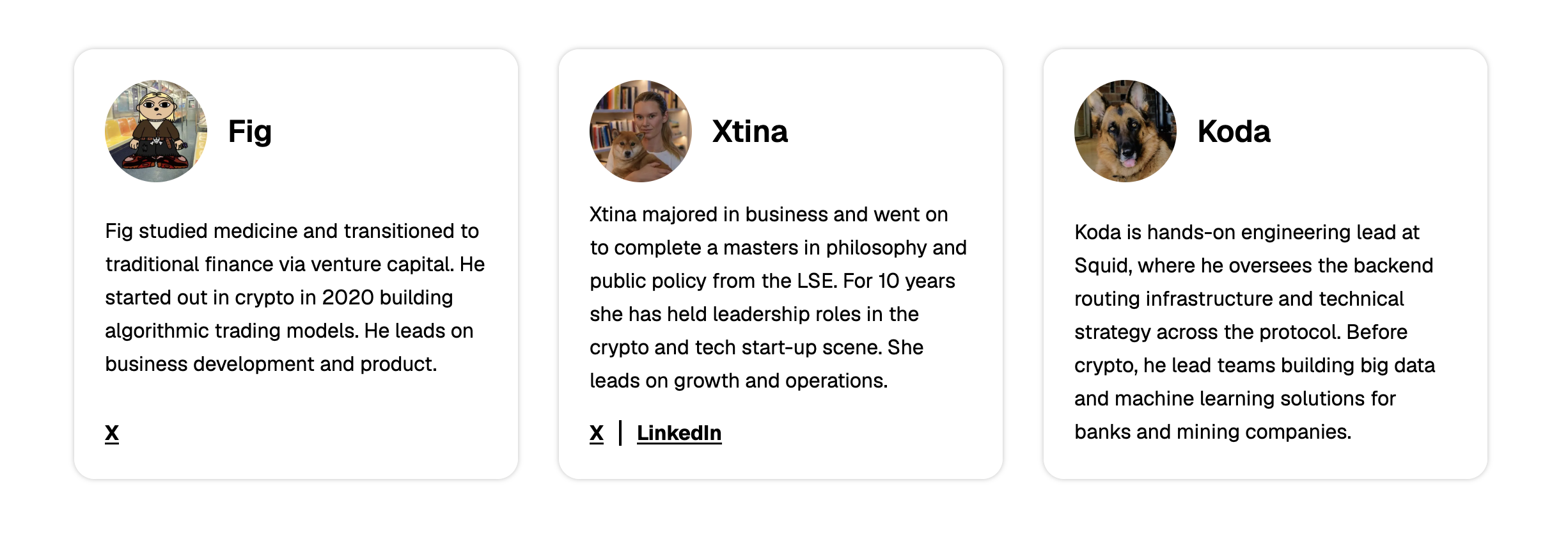
Fig, known online as “ecdsafu,” is an anonymous founder and a known advocate of chain abstraction. The article says he studied medicine, later entered traditional finance through venture capital, and began building algorithmic trading models in crypto in 2020. Before founding Squid, he was an early Axelar employee involved in the architecture of core cross-chain communication protocols. He now leads protocol and product work.
Xtina, or Christina Norgard Rud, studied business and holds a master’s degree in Philosophy and Public Policy from the London School of Economics. She has about 10 years of leadership experience across crypto and tech startups and is responsible for business, strategy, and growth.
Koda leads engineering. Before Squid, he built big data and machine learning solutions for banks and mining companies. He now oversees backend routing infrastructure and technical strategy.
The team built an early prototype during the hackathon, received recognition, and decided to commit full time. Their view was that the market had bridges and messaging providers already, but lacked a unified layer that could handle routing, cross-chain execution, and swapping at once. As chain count expanded, they argued, users would need a router from anywhere to anywhere rather than a bridge from A to B.
Squid was originally incubated in the Axelar ecosystem and relied heavily in its early days on Axelar’s General Message Passing, or GMP. It launched on Jan. 31, 2023 with support for 25 chains. After upgrades built around Squid Intents, it evolved into a multi-protocol routing architecture where Axelar became one option among several. Coverage later extended to non-EVM networks such as Bitcoin, Solana, and XRPL.
The team now has about 20 people and works remotely on a distributed global basis. Fig’s continued anonymity remains a point of debate in the cross-chain sector and adds trust friction for some users and institutions.
QUID tokenomics and public sale terms
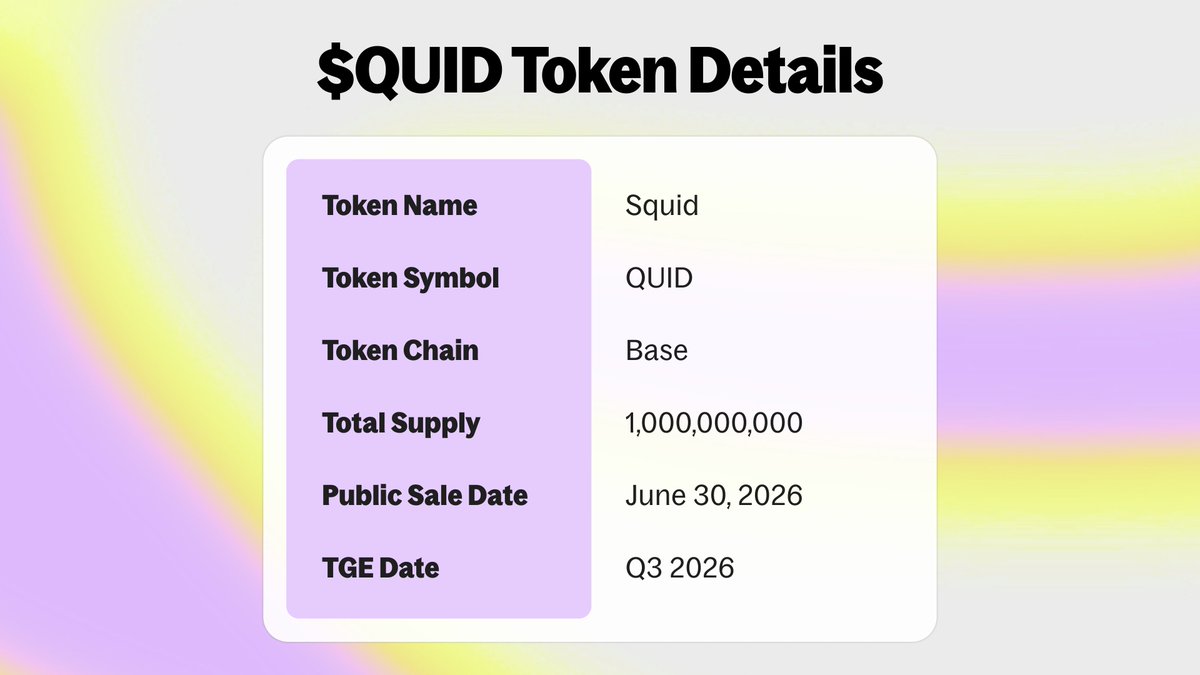
QUID is an ERC-20 token on Base. Total supply is fixed at 1 billion tokens, with no inflation and no additional minting.
| Allocation | Share | Unlock schedule |
|---|---|---|
| Public sale | 5% | 100% unlocked at TGE |
| Foundation treasury | 23.16% | 10% unlocked at TGE, with the rest released linearly over 36 months |
| Ecosystem development | 7.50% | Mostly unlocked at TGE |
| Investors | 30.39% | 12-month lockup |
| Team and advisors | 23.95% | 12-month lockup |
| Strategic partners | 10% | 12-month lockup |
The public sale ran from June 30 to July 3, 2026 on Legion and Kraken. The sale price was $0.045 per token, implying a fully diluted valuation of $45 million. The sale covered 5% of total supply, or 50 million tokens. The hard cap was $2.25 million, while total subscriptions reached about $26.66 million, around 11.9 times oversubscribed. The article says 3,542 unique participants from 78 countries took part.
QUID did not conduct a large-scale airdrop before listing. The project instead used the public sale as its main route for community participation.
Initial circulating supply was about 143 million tokens, equal to a 14.3% circulating ratio. Nearly 65% of supply classified as internal allocations is locked for 12 months. That limits near-term selling pressure, but it also sets up a concentrated unlock one year later. Token utility includes staking, governance, and future ecosystem use cases. First-year staking rewards total 5 million QUID, or 0.5% of supply.
On market performance, the article lists a public sale price of $0.045, an all-time high of $0.14, and a price range of about $0.09 to $0.11 as of Aug. 7. Current market capitalization is put at about $15 million, while fully diluted valuation stands at around $108 million. Twenty-four-hour trading volume was around $40 million to $50 million, implying turnover above 200%.
The exploit three days after funding
On May 25, 2026, a third-party Gnosis Safe module called “SquidRouterModule” was exploited. The attack did not rely on price oracle manipulation. Instead, the article says the module accepted a fixed string supplied by the caller as proof of identity, and that string was publicly visible in verified source code. Using that flaw, the attacker drained roughly $3.2 million to $4 million in assets from about 86 to 88 Safe wallets across Ethereum, Base, and other networks within two hours.
Squid said the module was not built, deployed, or operated by Squid itself. It added that the core routing contracts were unaffected and that all standard users and integrations were safe.
Even so, the episode highlighted a structural issue in aggregator models. Squid depends on many external components, including bridge protocols, liquidity sources, solver networks, and oracles. Audits may cover components submitted by Squid, but not the entire dependency tree. For users and integrators, the presence of “Squid” in the module’s name made brand spillover hard to avoid.
In cross-chain systems, where trust is spread across multiple chains and layers, the practical security boundary can still stop at the weakest line of code.
Competitors in cross-chain routing and aggregation
Squid’s direct competition does not come primarily from lower-level messaging protocols. The article places it in the cross-chain routing and aggregator layer.
The main direct rivals listed are Li.Fi, Socket, and Rango. Li.Fi is presented as a representative routing and execution layer that aggregates a large set of bridges, DEXs, and solvers. Its strengths are developer tooling and deep EVM ecosystem coverage, and many wallets and dApps use it as a routing engine. Socket, whose front-end product is Bungee, is described as modular cross-chain infrastructure focused on SDK flexibility and custom routing, again aimed at helping applications embed cross-chain features quickly. Rango is shown as a broad multi-chain DEX and bridge aggregator with strengths in long-tail chains and heterogeneous, non-EVM support. In some cases, it acts as a meta-aggregator that queries routes including Squid’s.
Based on the article’s compilation of publicly verifiable data as of August 2026, Rango leads in cumulative volume, Squid has an edge in non-EVM support and real user count, and Li.Fi is more mature in developer ecosystem depth and brand recognition. Socket is more infrastructure-oriented, with less public consumer-facing data available.
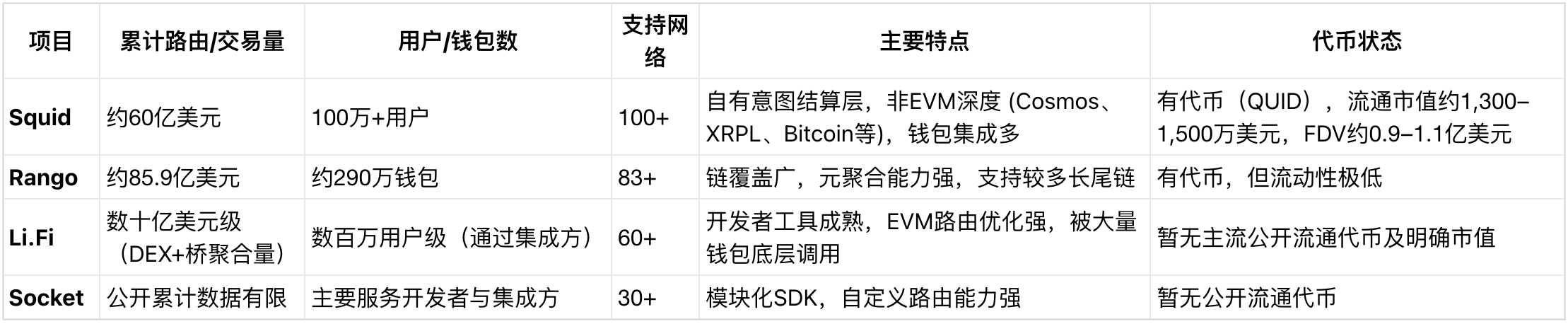
The piece distinguishes these projects from protocols such as LayerZero, Wormhole, and Axelar, which sit closer to the messaging layer, and from Across, deBridge, and Stargate, which are more focused on specific bridge or liquidity networks. Squid is framed as upstream or complementary to those protocols, while Li.Fi, Socket, and Rango are treated as direct competitors.
The article identifies three main points of differentiation for Squid:
- Its own intent settlement layer, Squid Intents, means it is not only aggregating routes but also operating its own settlement protocol. Much of the execution logic can happen off-chain, and the model supports non-smart-contract chains such as Bitcoin and XRPL.
- Its non-EVM depth is stronger than that of many pure aggregators, with native support and official partnerships across ecosystems including Cosmos, XRPL, and Hedera.
- It accumulated real business usage before token issuance, with $6 billion-scale routed volume and extensive wallet integrations built over more than three years without a token.
The risks are laid out just as clearly:
- Unlock pressure is a major medium-term factor. More than 64% of supply allocated to investors, team, and strategic partners is subject to a concentrated release after 12 months.
- Dependency risk is part of the aggregator model. Like Li.Fi and Rango, Squid relies on many integrated protocols. The May 2026 third-party module incident did not hit the core contracts, but it exposed the trust-boundary and brand-contagion problem.
- Competition is intense. In high-frequency EVM routing, more established players such as Li.Fi still hold advantages in pricing and speed, while Socket is ahead in developer tool maturity.
- The anonymous founder issue remains. Some institutions and users assign extra weight to team transparency, and Squid carries added trust cost there.
The article’s broader conclusion is that Squid is not trying to replace LayerZero or Wormhole. It is aiming for the last mile between user intent and final settlement, competing to become the routing and execution layer that applications and users rely on.
What comes next
In its May 2026 “State of Squid” update, the team said it plans to expand into consumer-facing products. Before that, Ripple USD, or RLUSD, had already moved natively across XRPL, Ethereum, Base, and Optimism through Squid. The article also says MiniPay surpassed 88,000 users after deployment in March 2026. Ripple’s participation in the financing round is described there as a potential path for deeper links between the XRP ecosystem and broader DeFi activity.
From the exploit that followed its funding announcement by three days to the Binance Alpha listing on Aug. 4, Squid compressed financing, a security incident, a public sale, a token launch, and exchange listings into roughly 74 days.
What QUID now puts to the test is whether three and a half years of mainnet operations, more than $6 billion in routed volume, and over 1,500 integrations can translate into lasting token value, and whether Squid can hold its place in an increasingly crowded cross-chain routing market.