
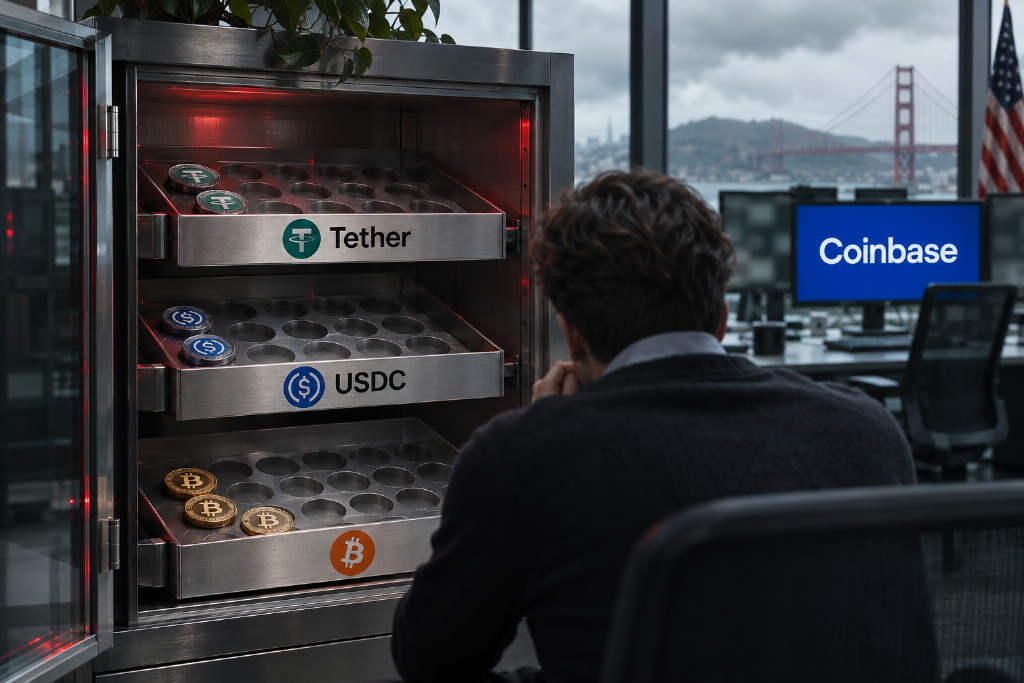
Crypto market liquidity is showing its sharpest contraction in years. Glassnode said in a research report released on Nov. 11 that the circulating supply of major dollar-backed stablecoins fell by $14.2 billion in the 30 days through Nov. 9. It was the largest decline since the bear market in June 2022.
The liquidity contraction has appeared alongside weaker U.S. demand. U.S. spot Bitcoin exchange-traded funds recorded roughly $1.6 billion in cumulative net outflows over the latest 20 trading days, while the Coinbase premium remained negative. The combination has raised questions about whether Bitcoin can sustain a rebound before new dollar liquidity returns to the market.
Stablecoin supply posts its largest contraction since June 2022
Stablecoins are commonly treated as a source of dollar liquidity for the crypto market. Investors can hold assets such as USDT and USDC on exchanges or on-chain while waiting to buy BTC, ETH and other digital assets. If redemptions remain larger than new issuance, part of the capital base may be reducing its exposure to crypto.
Glassnode wrote that the decline in stablecoin supply means holders are redeeming assets for dollars and taking cash out of the market, leaving a rebound with less fuel. The contraction was not limited to smaller stablecoins. USDT and USDC together lost nearly $11 billion in supply over the past month.
Separate research from CryptoQuant showed that USDT’s market capitalization fell by about $6.6 billion during the 60 days through Nov. 7. The decline was larger than the $3.2 billion reduction recorded over a comparable period after the FTX collapse at the end of 2022.
A drop in stablecoin supply does not mean that all of the capital has left crypto. Transfers between different stablecoins, along with the way issuance and redemptions are handled, can affect the figures.
ETF outflows point to weaker U.S. buying demand
Institutional demand has also remained soft during the stablecoin contraction. Glassnode’s data showed that U.S. spot Bitcoin ETFs saw about $1.6 billion in net outflows over the 20 trading days through Nov. 9.
The Coinbase premium, a measure of demand in the U.S. market, stayed negative on a 30-day average after an adjustment for the deviation in USDT’s price. The discount reached its deepest level since February this year.
The indicator measures the difference between BTC prices on a U.S. trading platform and the global market. A sustained negative premium generally points to weaker buying demand from U.S. participants. In the current setup, both on-chain stablecoin liquidity and capital entering through ETFs have yet to show a broad recovery.
Bitcoin trades below the short-term holder cost basis
Glassnode also found that Bitcoin had recently fallen below the average cost basis of short-term holders, estimated at about $75,600. Short-term holders are generally investors who have held their coins for fewer than 155 days. Their average cost basis is used to assess the overall profit and loss position of more recent market entrants.
Only about 35% of short-term holders are currently in profit, according to Glassnode. Most recent buyers are still carrying unrealized losses.
If BTC rebounds toward the average cost basis of those holders, some investors may reduce their positions or sell near break-even. That could create additional supply. A short-term rebound, by itself, may therefore not be enough to absorb the potential selling pressure above the market.
Some large wallets return to accumulation
The data is not uniformly negative. Glassnode said the recent decline has cleared a considerable number of leveraged long positions near the price, reducing part of the risk of another chain of forced liquidations.
Since the sell-off on Nov. 5, spot order books on Binance and Coinbase have shown more buy orders than sell orders within 5% of the current price. The pattern indicates that some investors are attempting to buy the dip.
On-chain holdings data also showed that two groups of larger wallets had returned to accumulation over the past week. One group holds between 100 and 1,000 BTC, while the other holds between 1,000 and 10,000 BTC.
Wallets holding more than 10,000 BTC, as well as wallets holding less than 1 BTC, continued to reduce their holdings. The result is a market with pockets of buying, but not yet broad accumulation.
Three signals may determine whether conditions improve
According to CoinGlass data from the afternoon of Nov. 12, BTC was trading at about $73,578, down roughly 0.74% over 24 hours. The price remained below Glassnode’s estimate of the short-term holder cost basis.
The first signal to watch is whether the supply of major dollar-backed stablecoins stops falling. A sustained return to net issuance could offer an early indication that dollar liquidity is improving.
The second is whether U.S. spot Bitcoin ETFs return to consecutive net inflows. Several days or weeks of inflows would provide a clearer measure of institutional demand than a single session.
The third is the Coinbase premium. A move back into positive territory would show that U.S. buyers are again willing to pay more for BTC than the broader market, pointing to a gradual recovery in spot demand.
Glassnode said that a move back above the short-term holder cost basis near $75,600 would support the case for a market reversal. A continued break below $73,000, by contrast, could lead to a longer consolidation period. The firm also said that some large holders have begun buying again and that the gradual clearing of leverage has improved the short-term trading structure.



