
Stablecoins have turned dollar account ownership into an open question
In the traditional financial system, the question of who owns an account barely stood on its own. Accounts were assumed to belong to banks. Users saw their balances, but in legal and regulatory terms, the account itself was part of a bank-issued debt relationship. Banks gained use of the funds, depositors held claims on the bank, and banks in return operated under licensing, capital, and customer fund segregation requirements.
The article says stablecoins broke that default arrangement for the first time. Once dollars could exist as USDT or USDC in a blockchain address instead of on a bank balance sheet, the role of holding funds could be separated from the role of being supervised like a bank.
That shift is framed not as a technical tweak but as a structural loosening. For decades, account ownership did not surface as a live issue because there was only one answer. Banks. Now the answer is no longer fixed, and companies building dollar products have to define the structure themselves and live with the consequences.
That is why the controversy around KAST’s terms of service in July 2026 matters in the article’s view. On the surface, the dispute centered on wording. When users topped up stablecoins, the funds were described legally as a “sale” rather than a “deposit.” But the article argues that treating the episode as a public-relations mistake misses the real point. KAST was, in effect, giving its own answer to the question of who owns the next generation of dollar accounts, and that answer did not match what many users would instinctively expect.
In emerging markets, dollar accounts solve a survival problem
To explain why this matters, the article goes back to a more basic issue: once a dollar account leaves the banking system, who owns it?
For many Americans, a dollar account is background infrastructure. It is used to receive salary, pay rent, or invest, and rarely becomes the object of attention. For a much larger part of the world, the article says, dollar access is not mainly about investing. It is about preserving purchasing power and getting paid efficiently.
Argentina is one example. In 2023, inflation there topped 200% at one point. In that setting, a household holding wages in local currency for even a few days could see purchasing power erode quickly, so converting income into dollars became an immediate priority. Nigeria illustrates a different version of the same logic. With the official exchange rate and parallel-market rate coexisting for long stretches, import businesses have struggled to obtain enough dollars through formal channels, and USDT has become a de facto trade settlement tool.
The article notes that Chainalysis has ranked Nigeria among the world’s most active crypto markets for several years in its global crypto adoption index, and says the driver has not been speculation but a real shortage of dollars. Together, the Argentina and Nigeria cases show how people build alternative paths to the dollar when the local monetary system does not let them hold value reliably.
A second source of demand is growing inside the internet economy. Citing data from the World Bank and the International Labour Organization, the article says India, the Philippines, Pakistan, and Bangladesh have become major exporters of digital labor. Programmers, designers, and freelancers working through Upwork, Fiverr, or directly for overseas SaaS companies earn in dollars, yet their payout channels remain tied to local financial systems.
A designer in the Philippines may wait several days for payment from a U.S. client to arrive. A developer in Pakistan may pay more than 5% in fees on a cross-border transfer. The article also cites World Bank estimates showing global personal remittances at about $905 billion in 2024, with roughly $685 billion in officially recorded remittances flowing to low- and middle-income countries. Average completion times still run into days, and the global average fee remains about 6%.
The conclusion drawn is straightforward: work has been global for nearly two decades, but account infrastructure still reflects an older world built around clear national boundaries.
First-generation neobanks changed the interface, not the ownership model
The article then asks why banks did not simply fill this gap if global dollar demand was already so large. The answer, it says, lies in cost structure rather than willingness. Banks are organized country by country, while internet-era dollar demand emerges across borders. Every additional jurisdiction adds KYC, anti-money laundering reviews, foreign exchange compliance, and capital requirements. Those costs are difficult to justify for freelancers earning a few hundred dollars a month or households making routine currency conversions.
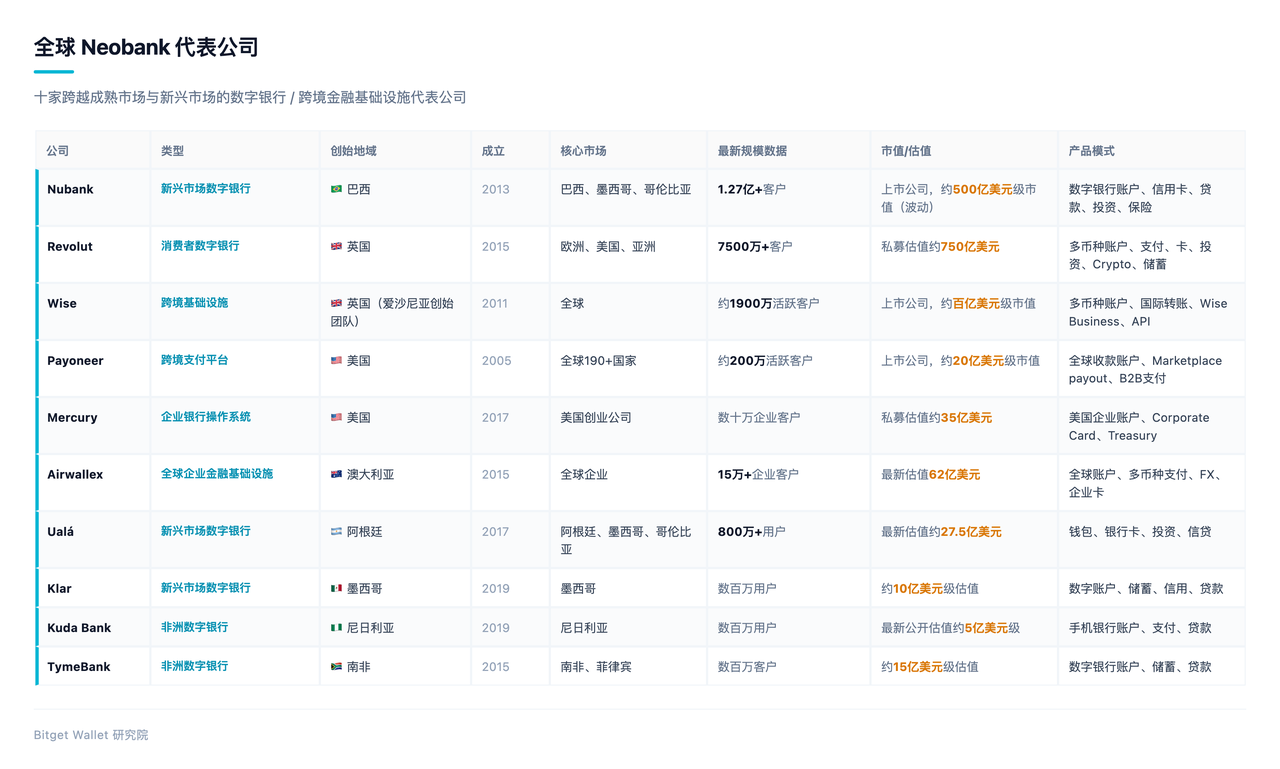
That left space for companies outside the banking system. Nubank, Revolut, Wise, Payoneer, and Mercury are presented as first-generation neobanks that grew in that gap. Their shared move was not to reinvent the dollar but to repackage banking.
- Wise split a cross-border transfer into two local transfers and used a global account network to offset flows, reducing dependence on correspondent banking.
- Payoneer worked with licensed U.S. banks to give global freelancers remote access to dollar accounts capable of receiving ACH transfers.
- Mercury turned U.S. business bank accounts into an internet-native product for founders operating from places such as Singapore or Brazil.
Still, the money behind those accounts remained inside regulated commercial banks, and the regulatory burden remained with the banks. In the article’s telling, these companies functioned as an internet layer on top of the banking system, not as something fundamentally outside it.
That is also where the ceiling sat. No matter how clean the interface became, as long as banks held sovereignty over the funds, the compliance costs tied to serving low-balance, high-frequency, cross-border users remained in place.
Stablecoins split apart assets, settlement, and payments
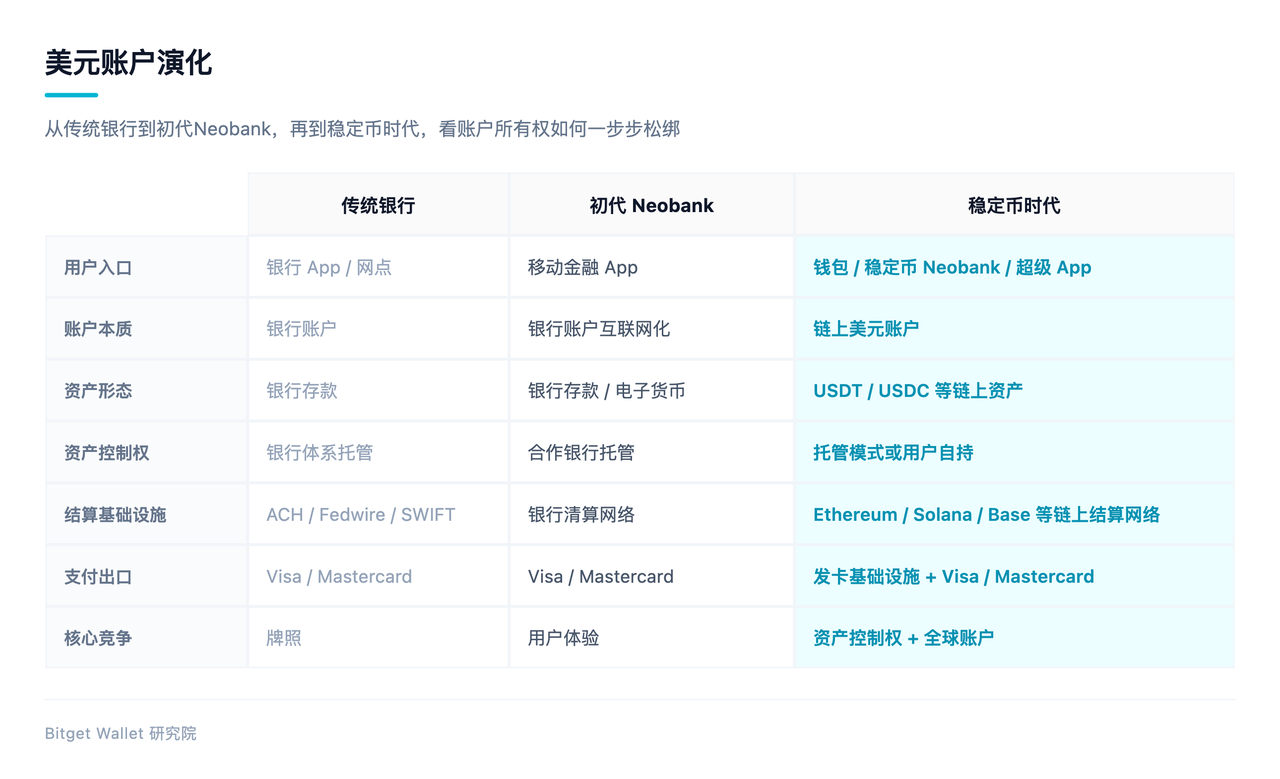
The real break came at the asset layer. The article points to Tether’s launch of USDT in 2014 and the 2018 launch of USDC by Circle and Coinbase as a deeper turning point than they first appeared to be. On the surface, these were new digital dollars. At a structural level, they allowed dollars to exist independently of bank accounts.
For a Nigerian entrepreneur, that could mean receiving dollars from a U.S. customer without opening a U.S. bank account. For an Argentine household, it could mean moving wages into digital dollars without waiting for local bank approval.
But the article argues that the deepest impact was not faster transfers or lower fees. It was the unbundling of three functions banks historically packaged together: the account asset itself, settlement, and payment rails.
In the banking era, money sat at a bank, interbank settlement moved through systems such as ACH, Fedwire, and SWIFT, and spending relied on Visa and Mastercard to connect bank accounts to merchants. Those three layers were coordinated by a single regulated institution, which made the supervisory model relatively simple.
Once the asset layer moved on-chain as USDT or USDC, settlement could happen in real time across public blockchains including Ethereum, Solana, and Base, while the payment layer could still rely on card infrastructure to convert digital dollars into fiat merchants accept. Wallets, blockchains, and card networks could now be separate actors. Regulators, the article says, had not previously needed to decide how to redistribute responsibilities once those layers were split.
That change defines the second generation of neobanks. The core contest is no longer who connects most smoothly to banks, but who can assign responsibility across assets, settlement, and payments in a way regulators can understand and accept.
The article names several examples. RedotPay is trying to connect stablecoin accounts directly with global bank cards. Gnosis Pay uses a smart-contract wallet linked to the Visa network so users retain payment authority. Ether.fi Cash combines stablecoins, staking yield, and spending in a single on-chain account. Plasma connects on-chain accounts to fiat infrastructure from Bridge, which sits under Stripe.
All of them may look like they are building a better dollar account. The article says the real divergence sits elsewhere: each product is answering the question of who owns the account.
KAST’s structure puts users in the position of creditors
KAST, as described in the piece, offers a familiar product surface: a global dollar account, a Visa card that can be linked to Apple Pay and Google Pay, stablecoin balances, and dollar-denominated yield. That is part of why the legal wording mattered so much. According to the article, KAST’s terms stated that when a user topped up a card account with USDC, the transaction was not a deposit but a sale.
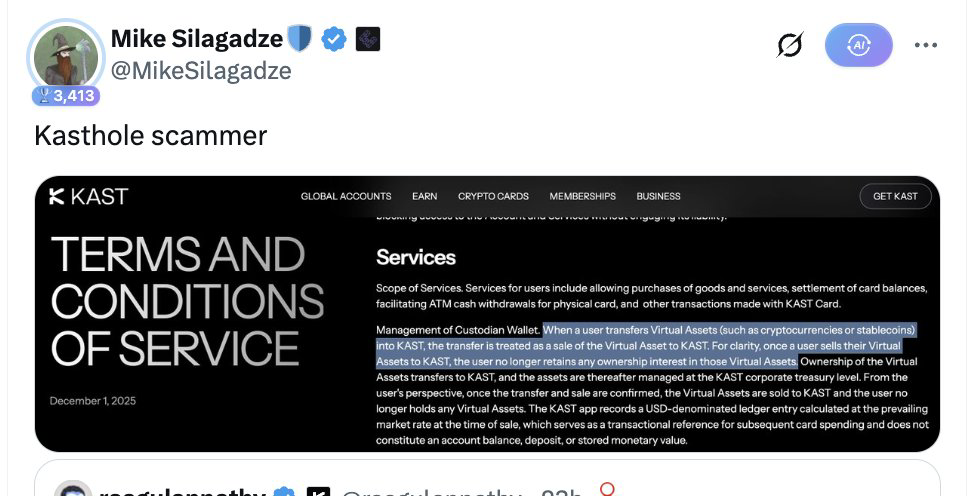
The distinction carries legal and economic consequences. If the top-up were a deposit, the funds would still belong to the user and the company would be safeguarding them. If it is a sale, ownership of the stablecoins passes to KAST, the funds move into the company treasury, and the user balance becomes a payment obligation owed by the company — in other words, a digital IOU.
That difference may feel invisible while a company is operating normally. It matters sharply in distress. If the company faces a liquidity crunch or bankruptcy, the user may stand not as the owner of ring-fenced assets but as a creditor in the liquidation queue. The article adds that KAST’s terms at the time capped the company’s liability at $500, which it reads as another sign that users occupied a creditor-like position rather than that of asset owners.
The article does not treat this as sloppy drafting. It presents the design as a calculated response to regulation. In many jurisdictions, a fintech that holds customer funds over time can be treated as operating e-money or stored-value business and may need an Electronic Money Institution, or EMI, license in Europe, along with customer fund segregation, capital adequacy, and ongoing audit requirements. Those licenses are costly and difficult to replicate globally at low expense.
By redefining the top-up as a sale, KAST could step outside that framework. If the company has bought the asset for itself rather than accepted a customer deposit, then rules centered on safeguarding client money no longer attach in the same way. The article characterizes this not as a loophole stumbled into by accident, but as a deliberate form of regulatory avoidance.
The same structure changes the revenue model. Once funds sit in the corporate treasury, they can be allocated to short-term U.S. Treasuries or money market funds. At short-duration yields of 4% to 5%, the article says, $100 million of parked funds can produce $4 million to $5 million in annual income, largely independent of whether users spend. That reserve-income logic, it says, resembles the way Circle and Tether profit from reserve assets and has now been imported into the neobank account structure.
Put differently, some products make money when users spend. KAST, under this reading, can make money even when users do nothing, because the economics come from interest on pooled funds rather than payment commissions. The cost of that model is that users no longer stand as owners of the underlying asset.
A different answer: do not own the user’s funds in the first place
The article contrasts KAST with Ether.fi Cash, Avici, Plasma, and Bitget Wallet. These products can also connect to Visa or Mastercard and support stablecoin spending, but they follow a different rule. Their business model is built around providing payment functionality, not around taking ownership of customer assets.
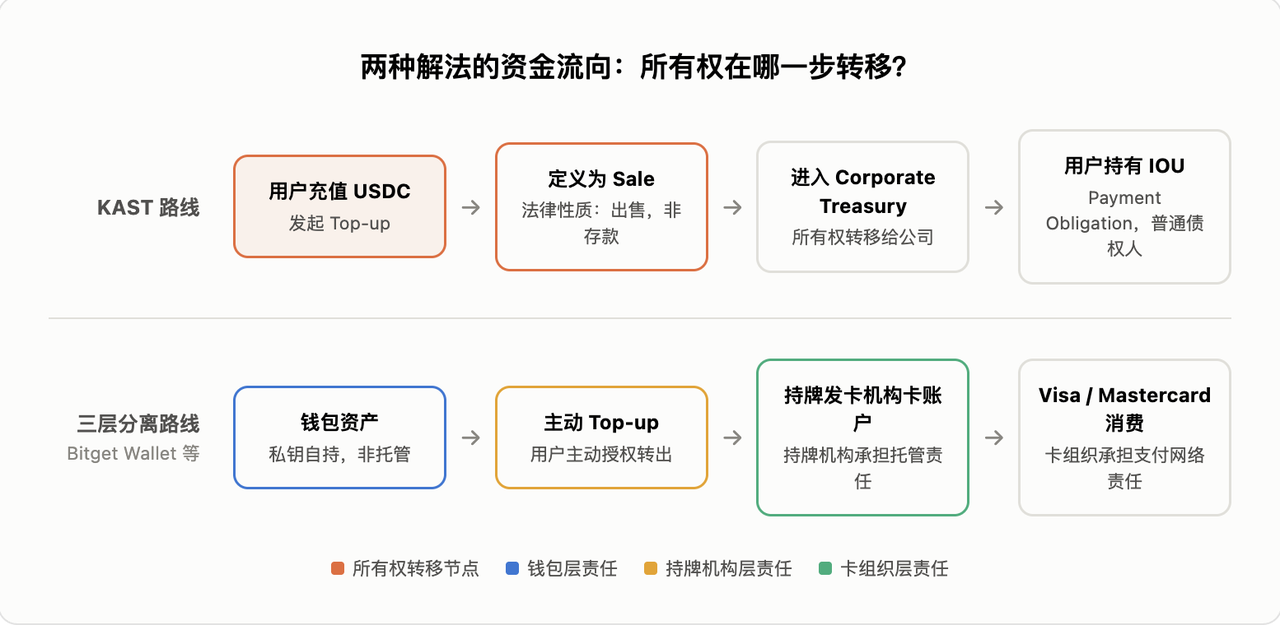
That principle shows up in attempts to minimize how long the platform itself ever controls user funds.
- Ether.fi Cash uses smart contracts to lock user assets as spending collateral, while the actual payment is funded by credit provided by the card issuer rather than by directly sweeping stablecoins out of the wallet.
- Plasma pushes fiat conversion to licensed providers such as Bridge, acquired by Stripe, while handling the on-chain account and network layer itself.
- Avici uses bank partners to provide virtual accounts, and once fiat enters, it is converted into stablecoins in the user’s wallet rather than sitting on the platform for long periods.
The shared logic is to avoid forcing one company to secure a license broad enough to cover wallet services, banking functions, and payment institution roles at the same time. Instead, each layer is assigned to the party best suited to carry it and most legible to regulators.
Bitget Wallet Card is presented as a more fully developed version of that approach. It separates accounts, funds, and payments into three layers and ties each to a different regulatory obligation rather than trying to collapse everything into one company.
At the first layer, Bitget Wallet remains a non-custodial wallet. Users’ on-chain USDT and USDC stay in their own wallet addresses, the users hold the private keys, and the platform neither can nor will unilaterally transfer or centrally custody the assets. In that layer, the article says, the platform does not create a customer-fund custody relationship and therefore does not fall into the corresponding custody regulatory bucket.
Funds only move into the second layer when the user actively initiates a top-up and transfers part of the balance into a card account managed by a licensed issuer. That layer is handled by the licensed institution and subject to local payment regulation. The third layer is the global merchant network operated by Visa or Mastercard, which converts that funding into real-world spending and carries its own regulatory responsibilities.
Under this three-layer split, no single point bears the full regulatory weight of all three roles at once. The user also keeps control over the asset for as long as possible, with one extra authorization step built into the flow. The article acknowledges that this costs some convenience, but says it materially changes the user’s position in a worst-case scenario: not a creditor in a bankruptcy queue, but the holder of private keys to assets that remain in the user’s own address.
In the article’s framing, KAST and Bitget Wallet-style structures are two answers to the same problem. KAST transfers ownership to simplify compliance and unlock reserve income. The other camp keeps control with the user by slicing responsibilities more precisely across regulated and non-custodial layers.
What regulators care about is who controls the money
Looking across the past few years of stablecoin regulation in major jurisdictions, the article sees a common pattern. Very few countries focus on wallet software itself. The central question is who controls user funds and on whose balance sheet the money sits.
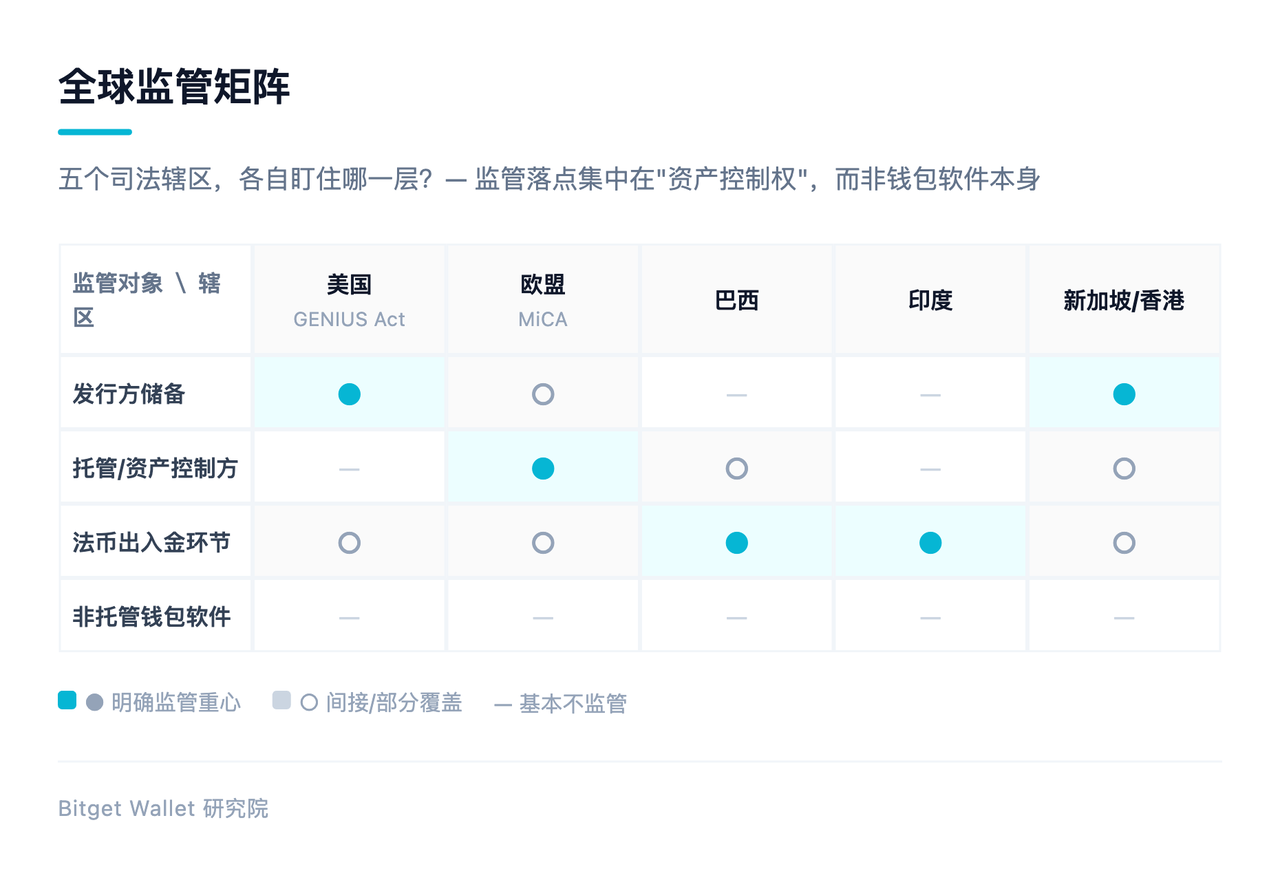
In the United States, the 2025 GENIUS Act did not ban stablecoins and did not ban non-custodial wallets. It focused on issuers, requiring reserves to be safe and audited and prohibiting direct interest payments to token holders. The key policy question, the article says, is who is issuing dollars, not who wrote the wallet software.
Europe’s MiCA takes a different route, but lands on a similar principle. It does not require every wallet to obtain a financial license. Instead, it places regulated status on crypto-asset service providers that custody client assets, execute transactions for clients, or manage funds. Software-only non-custodial wallets, where users keep their own keys, are treated more cautiously and with less direct intervention. The supervisory focus is on control over assets rather than the form factor of the software.
That, in the article’s reading, helps explain why ownership-transfer models like KAST are more likely to draw scrutiny, while non-custodial layered designs fit more readily into existing categories.
Brazil and India are described as emphasizing on- and off-ramp channels and capital movement. Brazil’s central bank has promoted Pix as one of the world’s most successful real-time payment networks while at the same time tightening oversight of stablecoin-to-fiat conversion, with the aim of keeping entry and exit within regulated rails. India has not directly targeted wallets, but has raised the cost of on-chain activity through high capital gains taxes and tax deducted at source, placing pressure on the movement of funds rather than the wallet layer.
Singapore and Hong Kong are portrayed as open to stablecoin innovation while requiring issuers to be licensed, reserves to be secure, and different roles such as wallets, payments, and custody to sit inside different regulatory frameworks.
The details vary, but the article says the shared logic is plain: regulators care less and less about which blockchain a dollar uses, and more and more about whose balance sheet that dollar inhabits at any given moment.
That is why the article argues a neobank’s regulatory fate is not determined by its marketing language. KAST may describe itself as a stablecoin-enabled dollar account rather than a crypto wallet, but what matters is the “top-up as sale” structure, not the label attached to the product. Regulation has not stopped the rise of second-generation dollar accounts. What it has changed is how responsibility gets distributed among the parties behind them. The closer an entity is to user funds, the closer it must be to the corresponding regulatory obligations.
The endgame is not issuing dollars, but holding them in a trusted way
The article closes by returning to a wider point. Over the past two decades, the internet transformed many industries but did not fundamentally transform banking. The limiting factor was not technology. It was ownership. As long as funds remained anchored to bank balance sheets, internet companies could redesign the interface but not the underlying account structure.
Stablecoins loosened that anchor by allowing dollars to exist independently of bank accounts. But loosening the anchor does not settle the question of responsibility. It turns a once-default answer into an open design problem that every company now has to solve for itself.
From that perspective, the divide between KAST and products such as Bitget Wallet, Ether.fi Cash, and Plasma represents two of the clearest answers now on the table. One approach trades user asset ownership for simpler compliance and reserve income, effectively turning users into creditors. The other keeps user control by splitting functions and licensing obligations across separate layers, at the cost of some one-tap convenience. The article does not present these as simply right or wrong. It presents them as different positions on two axes: regulatory friendliness and user asset sovereignty.
The next phase may make that trade-off even more important. As of January 2026, the article says, USDT had grown to more than $180 billion and USDC to more than $70 billion. PayPal has PYUSD. Open Standard has launched OUSD. Large U.S. banks are discussing jointly issued tokenized deposits. If dozens of digital dollars circulate at once, users will not want to memorize a growing list of ticker symbols any more than mobile payment users care which network sits underneath an app.
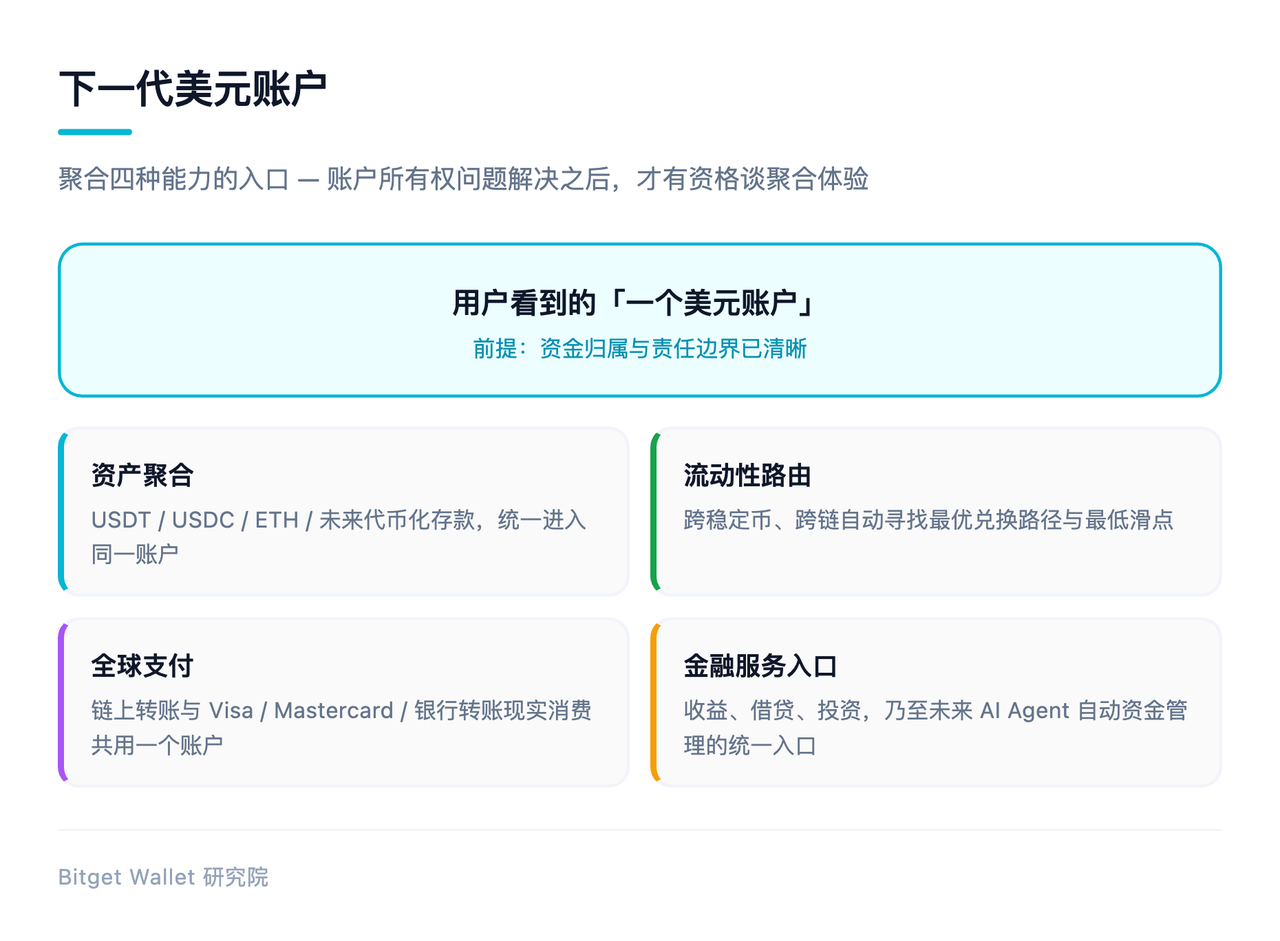
That pushes the original question one step further. The challenge will become not only who owns the account, but who can aggregate many forms of on-chain dollars back into a single dollar experience visible to the user.
The article says products that manage that feat will need four capabilities at once: bringing USDT, USDC, ETH, and future tokenized deposits into one account; finding the best path and lowest slippage across stablecoins and chains; allowing one account to support on-chain transfers as well as spending through Visa, Mastercard, and bank transfers; and folding yield, lending, payments, investment, and even future AI agent-driven money management into the same entry point.
Yet all four capabilities rest on the same base layer. Before a product can aggregate many dollars into one experience, it has to answer who owns the money and who bears responsibility for it. Without that, the trust needed for aggregation will not exist.
The final claim in the article is that the next generation of dollar accounts will not be decided by who issues the biggest stablecoin. It will be decided by who can find a balance between operating outside the banking system and standing up to regulatory scrutiny — a balance users are willing to trust and regulators are willing to recognize.