
Written by Prathik Desai

Translated by Saoirse, Foresight News
Stablecoins are changing cross-border remittances, but not in the simple way many expected. The main shift is not just lower transfer costs. It is a redistribution of profit across the stack, away from parts of the old banking and correspondent network and toward firms that control user access, local payout rails, orchestration software, and reserve assets.
The article says strong technologies tend to create a common baseline for value creation. Phones and the internet did that in the 20th century. Blockchain could play a similar role in the 21st. In remittances, the long-standing problem is cost, but that cost does not come from a single fee. A cross-border transfer passes through several layers, and each participant takes a cut.
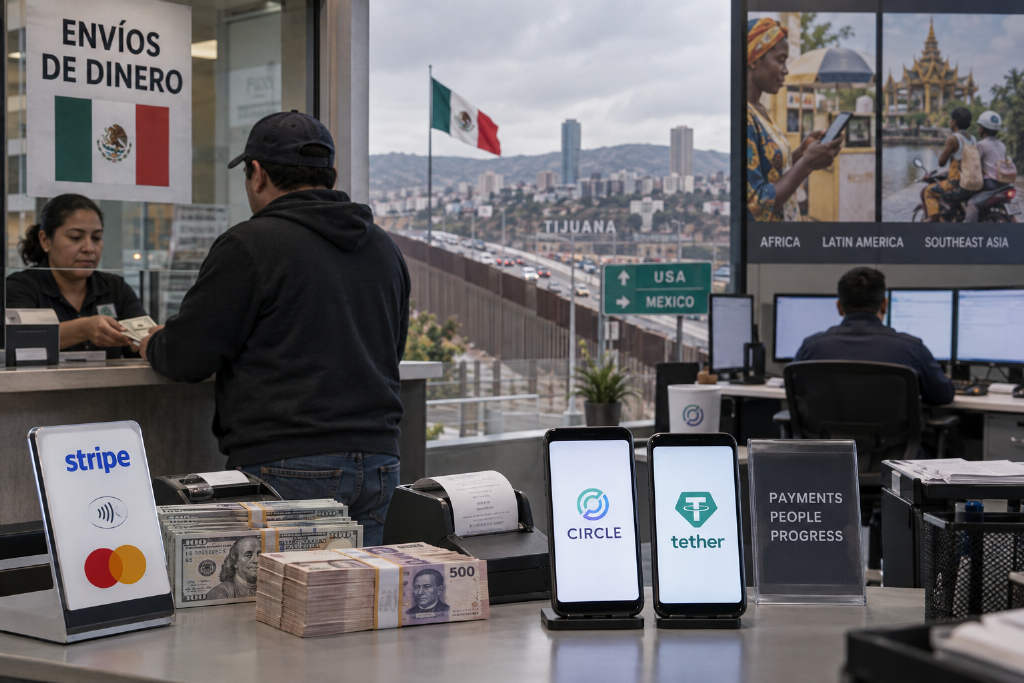
Users usually absorb the full cost without seeing where it goes. In the article’s example, a worker in the United States sends $100 home to Mexico. The family receives pesos worth about $94. The apparent loss is $6, yet the visible fee on screen is only about $2. Less than half of the total cost is explicit.
A large share of the rest sits in foreign exchange. Dollars must be converted into pesos before they reach a Mexican account, and banks add a spread on top of the mid-market rate. In this example, that spread is about $3, roughly half of the total cost. A standard remittance also moves through several intermediaries, each controlling a specific step and charging for it.
Blockchain lowers friction, but local infrastructure remains the moat
The piece argues that stablecoins did not erase competition. Blockchain is an entry ticket, not a moat, and it is unlikely to produce a single dominant winner in remittances.
The scarce value sits offline. Licensing, banking partnerships, and last-mile payout are still local businesses. Regulatory rules differ by country. Banking systems differ too. That is why the market is more likely to produce a set of regional leaders, each strong in a specific corridor, rather than one global giant. Their edge may come from licenses, distribution, or cross-selling power.

The article also notes that the $100 U.S.-to-Mexico example is only one route. A Europe-to-Asia corridor would have a different cost structure. So would consumer transfers versus business payments. Each corridor and each use case has its own bottleneck, and when the bottleneck changes, the opportunity and the value pool change with it.
In mature corridors, blockchain has less room to improve pricing
The U.S.-Mexico route is presented as a relatively mature case and the world’s largest bilateral remittance corridor. Payment infrastructure on both ends is already well developed. Competition has pushed the cost of sending dollars to Mexico down to 4.53%, and Mexico is described as the lowest-cost receiving market in the G20. The Mexican peso is liquid, and the country’s SPEI real-time payment system can process transactions around the clock. If every corridor looked like this, blockchain would have far less room to matter.
Globally, that is not the case. World Bank data cited in the article puts the average remittance fee at 6.36%, more than double the United Nations target. Sub-Saharan Africa is much more expensive, with an average fee of 8.46%. The article says 13 African corridors carry fees above 20%, making the region the most expensive place in the world to receive remittances. By contrast, the Middle East, North Africa, Afghanistan, and Pakistan region has the lowest average receiving cost at 5.11%.
Cost comes from friction. In countries such as Mexico, where banking systems are functional and local payment rails are reliable, many of the old problems are already solved. Blockchain has less to fix. In places where banking access is weak, costs are high, or trust in banks is low, blockchain becomes a more natural option. The article says there are about 20 remittance corridors worldwide with no low-cost service at all, and most of them are intra-African routes.
The biggest bottleneck in any corridor is usually FX spread. That spread depends on how closely the two economies trade with each other. If trade is active, each side is more likely to hold the other’s currency, which supports liquidity. U.S.-Mexico trade is deep, so USD/MXN liquidity is strong and banks have little room to mark up pricing. Where trade is thin, neither side has much reason to hold the other currency, and FX liquidity becomes scarce.
That creates a paradox. The places where remittances are needed most are often the places where transfers cost the most.
Consumer remittances and B2B payments face different constraints
Geography is only part of the picture. Business type matters just as much. The earlier $100 example is a consumer-to-consumer transfer. By 2025, according to the article, C2C remittances account for less than 5% of retail remittance transaction count but generate 14% of industry revenue, with an average fee rate of 3.1%, the highest among business types. B2B remittances are the opposite: they carry the largest volume, but fee rates are very low.

The reasons these businesses struggle to scale are different. Consumer remittances are small-ticket and often one-off. Identity checks, compliance reviews, cash-out, and marketing all raise customer acquisition costs. In that segment, the article says the real competition is not FX conversion. It is distribution. The underlying payment rails are becoming commoditized, so the firms that can acquire and retain remittance users cheaply are the ones that capture value.
B2B payments run into a different ceiling. Transactions are larger and more frequent, but margins are thin. To make same-day payout possible in Manila, a provider must keep pesos ready in a local account in advance. That is prefunding. Once a provider serves many countries, trapped capital across those local accounts can balloon quickly, and few firms can carry that burden indefinitely.
That is why the article sees two different solution sets. Consumer remittances need lower acquisition and distribution costs. Business payments need lower capital intensity so providers can deliver faster settlement across more corridors with less prefunding. A number of blockchain-based companies are now rebuilding the industry around those two needs.
Where the profit goes in the new remittance stack
The article argues that blockchain is now the easiest part to build. It can reduce settlement and FX costs, but because everyone can use it, that cost compression does not create a unique edge. Participants using blockchain start from roughly the same place. The real value pool shifts offline.
Local firms with exclusive licenses, banking relationships, and mature cash-in and cash-out networks are in a better position to capture the largest share. The core functions in the remittance stack have not changed much. What changed is the asset used for settlement, and that has reshuffled the economics.
Interaction layer: distribution is the moat in C2C
Every remittance starts at the customer interface. Apps with large traffic can add a transfer entry point and solve the main pain point in consumer remittances.
Felix Pago is one example. It uses WhatsApp as the front end, so migrant users do not need to download a new app. The article says sending $200 through Felix Pago yields 3,680 Mexican pesos, while Wise offers only 3,604 pesos. Settlement happens on-chain with stablecoins, but the user experience stays inside a familiar messaging app.

That distribution channel is described as Felix Pago’s moat. On that basis, the company completed a $75 million Series B round and reached annualized transaction volume in the billions of dollars.
Cash-in and cash-out: the hardest and most local layer
The article calls cash-in and cash-out the hardest part of the system. Stablecoin transfers themselves are almost free, but converting between cash and stablecoins remains the weak point for most crypto payment products. Every country has its own banking system, licensing rules, and cash habits. That means on- and off-ramp infrastructure must be built market by market. Only firms focused on a specific region are likely to spread those costs well enough to make the model work.
That is also why the likely winners are regional specialists, not a single universal on-ramp and off-ramp product.
Yellow Card has obtained money transmission and virtual asset service provider licenses in more than 20 African countries, according to the article. It connects banks and mobile money networks and supports two-way conversion between stablecoins and local currencies such as the naira, cedi, and rand. Because assembling that license stack takes time and money, Yellow Card sells the infrastructure outward and earns from on/off-ramp fees and enterprise transaction volume rather than charging retail users directly.
Kotani Pay uses USSD to connect stablecoins to mobile money, allowing even feature phones without internet access to complete payouts. The article describes this kind of integration as difficult but necessary, and says few companies are willing to do it.
Coins.ph is cited as a licensed Philippine on/off-ramp provider connected to the country’s real-time payment system and cash agent network. Its revenue comes from licensing and payout reach.
Across the market, the on/off-ramp layer is full of local problems. That is exactly why regional players can capture value there. Yellow Card and Coins.ph each focus on their own corridors rather than competing head-on for the same market.

ZyntaFinance addresses a similar problem for businesses. Many African currencies do not trade directly against each other. A transfer from Accra to Lagos may have to pass through correspondent banks in New York or London, converting cedi into dollars and then dollars into naira. ZyntaFinance uses stablecoins for settlement, charges 0.5% to 1% per transaction, and chooses the cheapest route in real time across Solana, Ethereum, and Stellar.
Orchestration layer: absent in the old model, now a takeover target
The orchestration layer mainly serves B2B payments. Providers in this layer manage payment rails, stablecoin types, and remittance routes in one place, packaging on/off-ramp and settlement functions into an API. The article says this layer did not exist in the old industry structure. Now large incumbents are moving in through acquisitions.
Stripe spent about $1.1 billion to acquire Bridge. That lets developers move money across borders without dealing directly with wallets, blockchains, or licensing details. Stripe can then monetize each transfer through service fees, using its merchant base to scale quickly.
Mastercard spent $1.8 billion to acquire BVNK, aiming to provide large enterprises with multi-rail fiat and stablecoin settlement backed by local compliance coverage.
The article sees orchestration as one of the few layers where a global leader could emerge. A company like Stripe or Mastercard can connect many remittance corridors through one API. Even so, a global orchestrator still cannot directly control a naira cash-out rail, a Philippine payout license, or a local bank account in Manila. It still has to plug into regional leaders. In that sense, global firms become customers of local providers, and value continues to flow down into corridor-specific champions rather than concentrating entirely at the top.
The article sums up the shift this way: stablecoins rebuild the remittance stack across seven layers, cutting the cost of a $100 cross-border transfer from $5.99 to $1.10, while replacing SWIFT in the settlement leg.
Reserve income, FX compression, and netting are changing the economics
Settlement asset layer: reserve yield becomes a profit center
The settlement asset layer replaces the traditional cross-border messaging system. Stablecoins can take the place of SWIFT messages and prefunded nostro accounts, enabling 24/7 settlement.

The value here comes from reserves. The article says Circle holds billions of dollars in U.S. Treasuries as reserves for USDC and earns interest on those assets, while ordinary token holders do not receive that income. In 2025, Tether generated more than $10 billion in profit through the same model, with a strong position in emerging markets where remittance pain points are most severe.
That, the article argues, is why incumbents such as Western Union, Visa, and PayPal are all trying to issue their own stablecoins instead of relying only on third-party tokens.
FX layer: once the richest part of the stack, now under pressure
In the old system, FX was one of the most profitable layers. In the new one, bank markups of 50 to 150 basis points are being compressed into single-digit costs.
OpenFX is quoted at 3 to 12 basis points. It uses stablecoins as the settlement rail for FX trades, tries to offset exposure with reverse orders, and takes positions itself when it cannot hedge internally, allowing it to quote a firm real-time rate.
When liquidity is poor and currencies are volatile, holding that exposure becomes riskier. In those cases, OpenFX shifts the risk to local banks or OTC desks and accepts lower profit. Internal matching reduces capital needs, which makes fee income more important to the model. The article says dLocal uses a similar approach in Africa, Latin America, and Asia, keeping fees around 0.7% and relying on volume rather than high margins.
Clearing and netting: reducing trapped capital
The clearing and netting layer improves capital efficiency. Netting offsets flows moving in opposite directions and transfers only the residual amount. The clearing layer handles that process across multiple parties and settles the net balance.
Earlier in the article, providers were described as needing prefunded balances in multiple countries to support fast payouts. Companies such as OpenFX and dLocal use clearing and netting to reduce the amount of idle capital trapped across those local accounts.

Ubyx, t-0 Network, and Cycles go further by offsetting two-way flows so that neither side needs prefunding. If one user sends dollars to Manila while another sends pesos back the other way, the two transactions can cancel each other out. A clearing provider can combine many bilateral obligations into one net settlement and charge for that service.
The article says the model is still small today, but it could release tens of billions of dollars in trapped capital. t-0 Network went live in early 2026 and already supports cross-border payments across 1,200 FX pairs. From January through August 2026, B2B stablecoin settlement volume reached $150 billion, up 40% year over year.
Profit is no longer concentrated in FX alone
Comparing the old remittance architecture with the stablecoin-based version, the article’s main conclusion is that profit used to sit largely in foreign exchange. Now it is being redistributed across three main areas: the interaction layer with scarce user traffic, the orchestration layer that large incumbents are racing to buy into, and the issuers of settlement assets that earn reserve income.
Value flows to whoever controls scarce resources inside each corridor. That may be a trusted user entry point, a hard-to-obtain license, or a large reserve base that generates passive income. By contrast, the on-chain layer is unlikely to capture outsized value on its own. Stablecoins can speed up the movement of dollars across borders, but someone still has to hold pesos in Manila and complete the conversion.
The article ends by extending that logic beyond remittances. Blockchain reduces transfer costs, but it does not let any one company build a moat from efficiency alone. In a Web2.5 model, protocols do the base-layer work while applications control the user relationship. Cross-border remittances add one more factor: geography. Infrastructure becomes global, but competitive differentiation stays rooted in local markets.
The sender in the United States still sends $100. The family in Mexico may receive a few dollars more on the same day. Much of the value created in between, however, ends up in companies based in cities that neither side has heard of, let alone visited.