
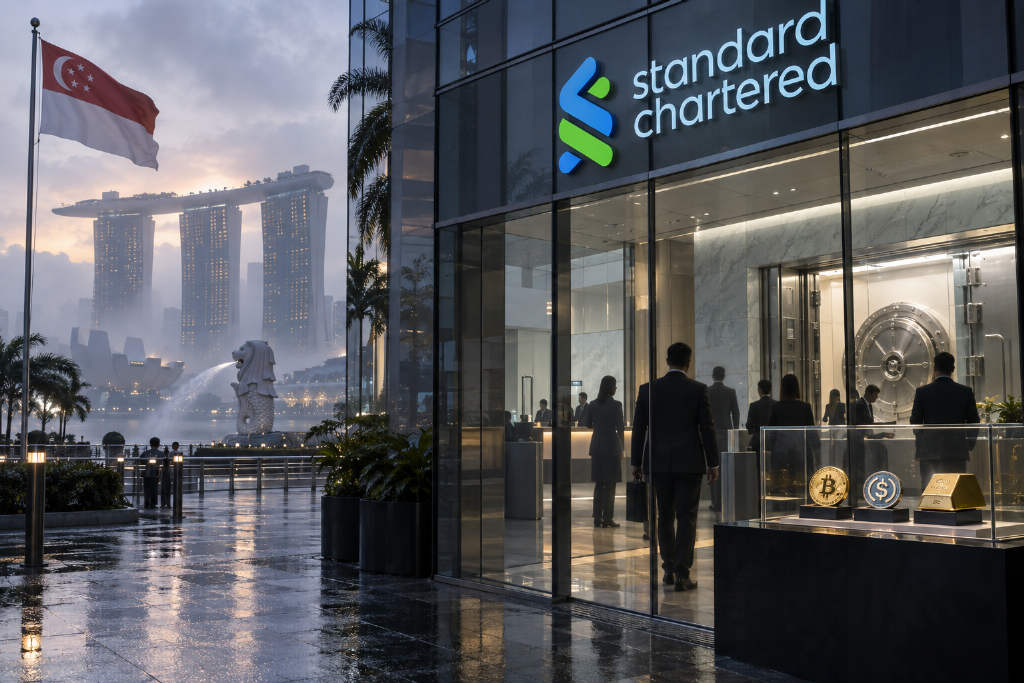
Standard Chartered has launched digital asset custody services in Singapore, allowing institutional clients and eligible corporate investors to hold Bitcoin, stablecoins, and tokenized real-world assets, or RWAs. In its official release, the bank said the new service will operate under local regulatory requirements and that the digital assets covered will go through a strict screening process.
Singapore is the first market for the service
With the launch, Standard Chartered becomes another major traditional bank to formally offer digital asset custody. The source article placed the bank alongside other financial giants that have already entered the segment, including Wells Fargo and JPMorgan.
Standard Chartered, which is headquartered in London and has long focused on Asia, described Singapore as a "leading financial and innovation hub" and an important part of its "global strategy." The choice of Singapore as the first market for the custody service fits that positioning.
The bank did not disclose the full asset list
Standard Chartered did not specify which digital assets will be supported by the custody platform. According to the source article, Cointelegraph asked the bank for details but did not immediately receive a response.
The same report said the industry expects the first batch of supported assets may include Bitcoin (BTC), Ether (ETH), and major stablecoins such as USDC, while the RWA portion may cover tokenized government bonds and fund products. Those assets, however, were not confirmed in Standard Chartered’s own announcement.
Crypto expansion has been building over the past year
This is not Standard Chartered’s first move into the sector. The article said that in May, the bank announced the acquisition of the core custody business of Zodia Custody and planned to spin out Zodia Solutions after shareholder approval, as part of an effort to consolidate its custody operations. The report described that deal as part of the groundwork for the Singapore launch.
Standard Chartered has also been expanding in the Middle East. Last month, the bank launched spot trading services for Bitcoin and Ether in the United Arab Emirates, covering institutional crypto trading and fiat payment infrastructure. In June, it also signed a banking partnership with crypto exchange CoinMENA to support fiat on- and off-ramps, client money accounts, and virtual account transaction management.
Singapore’s regulatory setup is a key factor
The source article said Singapore’s more developed crypto regulatory framework has made it a natural hub for digital asset finance in Asia. The Monetary Authority of Singapore’s Payment Services Act, or PSA, was cited as providing a clearer compliance path for digital asset service providers. By launching custody there, Standard Chartered can serve local institutional clients while also extending into Southeast Asia.
The report also said Asia’s crypto custody market is still in an earlier stage of expansion than North America and Europe. In Japan and South Korea, custody services are largely shared by domestic banks and crypto-native firms. Singapore, by contrast, has become one of the entry points for global institutions allocating to Asian digital assets because of its concentration of foreign banks and freer cross-border capital flows.
What the market will be watching next
The article said Standard Chartered’s move into Singapore sends two signals: traditional banks are shifting from deciding whether to engage with digital assets to deciding where to do it, and Asia, especially Singapore, is becoming a strategic base for institutional crypto services.
It also highlighted three points to watch next: the final list of supported assets, the pricing and compliance terms after the Singapore service goes live, and whether Standard Chartered can connect its crypto businesses in the United Arab Emirates and Singapore into a cross-regional custody network.