
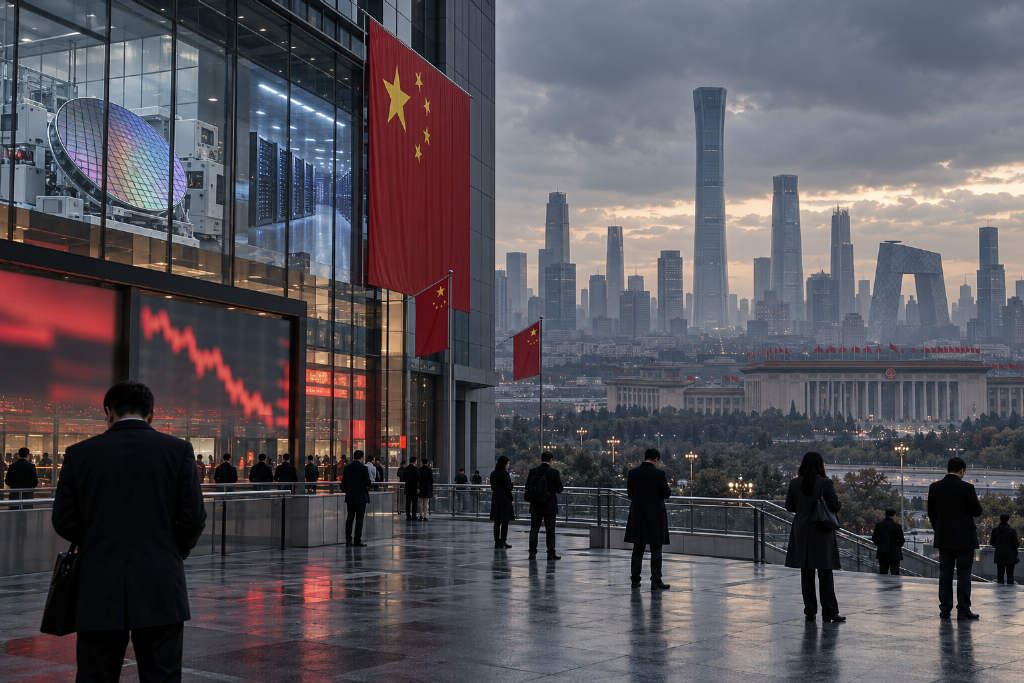
China’s STAR 50 index, which is concentrated in leading domestic AI and semiconductor companies, has dropped about 40% in less than four months, erasing more than $480 billion in market value, according to Reuters. Over the same period, the Nasdaq has pulled back only about 6% from the record high it reached three weeks ago.
The correction has gone beyond a sector selloff. It has also clouded Beijing’s effort to steer household savings into equities and support AI funding through a steadier “slow bull” market approach.
STAR 50 and CSI 300 both retreat
Reuters said the STAR 50 has lost more than 40% in four months, while the blue-chip CSI 300 has fallen about 20% from its June high. That has interrupted a two-year rise driven by expectations of stimulus policy and triggered panic among retail investors.
Goldman Sachs data cited in the report showed AI-related stocks account for 42% of China’s market capitalization and 57% of trading volume across A-shares and Hong Kong-listed H-shares. In a market dominated by retail participation, the AI trade had become so widespread that few investors were left untouched by the slump.
Beijing fund manager Dong Baozhen said China’s AI stock market had gradually turned into a “speculative crazy bull market,” and that the market is now seeing the bubble burst.
No single trigger behind the decline
The report said there is no clear single cause for the selloff. Traders pointed to elevated share prices, tax pressure, and the possibility that the United States or other countries could ban Chinese equipment from use in data centers.
Optical communications component makers have become a clear example of that external risk. Zhongji Innolight (300308.SZ) and Eoptolink Technology (300502.SZ) have each fallen about 60% from their June and July highs. Reuters said part of the pressure comes from Washington moving toward barring the two companies from supplying U.S. data centers.
Valuation remains another concern. The STAR 50 is still trading at roughly 100 times earnings. That is well below its peak near 250 times, but still far above the Nasdaq 100 at about 30 times. The market is questioning whether the idea of short-term pain followed by later gains can still hold, and whether the decline has further to run.
Former retail favorites lead the losses
Many of the hardest-hit names were once star listings that drew intense retail demand.
- Unitree Technology (688836.SS): retail subscriptions were oversubscribed by 8,000 times at listing, and the stock has halved since its August debut.
- ChangXin Memory (688825.SS): down more than 25% over the past month.
- Moore Threads (688795.SS) and MetaX (688802.SS): after surging about 400% and 700% on their first trading day last year, their market values have also been cut in half since July.
Hainan-based investor and entrepreneur Chen Wensheng said he bought into Unitree because a state fund had taken a stake and he believed that meant official backing. He said he and his friends are now sitting on losses. Reuters said the collapse of that belief — that an “official theme” could not lose — has dealt a heavy blow to confidence.
Beijing’s “slow bull” policy faces a test
The policy meaning of the correction may matter more than the size of the drop itself. In recent years, Beijing has tried to move China’s stock market away from boom-and-bust cycles and toward a steadier “slow bull,” including by tightening leverage and high-frequency trading. State-backed funds have also sold into rallies to cap gains. The violent rise and fall in technology shares has moved in the opposite direction.
Some investors have already shifted into defensive assets, and the market expects equity financing for technology companies to slow. Hong Hao of Lotus Asset Management said the decline would cause many companies waiting to go public to pause. Leo Wang of Qianchuang Capital criticized the heavy index weighting given to technology stocks, saying it distorted capital flows, created severe bubbles in some industries, and drained funding from others.
Investors remain divided on what comes next
There is still no consensus on whether the move should be seen as a bubble bursting or a valuation reset.
Wang Zhuo, a fund manager at Shanghai Zhuozhu Investment Management, said chip and AI suppliers would eventually be pulled into price wars and that all bubbles ultimately burst.
Others still see selective opportunity. Goldman Sachs kept Zhongji Innolight and ChangXin Memory on its updated recommendation list this month. BNP Paribas strategist William Bratton said the market pullback offers a buying opportunity for cautious investors. HSBC Research said Asian funds remain overweight China overall, even though they have been selling for the past three months.
Some industry participants also said the correction was not surprising and does not alter the long-term direction of reform. They added that reforms in recent years have improved stock market returns, especially dividend income.
Whether the bubble has fully burst remains unsettled
Reuters said China’s AI-related shares have clearly gone through a sharp bubble-style correction, but it is still difficult to say with certainty that the bubble has fully burst. For global investors, the direction of China’s AI stocks may also serve as an early signal for whether AI valuations worldwide have become overheated.



