
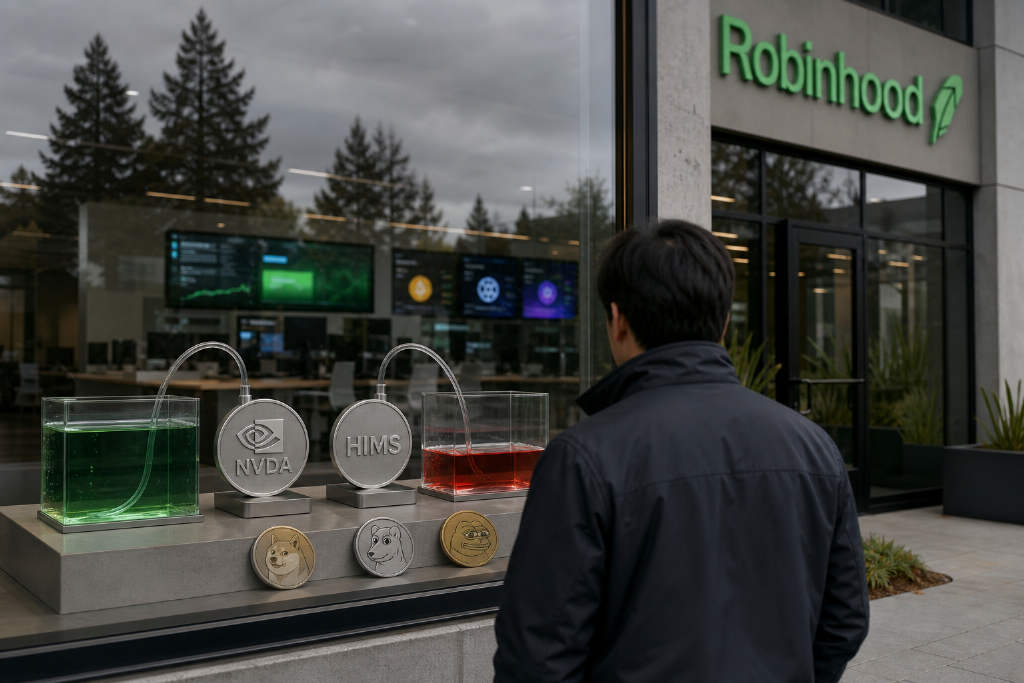
On-chain meme-coin trading is taking a new form. Issuers are using tokenized U.S. equities such as NVDA and GME as liquidity pools for newly launched Stock Meme tokens, creating what traders describe as a stock-and-coin pairing. The format has attracted intense activity on Robinhood Chain and produced squeeze-like moves and premiums, while leaving the assets exposed to depegging and sudden liquidity withdrawals.
The model departs from the more familiar meme-coin structure, in which ETH, SOL or USDT serves as the liquidity pool asset. Here, a tokenized equity becomes the other side of the trading pair. The meme coin’s market value is then tied to both the trading demand for the meme token and the dollar price of the underlying stock token.
How the pairing mechanism works
On Robinhood Chain platforms such as LONG.xyz, users can select a tokenized stock as the pool asset before issuing a meme coin. The examples listed in the source include NVDA, TSLA, HIMS, SPCX and GME.
When a retail trader uses ETH to buy one of these meme coins through the front end, the system first converts the ETH into the corresponding stock token on the back end. That stock token is then placed into the liquidity pool and used to exchange for the meme coin.
The meme coin’s dollar price is determined by two variables: how many stock tokens one meme coin can exchange for, and the dollar price of that stock token. Traders are therefore taking two positions at once. They are betting that the meme coin will outperform its underlying stock, while also taking on the price risk of the related equity itself.
Pairings reach market caps near $200 million
From late August to early September 2026, the pairing trend expanded rapidly on Robinhood Chain before spreading to public blockchains including BSC and Solana. Some traders used meme coins to lock up the floating supply of stock tokens on-chain. Because U.S. stock markets were closed over the weekend while on-chain trading continued, the stock tokens showed squeeze-like price action and substantial premiums.
Several pairings recorded sharp market-cap increases:
- AI / NVDA: The pairing reached a market capitalization between $100 million and $190 million at one point. Its community also introduced a mechanism to use fees to buy back and burn tokens.
- BONER / HIMS: The pairing centered on HIMS, a men’s health stock, and built its squeeze narrative during the weekend closure. Its market cap expanded from several million dollars to nearly $100 million.
- Rabbit / WYFI: Linked to the small AI infrastructure stock WYFI, the token exceeded a $10 million market capitalization shortly after launch.
SPCX and Micron, identified by the ticker MU, were also cited as targets of meme-coin speculation.
No 1:1 redemption for the underlying tokens
The price action comes with a structural risk that is central to the design. The meme coins have no 1:1 redemption relationship with their underlying stock tokens. In this arrangement, the stock token functions as a quoted asset. It is not collateral backed by fiat currency or by actual shares.
The structure effectively places the volatility and community-driven speculation of a conventional meme coin on top of the narrative and liquidity of tokenized U.S. equities. The buyer ultimately holds a meme-coin code. The asset is neither an actual share nor a regulated stock token.
Should trading interest fade, the tokens could face depegging, a rapid retreat in their premium and an abrupt withdrawal of liquidity. The source describes those risks as potentially more severe and faster-moving than those associated with conventional meme coins.