
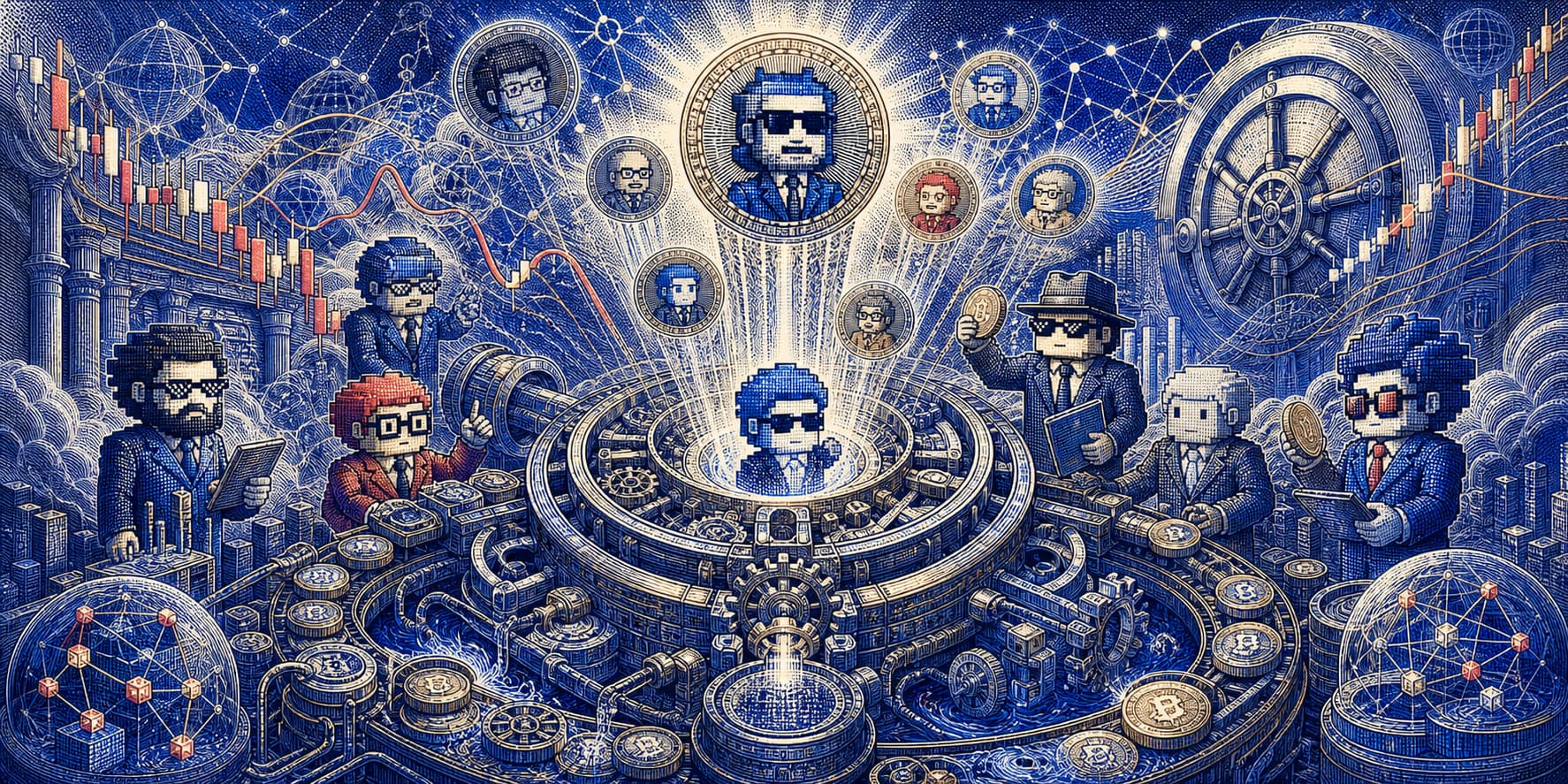
About a month after 4,444 StonkBrokers pixel broker NFTs first appeared onchain, the collection’s floor price has climbed to 13 ETH. Using that floor across the full supply implies a floor valuation above $100 million, though that figure is only a rough gauge of market heat because it assumes every NFT could be sold at the current floor.
The STONKBROKER token, which sits inside the same product system, has also been rising. According to GMGN data, its valuation at one point neared $100 million. What the market is pricing now is no longer limited to 4,444 profile-picture NFTs. It also includes the next layer StonkBrokers is trying to build out: the Stonk Launcher token launchpad and a trading protocol.
From wallet-enabled NFTs to a broader product stack
Foresight News had introduced the project on July 21, describing StonkBrokers as a package of NFT, token and DeFi products launched by Clutch Markets on Robinhood Chain. The core assets are the 4,444-piece StonkBroker NFT collection and the transferable ERC-20 token STONKBROKER.
Each StonkBroker NFT is tied to an ERC-6551 token-bound account. In practical terms, every NFT comes with its own onchain wallet that can hold tokenized stocks and other onchain assets. When the NFT changes hands, the bound account stays at the same address, but control of that account moves to the new holder.
At mint, each NFT received a one-time injection of stock tokens. After that, holders can pay STONKBROKER to activate the NFT and join Clock In rewards that are allocated by tier weighting. The process is described in simplified form as follows:
- NFTs are traded on Anvil and generate ETH fees.
- Seventy percent of those fees flow into StockBooster.
- Community users call Clock In.
- ETH is swapped into stock tokens.
- Those stock tokens are sent into the bound accounts of activated NFTs.
The original question StonkBrokers set out to address was whether an NFT could come with its own wallet, receive token rewards and then move into trading and lending markets. Stonk Launcher is positioned as the next step, extending that system into token issuance and liquidity infrastructure for outside projects.
Stonk Launcher is scheduled for Aug. 11 at 8 p.m. ET
According to the project page, Stonk Launcher will open at 8 p.m. Eastern Time on Aug. 11, which corresponds to 8 a.m. Beijing time on Aug. 12.
At its core, Stonk Launcher is a token launch platform on Robinhood Chain. It lets creators deploy ERC-20 tokens and choose how they want to sell them. The currently available materials list three main issuance modes:
- Fixed price: tokens are sold during the sale phase at a preset price.
- Bonding curve: token prices move according to bonding-curve rules and change with trading activity and curve state.
- Custom issuance: creators can further modify token supply, denomination and related parameters.
Launching a sale costs 0.00042069 ETH. Tokens can be paired with ETH, STONKBROKER or Robinhood stock tokens.
The project documentation sets a default graduation threshold at four units of the paired asset. That does not necessarily mean 4 ETH. If another paired asset is used, the threshold is measured in that asset, and custom issuance may alter the setting.
Completed launches feed into Uniswap V3 liquidity and staking vaults
The full flow described for Stonk Launcher starts with creating an ERC-20 token and sale parameters. Users buy during the sale period. Once preset conditions are met, the launch moves into the Finalize stage, where the system creates a Uniswap V3 liquidity pool, an LP position, a fee-distribution contract and a token staking vault.
Every completed launch is also meant to have its own staking vault. Under the current design, token holders can deposit that token into the vault and receive a proportional share of LP fees routed in from the fee-distribution contract. Public materials have not listed the full fee split, however, and actual returns would depend on trading volume, liquidity depth and LP position performance. The project does not frame this as fixed yield.
Stonk Launcher is also planned to connect with the yet-to-launch Stonk Exchange. Tokens that complete issuance can apply to trade, or enter trading, on that vDEX. Stonk Exchange is currently scheduled to open at 8 p.m. Eastern Time on Aug. 29. It is expected to use a Uniswap V3 structure, with STONKBROKER holders taking part in deciding where some fees and liquidity incentives are directed.
up joins as a Special Projects partner
Before the public opening of Stonk Launcher, Clutch Markets on Aug. 11 introduced up, described as a native (3,3) trading and liquidity layer on Robinhood Chain, and named it as the latest Special Projects partner.
Under the plan released by both sides on Aug. 11, up will provide trading and liquidity infrastructure for Stonk Launcher and Stonk Exchange. Tokens that complete issuance through Launcher will, by default, enter up liquidity pools and trade through the StonkBrokers frontend.
Opening Bell routes part of curve-trading fees back into token buys
The most distinctive feature in the Stonk Launcher design is Opening Bell Buybacks, a system of random market purchases funded by bonding-curve trading fees.
Project documents say that every bonding-curve trade pays a Launcher fee, and part of that fee goes into an onchain pool called the Buyback Bar. Once the pool reaches the required condition, the protocol uses a VRNG-based random mechanism to decide two things: when Opening Bell can be triggered, and which token that is still in the bonding-curve phase will be bought.
Opening Bell only applies to tokens that use the bonding-curve mode and have not yet graduated. Projects that have already moved into a Uniswap V3 liquidity pool, along with tokens issued through fixed-price or other formats, are outside the random selection set.
The probability that a token is chosen is tied to how much fee contribution it has made to the Buyback Bar. The more active the trading and the greater the fee contribution, the higher the theoretical selection weight, though every live curve token remains eligible.
Once Opening Bell becomes triggerable, any user can pay gas to call Clock In. The protocol then uses assets from the pool to make a one-time buy of the selected token on the bonding curve, while the caller receives a tip reward.
The design is meant to redirect part of trading fees back into the Launcher token market instead of letting all fees leave the issuance system immediately. Still, the term buyback does not mean the project is promising price support. Purchases happen only when conditions are met and the random process selects a token. They are neither fixed in frequency nor spread evenly across all assets.
The current documentation also does not disclose what portion of each bonding-curve trade actually enters the Buyback Bar. Whether Opening Bell can produce buying pressure with lasting effect will depend on final contract settings and real trading activity after launch.
DERP and MANCER appear on the page before public opening
Even though Stonk Launcher has not opened to the public yet, its page already displays DERP and MANCER. Both are listed as StonkBrokers Special Projects, meaning they are independent incubation partners connected in advance.
The page specifically notes that DERP and MANCER are each developed and operated by their own teams, with separate tokens and separate risk, and should not be treated as proprietary Clutch Markets products.
DERP ties NFTs, browser proof-of-work and randomness infrastructure together
DERP is linked to a product called StonkPit. It is described as an onchain mining system that connects StonkBroker NFTs, PitBoy NFTs and browser-based proof of work. The article states that PitBoy NFTs come from MineBoy and are bridged from ApeChain through LayerZero. The system also uses onchain entropy and verifiable random number generation, or VRNG.
Unlike ordinary token mining, DERP is not only a reward token. It is also designed as an economic layer for an onchain randomness service.
After activating StonkBrokers and PitBoy NFTs, users can run SHA-256 hash computations in the browser and submit proofs. Once valid proofs are verified by contract, participants receive DERP, and the resulting output is fed into The Ticker public entropy system. The Conductor handles entropy requests from external applications and returns random outputs to onchain games or other contracts that need randomness.
That makes DERP more than a simple reward mechanism. It is designed to connect mining zones, entropy demand and random-number services. The project has two mining zones: StonkBrokers participate in the green zone, while bridged PitBoys participate in the blue zone.
DERP has a maximum supply of 4.444 billion tokens. Of that total, 75% is allocated to the green zone, 15% to the blue zone, and the remainder to partners, liquidity and game funding, among other uses.
MANCER is building a DEX protocol around off-vault orders
MANCER refers to the Mancer trading protocol, the MANCER token and Chain Mancers NFTs. According to the Mancer white paper, the team plans to build a decentralized trading protocol on Robinhood Chain that supports token swaps, limit orders and recurring buys.
A key part of the design is that users do not need to deposit full funds into a protocol vault when placing an order. Instead, they sign an EIP-712 order. Assets remain in the user’s own wallet, and the settlement contract only pulls the amount needed if and when the order is actually filled.
Mancer also plans a 5,000-piece Chain Mancers NFT collection, which currently has a floor price of 1.3 ETH. Under the white paper design, orders at launch will be processed by permissioned executors. Each fill carries a 10 basis point protocol fee, or 0.1%, and a 5 basis point tip, or 0.05%, paid to the executor.
If a Keeper network goes live later on, activated Chain Mancers would become eligible to execute orders. A Keeper that completes a fill would receive the 5 basis point execution tip, while the 10 basis point protocol fee is planned to be converted and distributed to activated NFTs.
CLOCKIN has publicly confirmed plans to launch through Stonk Launcher
Beyond DERP and MANCER, another project already publicly confirmed for Stonk Launcher is Clock In.
Clock In describes itself as a theme token derived from StonkBrokers community culture, while also stressing that it operates as an independent, community-run brand. The plan is to create trading pools for CLOCKIN against ETH, STONKBROKER, APE and stock tokens including TSLA, NFLX and AMZN.
CLOCKIN itself does not impose a token trading tax. Its tokenomics are mainly tied to fees generated by permanently locked LP positions. Under the published plan, 20% of those LP fees would go to participating StockBooster brokers, 20% would be used for further development, and 60% would be used to buy back and burn CLOCKIN in the open market.
The project also plans to reserve 2% of total supply, equal to 20 million tokens, for four rounds of rewards to activated StonkBroker NFTs. The four rounds correspond to CLOCKIN reaching and sustaining market capitalization thresholds of $1 million, $3 million, $5 million and $7 million. Each round distributes 5 million tokens. Starting from the second round, holders must also own a specified amount of CLOCKIN for each NFT they enter.
TickerYard is taking a separate path
TickerYard needs to be handled separately. Its technical design paper does not clearly say that YARD will be issued through Stonk Launcher. Instead, it proposes using Anvil to build a market centered on 3,333 Yardkeeper NFTs and the YARD token.
TickerYard wants to create a cross-chain asset routing interface. Users would specify the source asset, the target network and the asset they want to receive. The system would then search external cross-chain protocols and liquidity channels for available routes and display cost, time and security assumptions. The project names tokenized stocks as its first major focus. It also outlines a later plan to lock eligible assets on their native network through standardized vaults and mint corresponding representations on other supported chains.
Yardkeeper NFTs are designed as transferable protocol-participation seats. Under the current setup, a holder may qualify for certain protocol tasks only after reaching a designated Anvil activation level, completing Keeper Enrollment and binding a local Runner.
StonkBrokers is pushing past NFTs into issuance, incubation and trading
Based on the information disclosed so far, StonkBrokers is trying to expand its product boundary from wallet-enabled NFTs that receive stock-token rewards into a wider system that includes token issuance, ecosystem incubation and a trading protocol.
If Stonk Launcher is delivered on schedule, the role of STONKBROKER would extend beyond NFT redemption and activation into token pairing, platform curation and the later vDEX environment. Until the product is live and has been running for some time, though, any judgment about volume, fee revenue or a broader flywheel remains limited to mechanism design rather than observed performance.
Foresight News also noted that the Robinhood Chain ecosystem is still at an early stage. StonkBrokers NFTs, STONKBROKER and tokens created through Launcher may all face risks including thin liquidity, sharp price swings and smart-contract flaws. Partner projects such as DERP, MANCER and CLOCKIN are run by independent teams, and being displayed or incubated through StonkBrokers does not amount to a guarantee of security, liquidity or token value.
The article’s final message was straightforward: participants still need to verify project information on their own and assess the risks carefully.