
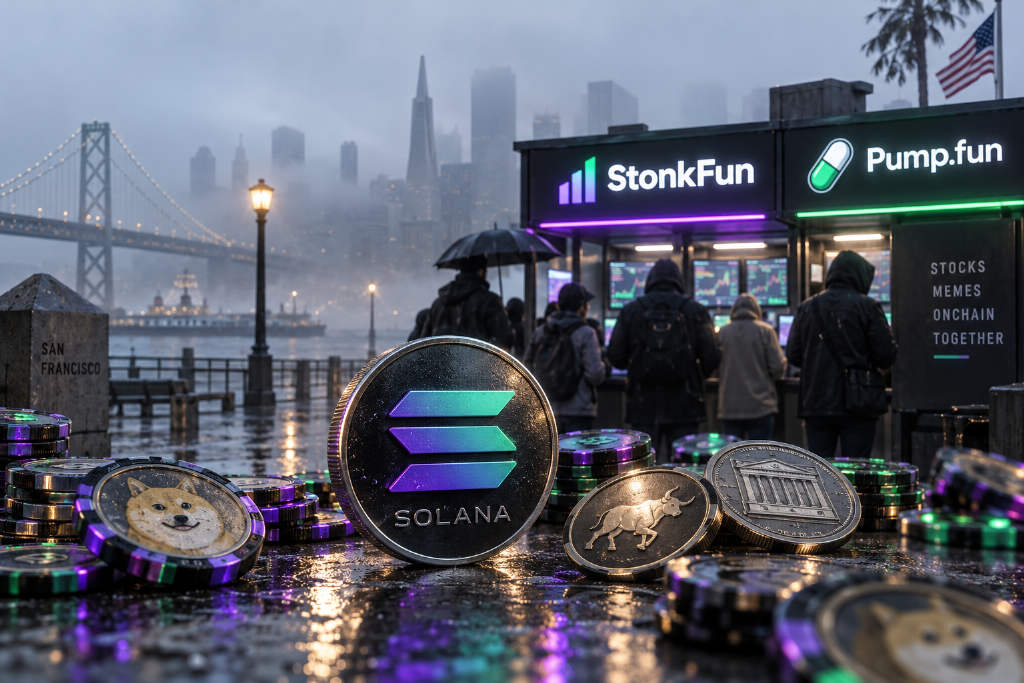
StonkFun has turned tokenized stocks into a trading currency for meme coins on Solana, creating a surge in volume while converting very few users into actual stock investors.

Research from 0xResearch, translated and published by TechFlowPost, found that meme trades priced in tokenized stocks accounted for 31.5% of tokenized stock DEX volume on Solana from Sept. 1 to Oct. 11. That came to $1.76 billion out of the $5.58 billion tracked in the study. The researchers estimated that about four-fifths of that total was driven by StonkFun-linked tokens.
The report frames the trend as a test of how attention becomes liquidity. Meme traders are being routed into tokenized stock pools, with stock tokens functioning as the quote asset. That structure multiplies turnover, but less than 2% of users ultimately become investors buying tokenized stocks to hold them as stock exposure.
Meme pairs priced in tokenized stocks gained traction quickly
Pump has moved ahead of StonkFun in this market segment. After launching custom trading pairs on Sept. 9, Pump captured about one-quarter of the volume in its first week. By the week ended Oct. 11, that share had risen to 58%, equal to $125 million out of $216 million. Its daily volume increased from about $10 million to $18 million over the period, while StonkFun dropped from about $42 million to $13 million.

Every meme trade in these pools is counted as tokenized stock volume because the stock token sits on the quote side of the pair. Buyers entering with SOL or stablecoins must pass through those pools before they can acquire the meme token.
SpaceX and SPCX show how the model works
The report highlighted SpaceX as the clearest recent example. Custom pairs allowed meme coins to trade directly against SPCX, Sunrise’s tokenized SpaceX asset. Pump’s share of trading in tokens issued through Sunrise rose week by week from about 5% to about 12%, with SPCX contributing more than 80% of that increase.
On Oct. 10, meme/SPCX pools on Pump recorded about $20 million in trading, or roughly 38% of all SPCX DEX volume. About half of that came from two newly issued Super Intelligent Beauty tokens.

The effect also spilled into other DEX venues. On Oct. 10, more than $18 million of SPCX swaps elsewhere shared the same transaction as a Pump meme swap. The report said that reflected routing paths more than fresh demand for SpaceX itself. Separately, a StonkFun SpaceX meme traded against another token on Raydium, where daily volume held near $2 million to $3 million.
Reward token distribution reached more than 360,000 wallets
Reward tokens have also been used to pull meme traders toward stock tokens. Between Aug. 3 and Oct. 11, reward distributions sent about $31 million in tokenized stock assets to more than 360,000 wallets. About four-fifths of those wallets had no prior record of buying stock tokens. According to the study, this theme helped triple the number of tokenized stock holders on Solana in September.
Most recipients did not keep what they received. Among 289,000 wallets that had never bought tokenized stocks before, 82% sold the tokens or moved them elsewhere. Of the 18% that kept them, most held only small balances.

Very few users bought tokenized stocks to hold them
Only a small share later bought tokenized stocks directly. Roughly one-sixth of recipients did go on to buy stock tokens, but the report said those purchases were mainly used to buy meme coins priced in the stock asset rather than to gain stock exposure. Within that group, only about 2% ended up buying tokenized stocks for the purpose of holding the stock itself.
That leaves a clear imbalance in the market structure described by 0xResearch. StonkFun and Pump.fun have succeeded in turning tokenized stocks into meme trading currency, lifting volume and distributing small stock-token balances to hundreds of thousands of wallets. But the audience remains dominated by meme traders, not by a wave of new equity investors entering through tokenization.
Attention, meme demand and stock-token liquidity now feed each other
The report also pointed to a positive feedback loop connecting two active parts of Solana trading: real-world companies drawing attention and meme markets built around those names. When a company becomes a talking point off-chain, related meme tokens tend to appear, and those memes can now trade against that company’s tokenized stock.

Because each meme trade routes through the stock token, meme attention adds turnover and liquidity to tokenized equities. Reward tokens, in turn, give users an asset they can hold. The study described this as a form of synergy enabled by Solana’s composable trading environment.
SPCX provides the largest example in the dataset. Sunrise’s tokenized SpaceX asset has generated $1.56 billion in cumulative DEX volume on Solana, led by Zerofi. Since custom pairs went live on Sept. 9, SpaceX-themed meme trading on Pump has contributed about $56 million of that total.
Sam Schubert of 0xResearch left two open questions: how long this synthetic demand created by attention can last, and whether tokenized stocks will develop into standalone assets or remain attached to meme trading as a quote currency.




