
Inflation data and oil are back at the center of the macro trade
Bitget UEX said in its Aug. 11 daily report that markets are entering a key week for U.S. inflation data. After July nonfarm payrolls came in well below expectations, traders cut back near-term expectations for further rate hikes. Even so, the next round of pricing for Federal Reserve policy now depends heavily on the upcoming Consumer Price Index and Producer Price Index releases.

The report said the latest rise in oil prices, tied to a standoff around the Strait of Hormuz, could push inflation expectations higher again. That leaves markets balancing weaker employment data against rising energy costs. For now, the Fed path remains uncertain, and sensitivity to incoming macro data is rising.
Trump says the U.S. has “100% control” of the Strait of Hormuz
In the commodities section, the report said Donald Trump stated that the U.S. Navy is the only force controlling the Strait of Hormuz. He described the blockade as 「impeccable」 and 「like an iron wall」, adding that the entire strait had been cleared of mines. According to the report, the waterway is open to non-Iranian vessels, but they are not allowed to enter Iranian ports.
Trump also demanded compensation from Iran for casualties and losses related to the conflict, adding a fresh complication to any talks on reopening the strait. Iran, for its part, reiterated its own conditions for reopening and said an agreement with Oman on a new route was close to completion.
Bitget UEX said uncertainty around actual shipping access remains in place. In its view, the rebound in oil has revived both inflation concerns and the geopolitical risk premium, leaving the energy market vulnerable to sharper near-term swings.
U.S. stocks slip as tech and energy diverge
U.S. stocks pulled back modestly on Monday as higher oil prices fed inflation worries. The Dow Jones Industrial Average closed around 53,976, down 0.1%. The S&P 500 ended near 7,753, also down 0.1%. The Nasdaq closed around 26,605, off 0.3%.
The report said Intel may sell $15 billion in stock to support its AI and manufacturing businesses, which weighed on its shares. Berkshire Hathaway and other companies that beat earnings expectations were described as relatively stable. The broader read was that geopolitical tension and inflation expectations are setting the tone, with money rotating between energy and technology while investors stay cautious overall.
Among the megacaps, Nvidia was around $217.55, down 2.86%. Apple was around $308.26, down 1.62%. Microsoft rose 1.21% to about $506.06. Alphabet gained 0.91% to roughly $357.52. Amazon added 1.32% to about $278.09. Meta rose 0.48% to roughly $594.92, and Tesla climbed 0.70% to about $330.88.
Bitget UEX said Monday’s pullback was mild at the index level, but weakness was more visible in the Nasdaq. Nvidia and Apple came under pressure, while Microsoft, Amazon, Alphabet, Meta and Tesla finished higher. The report said weaker labor data had previously helped rate-cut expectations, but the oil move shifted attention back to inflation risk and forced markets to weigh geopolitical headlines against incoming data.
Commodities and FX snapshot
The report listed spot gold at about $4,414 an ounce, up 0.6%, and spot silver at about $65 an ounce, up 0.2%. WTI crude was around $82.2 a barrel, up 0.07%, while Brent was around $83.98 a barrel, up 0.12%. The U.S. Dollar Index stood near 99.75, down 0.06%.
Its explanation was straightforward: Trump’s claim that the U.S. has 100% control of the Strait of Hormuz and is maintaining a blockade, along with disagreement over compensation, kept the reopening outlook uncertain and supported oil prices. Gold, meanwhile, moved higher more cautiously as safe-haven demand and the dollar pulled in different directions.
The report framed the cross-asset chain this way: geopolitical deadlock leads to higher oil, higher oil lifts inflation expectations, and firmer inflation expectations support the dollar while adding pressure to risk assets. In the short run, commodity volatility is likely to hinge on actual shipping progress through the strait and this week’s inflation releases.
Crypto recap: BTC slips, spot ETF flow turns negative on a 24-hour basis
In crypto, BTC was quoted at about $64,037, down 1.55%. ETH was listed at around $1,874, with the report showing 2.12%. Total crypto market capitalization was about $2.27 trillion, down 0.4%.
Liquidation data in the report showed $205 million in total liquidations over 24 hours, including $59.25 million from short positions.
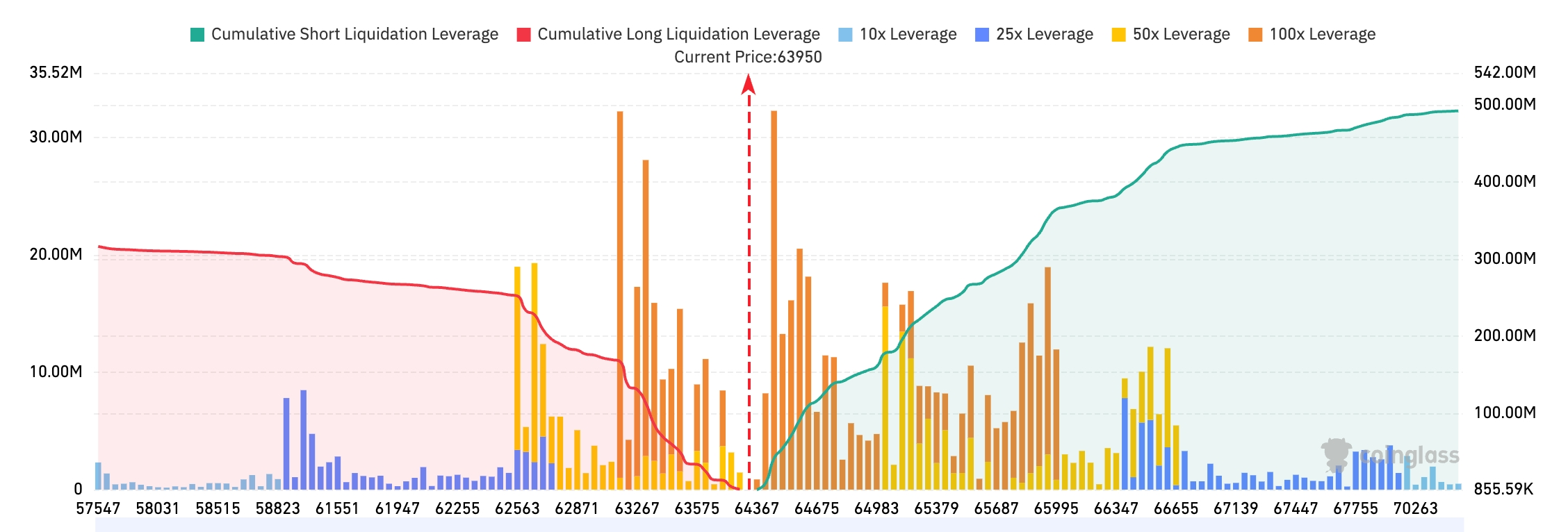
Bitget’s BTC/USDT liquidation map put spot BTC around $63,950. It highlighted dense long liquidations between $63,300 and $63,700, saying a drop below $63,500 could trigger a chain of long unwinds. On the upside, short liquidation pressure was described as significant between $64,300 and $65,000. A break above $64,400 could push a further short squeeze, leaving near-term volatility elevated.
The report also showed a dynamic net outflow of $91 million for spot BTC ETFs over the past 24 hours.
Bitget UEX said the jump in oil prices and the rise in geopolitical uncertainty have reduced risk appetite, but the crypto market is still holding in a high-level range. The report said BTC remained above $64,500, ETH showed limited elasticity, and continued ETF inflows were still providing support, while leverage-driven liquidations remained manageable. It added that weaker employment and higher oil prices are offsetting each other at the macro level, so crypto may continue range trading in the short term, with this week’s inflation data likely to shape expectations for liquidity.
Sector moves: energy up, semis down, cloud software holds up better
Energy
The report said oil and energy names broadly moved higher, with some stocks among the day’s stronger performers. The main driver was Trump’s statement that the U.S. has 「100% control」 of the Strait of Hormuz and is maintaining the blockade. Combined with unresolved disagreement over compensation, that has pushed the market to price in more geopolitical risk. Near-term direction still depends on negotiations and on whether shipping access is actually restored.
Semiconductors
Semiconductor stocks pulled back, with Nvidia down 2.86% and other chip names also retreating. Bitget UEX said the rise in oil linked to the Hormuz standoff revived concerns that inflation could reaccelerate and influence both liquidity conditions and the Fed’s policy path. A weak payrolls report had previously helped sentiment recover, but that macro narrative changed quickly, leading investors to take profits and adjust exposure in high-valuation AI hardware names.
Cloud software
Cloud and software stocks were steadier. Microsoft rose 1.21%, and Amazon gained 1.32%. The report said that in an environment shaped by geopolitical uncertainty and higher inflation anxiety, capital is leaning toward companies with revenue already showing up and commercialization paths that are easier to see. Continued strength at Azure and AWS gave cloud leaders more defensive characteristics relative to volatile, expensive hardware names.
Single-stock read-through
Nvidia (NVDA)
Nvidia fell about 2.86% to $217.55, making it one of the weaker performers among the large technology names. The report said investors are worried that the Hormuz standoff could lift oil and reignite inflation expectations, which would then affect liquidity conditions and the Fed path. As a high-valuation, high-beta leader in AI compute, Nvidia tends to come under pressure quickly when inflation concerns reappear.
Bitget UEX said the key things to watch now are how CPI and PPI affect inflation expectations and whether major customer capex guidance continues to support the AI demand narrative. Volatility could pick up around those releases.
Apple (AAPL)
Apple dropped about 1.62% to $308.26 and underperformed most megacap peers. The report said consumer electronics and hardware companies often show less upside when risk appetite narrows and money rotates toward cloud and software names. In the near term, the market is more focused on marginal changes in hardware demand and on whether AI features can materially influence upgrade cycles.
Future watch points listed in the report include the product cycle, the durability of services growth, and the real effect of Apple Intelligence and related AI features on user upgrade behavior.
Microsoft (MSFT)
Microsoft rose about 1.21% to $506.06 and held up well during the broader tech pullback. The report said sustained upside in Azure growth and more visible commercial execution in AI have made Microsoft one of the higher-conviction names in the sector.
With oil rising and inflation worries building, investors are paying a relative premium for cloud and software leaders that have clearer revenue realization. Bitget UEX said the next question is whether cloud growth can keep absorbing capex and whether AI-linked revenue contribution becomes more visible.
Amazon (AMZN)
Amazon gained about 1.32% to $278.09 and outperformed hardware names. The report said AWS growth and the long-term logic behind AI infrastructure spending continue to support the stock. In a market dealing with geopolitical and inflation uncertainty, investors are leaning toward companies that already show revenue traction and have clearer commercialization paths.
The report said attention should stay on whether AWS growth can continue to justify capex, and on how retail and advertising perform during broader macro volatility.
Tesla (TSLA)
Tesla rose about 0.70% to $330.88 and traded relatively steadily. Bitget UEX said Tesla still carries multiple narratives at once, including electric vehicles, autonomous driving and humanoid robotics. That gives it high-beta characteristics: the stock tends to respond strongly when risk appetite improves quickly, but upside can also be capped when macro uncertainty rises or sentiment cools.
The report said investors should keep tracking delivery data, self-driving progress and the pace of Optimus commercialization to test how the longer-term story is developing.
Market and project developments
The U.S. Securities and Exchange Commission is scheduled to hold a public meeting at 10:00 a.m. Eastern Time on Aug. 14 to consider whether to issue a new rule proposal that would create a tailored issuance regime for certain investment contracts involving crypto assets.
A whale moved 1,275 BTC, worth about $81.5 million. Of that, 500 BTC worth about $32 million went to FalconX, 274 BTC worth about $17.5 million went to Cumberland’s OTC platform, and another 500 BTC worth about $32 million was sent to a new address that the report said could later be connected to Galaxy Digital.
Futures whale account 「先定 10 个大目标」(@jasonleo) wrote that its medium- and long-term trend view has not changed and that the current area is still seen as a staged bottom. Barring an extreme structural collapse, the account said it still places BTC’s bottom area for this cycle near $58,000. It also said it cut two-thirds of its position around a $64,000 cost basis not because its directional view changed, but to manage risk and preserve room for extreme scenarios. If price action develops as expected, it plans to buy back the reduced exposure over time.
Strategy CEO Phong Le said the company has adjusted its strategy and now holds $4.75 billion in cash, enough to cover roughly 2.7 years of preferred share dividends. Le said he had initially thought investors would place strong value on bitcoin because of its liquidity and long-term appreciation, but institutional investors care more about cash, which led the company to adjust. He described Strategy as a financial platform built around bitcoin rather than simply a leveraged bitcoin proxy, with the goal of becoming the 「JPMorgan of digital finance」. He also outlined an iPhone-like ecosystem in which other companies could build financial products on top of Strategy’s offerings. Le said DeFi could expand that ecosystem and ultimately bring more capital into bitcoin. The company currently holds about 840,000 BTC, roughly 4% of the final supply. Le said, 「we are now a bellwether, the central bank of bitcoin.」
Bitwise Head of Research Ryan Rasmussen said Circle is undervalued as the stablecoin market expands toward the trillion-dollar range. He expects the market to grow from about $300 billion to $3 trillion to $5 trillion. In his view, Circle has a first-mover advantage because of its current market share as U.S. stablecoin regulation takes shape. He said Circle will not only be a stablecoin giant but also a payments giant, and that the payment infrastructure it is building will play a key role in a financial system driven by stablecoins, even as investors remain too focused on its reserve business.
BlackRock Head of Digital Assets Robert Mitchnick said bitcoin sentiment has improved noticeably, though subtly, over the past month, and that bitcoin’s correlation with U.S. equities is declining. He said that is healthy for the case that bitcoin can serve as both a diversification tool and a tail-risk hedge in portfolios. He pointed to bitcoin’s outperformance during July’s sharp AI-sector pullback as evidence of that decoupling. Despite bitcoin being down nearly 30% this year and about 50% versus a year ago, ETF investors have kept buying. U.S. spot bitcoin ETFs brought in $853.5 million last week, the best weekly showing since mid-April. BlackRock’s IBIT accounted for $693.7 million, or more than 80%, while Fidelity’s FBTC contributed $116.4 million. Bloomberg analyst Eric Balchunas said that after a Coldcard vulnerability was disclosed, multiple funds recorded daily net inflows, adding that it was 「hard not to see causality」.
According to people familiar with the matter, OpenAI has completed an employee share sale worth about $7 billion as the company considers a Wall Street listing. Two people familiar with the matter said the ChatGPT developer did not bring in outside investors for this employee tender, instead buying back shares held by current and former employees itself. The transaction valued OpenAI at $852 billion, unchanged from its most recent funding round.
This week’s calendar
The report listed U.S. CPI and PPI data, along with developments in shipping through the Strait of Hormuz, as the week’s top watch items.
Tuesday, Aug. 11
The U.S. is due to release ADP employment change for the week ending July 25 and July existing home sales. Super Micro Computer, CoreWeave and Lumentum are scheduled to report after the close, with attention on AI server order conversion, data-center deployment, electricity, financing costs and demand for 800G and 1.6T optical modules and data-center optical communications. Sea and Tencent Music are due before the open, while CAVA reports after the close.
Wednesday, Aug. 12
The U.S. will publish July CPI. The report gave market expectations of about 3.4% year over year for headline CPI versus 3.5% previously, 2.5% for core versus 2.6% previously, and around 0.1% month over month for headline and 0.2% for core. Bitget UEX said this is the most important macro release of the week after payrolls and is directly tied to pricing for the Fed’s September rate decision, where the implied probability currently stands near 44%.
Tencent Holdings is also due to report, with focus on gaming, advertising, fintech and AI capex as well as progress for Hunyuan. Coherent, Cisco and Nebius are also on the earnings calendar, while API and EIA crude inventory figures and monthly IEA and OPEC reports are set to be released.
Thursday, Aug. 13
The U.S. will release July PPI and weekly initial jobless claims. SanDisk will host its investor day, with investors watching NAND supply and demand, capex, its high-bandwidth flash roadmap and long-term margin targets. Google is set to hold its Made by Google event covering the Pixel 11 series, wearables and deeper Gemini integration. Fed officials Hammack and Barkin are scheduled to speak. Applied Materials reports after the close, and earnings from JD.com, SMIC and Hua Hong are also due.
Friday, Aug. 14
The U.S. will publish July retail sales, the preliminary August University of Michigan consumer sentiment index and one-year inflation expectations, offering another test of consumer resilience after cooling employment data. It is also the deadline for U.S. institutions to disclose Q2 13F holdings, which could show how large funds have shifted allocations across sectors such as technology and energy.
The report said the main U.S. equity themes this week are July inflation, the Fed’s September policy path, and a heavy slate of earnings and events tied to the AI infrastructure chain and memory names. It also noted that rate-hike expectations cooled after payrolls unexpectedly fell by 23,000 last week. If CPI and core inflation continue to ease while consumption stays resilient, soft-landing trades and growth stocks could keep running. If not, tighter pricing could return and test high-valuation sectors.
Analyst view and disclaimer
In its analyst-view section, the report said the market broadly sees Trump’s claim of 100% U.S. control over the Strait of Hormuz, together with the ongoing blockade, as a reason the reopening outlook remains unclear. Oil’s move higher has revived inflation concerns and offset part of the easing in rate expectations that followed weaker labor data. U.S. stocks have pulled back modestly, leadership inside tech has split further, cloud and software have been more resilient, hardware has lagged, and crypto has stayed range-bound with ETF flows still offering support.
The report also carried a disclaimer saying the material was compiled with AI search and manually verified for publication, does not constitute investment advice, and may contain data discrepancies. It said real-time market data should prevail.