

MarsBit on July 21 published a commentary by columnist Zuoye Waiboshan that examines Stripe, PayPal, stablecoins and the structure of the payments business. The article’s main argument is blunt: there is no single “first principle” in payments because the sector remains fragmented and ultimately tied to the banking system.
The author opens with Stripe’s renewed attempt to acquire PayPal and places that move in a longer industry timeline. The piece says the last comparable moment came 30 years ago, when Peter Thiel’s PayPal combined with Elon Musk’s original X.com.
Stripe’s missed IPO window and its turn toward acquisitions
The commentary argues that Stripe made a major mistake by not going public during the pandemic era. It says Stripe reached a $100 billion valuation for the first time during the liquidity boom, but did not follow companies such as Coinbase into the public market. Its valuation then fell repeatedly, pushing the company to rethink its path and lean into acquisitions.
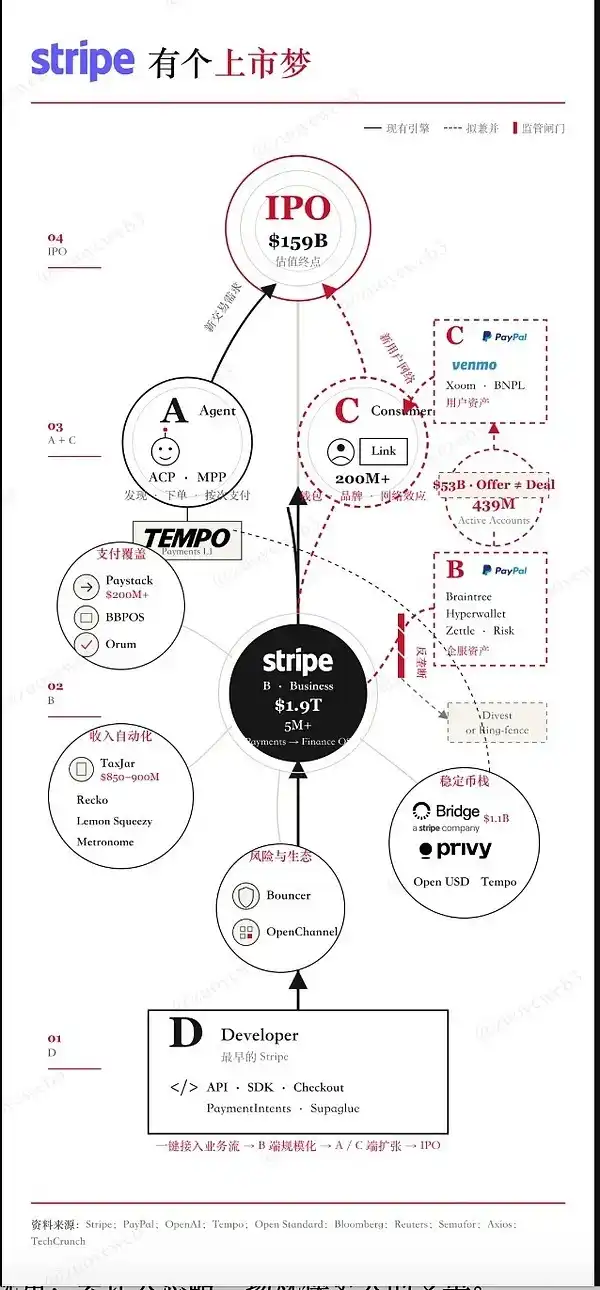
According to the article, Stripe’s early rise came from a developer-friendly model built around one-click API integration. That approach worked because Stripe targeted the people who actually built and maintained payment systems rather than focusing only on pricing or narrow payment scenarios.
The piece says Stripe has tried to reuse that formula across several fronts: merchant acquiring on the B side, stablecoins on the consumer side, and ACP and MPP protocols on the agent side, all with the stated aim of reshaping payments.
Two structural limits: fragmentation and dependence on banks
The article says Stripe’s path is blocked by two long-standing features of the industry. First, payments remain highly fragmented. In the author’s view, a company can survive for years by controlling one country, one industry segment or even a few corporate relationships, which makes the sector difficult for outside forces to consolidate by sheer scale.
Second, payments still function as an extension of banking. The commentary says developer tools and enterprise-facing workflows are ultimately outward expressions of bank processes, and stablecoins will also be drawn into the banking system over time.
That is why, the article argues, Stripe’s stablecoin-related acquisitions and expansion plans — including Bridge issuance, Privy as a wallet entry point, and Tempo and OpenUSD — are unlikely to recreate Stripe’s earlier growth story.
The PayPal bid as a way to fill Stripe’s consumer gap
The piece describes the proposed PayPal acquisition as a stage result of Stripe’s limited success in opening up the consumer market through stablecoins. In that reading, Stripe is trying to use PayPal’s consumer business to make up for what it lacks on the C side.
The author does not frame PayPal’s problem as a failure to keep up with the times. Instead, the article says products from Venmo to PYUSD have not stopped the company’s decline, and argues that PayPal’s larger issue is structural exhaustion across the business rather than a simple shortage of new products.
Stripe, which moved later on some of these fronts, is presented as still searching for more narrative support before any eventual IPO.
Stablecoins and agent payments have not yet broken through
The article says Stripe once captured the developer market by wrapping the back end, while stablecoins attempt to wrap the front end. Even so, the author argues that the story around issuance networks is probably nearing its end. In the piece’s words, Tempo and OpenUSD may hit Circle’s stock price, but they will not move Tether.
From there, the commentary makes a valuation argument. If Stripe’s ceiling is only the range represented by Coinbase or Circle, then a weak public-market debut becomes hard to avoid. Compared with Adyen’s market capitalization and Airwallex’s valuation, the author says Stripe’s stablecoin and agent narratives mainly serve to expand what investors are willing to imagine.
The article separates two threads. Stablecoins are not yet part of the everyday payment system, but they are a visible trend. Agents, meanwhile, still need an entry point into the existing system.
The author notes that agents are already using stablecoins to buy compute and tokens, but says that once volume effects are stripped out, agents still have not entered real Web3 business activity, much less more conservative corporate or banking environments.

The article maps this into several layers: A-side as the future, B-side and C-side as current operating markets, and D-side as Stripe’s historical foundation. Even so, it says Stripe is unlikely to escape a reasonable fintech ceiling of $50 billion, while a $100 billion valuation would rely on too much forward imagination.
If the future cannot be reached quickly, then scale and ecosystem expansion become Stripe’s main levers. The author compares Stripe to an option-like product and lays out three scenarios:
- If agents use OUSD and run on Tempo, Stripe could reach Visa-like scale.
- If agents use stablecoins but OUSD fails while Tempo captures part of the market, Stripe could be worth $100 billion plus the valuation of the Tempo chain.
- If the agent economy does not materialize and agentic payments are replaced by a new concept, Stripe would still retain its core business.
The piece says investment mistakes are costly, but missing a major window can be worse. In that sense, Stripe has become a hard question for the primary market and for anyone trying to map the next phase of payments.
Payments as an entry point, with value in settlement and services
The article says agents are a visible future, assuming companies can survive long enough to reach it. It describes mid-2026 as a delicate moment, with the final window for the passage of a “clear law” potentially locking in the economics of stablecoin yield.
On the longer horizon, the commentary says discussion around the agent economy is now centered on replacing white-collar and blue-collar work and on hardware such as new wearables and AIOS phones. By contrast, the impact of agents on payments has not drawn broad social attention. The author treats that gap as a hidden opportunity for stablecoins.
Still, the article argues that the operating model built on licensing and localization may face sustained pressure from settlement networks. Stablecoins may improve the front end, but they still need fiat on-ramps, on-chain transfer paths, and off-ramps for booking and cash conversion. Those steps remain a source of compliance strength for banks.
The piece also says that over the past 30 years, the fintech wave created by the internet did not remake or erase banking in the way technology reshaped publishing, consumer goods, entertainment or dining. Instead, it increased banks’ hold over payments. Banks may have become more transparent under new technology, but they still control cash and account-opening touchpoints. In that sense, the industry’s fragmentation reflects the segmented and regional nature of banking itself, while licenses and sovereignty lines are merely formal recognition of that reality.
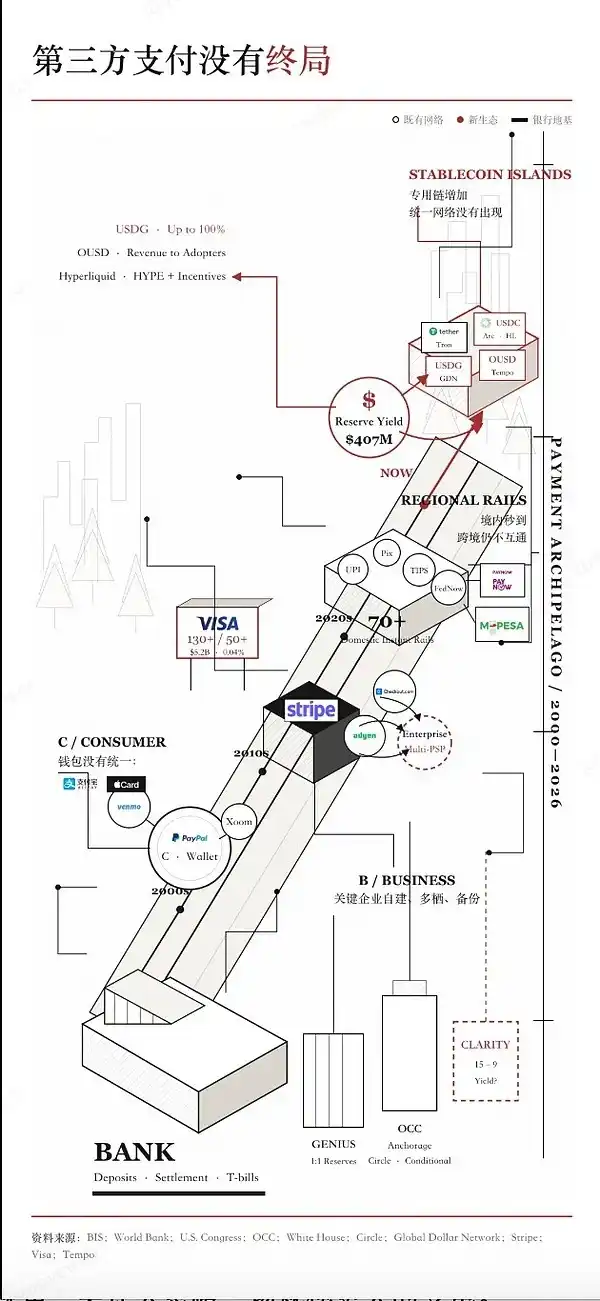
Even so, the article says Stripe and Circle may be pointing to another model: stablecoins for customer acquisition on the front end, and profit from settlement on the back end.
The author portrays Stripe and Circle as parallel expressions of an eventual fintech-crypto crossover. Both, the article says, are building public chains, stablecoins and settlement rails, naming the comparison as Tempo versus Arc and OUSD versus USDC.
The commentary is skeptical of stablecoin issuance revenue-sharing as a durable end state. It says Circle has already begun subsidizing Hyperliquid channel partners, while OUSD directly shares revenue with partners, a sign that both sides have already entered a phase of internal competition.
Settlement looks more meaningful in the author’s view. The article argues that settlement systems would let these chains avoid forcing subsidies onto partners and instead earn returns from capital efficiency and the network effects of payments and stablecoins.
It contrasts this with traditional fiat settlement, which the piece says depends on card networks, SWIFT, central banks and commercial banks in a layered structure that has already grown too heavy. New stablecoin chains, by contrast, have no legacy burden and can focus directly on settlement efficiency.
The article adds that Circle and Stripe have obtained conditional approval for OCC trust bank charters. After the current phase of stablecoin revenue sharing, the author says, both are likely to move toward settlement. A settlement network, in that view, could partially break away from the commercial banking system and keep more profit inside the network itself.
The article’s conclusion
The piece ends by saying Stripe missed the pandemic IPO window and has now entered a trench war in third-party payments. The author compares that battle to a permanent Verdun-style contest, one in which no player can simply use scale to wipe out local and industry-specific competitors.