

Joe Burnett, vice president of Bitcoin strategy at Strive, said he still sees a path for Bitcoin to reach $11 million by 2036, but he argues that the more important question is how the asset would get there.
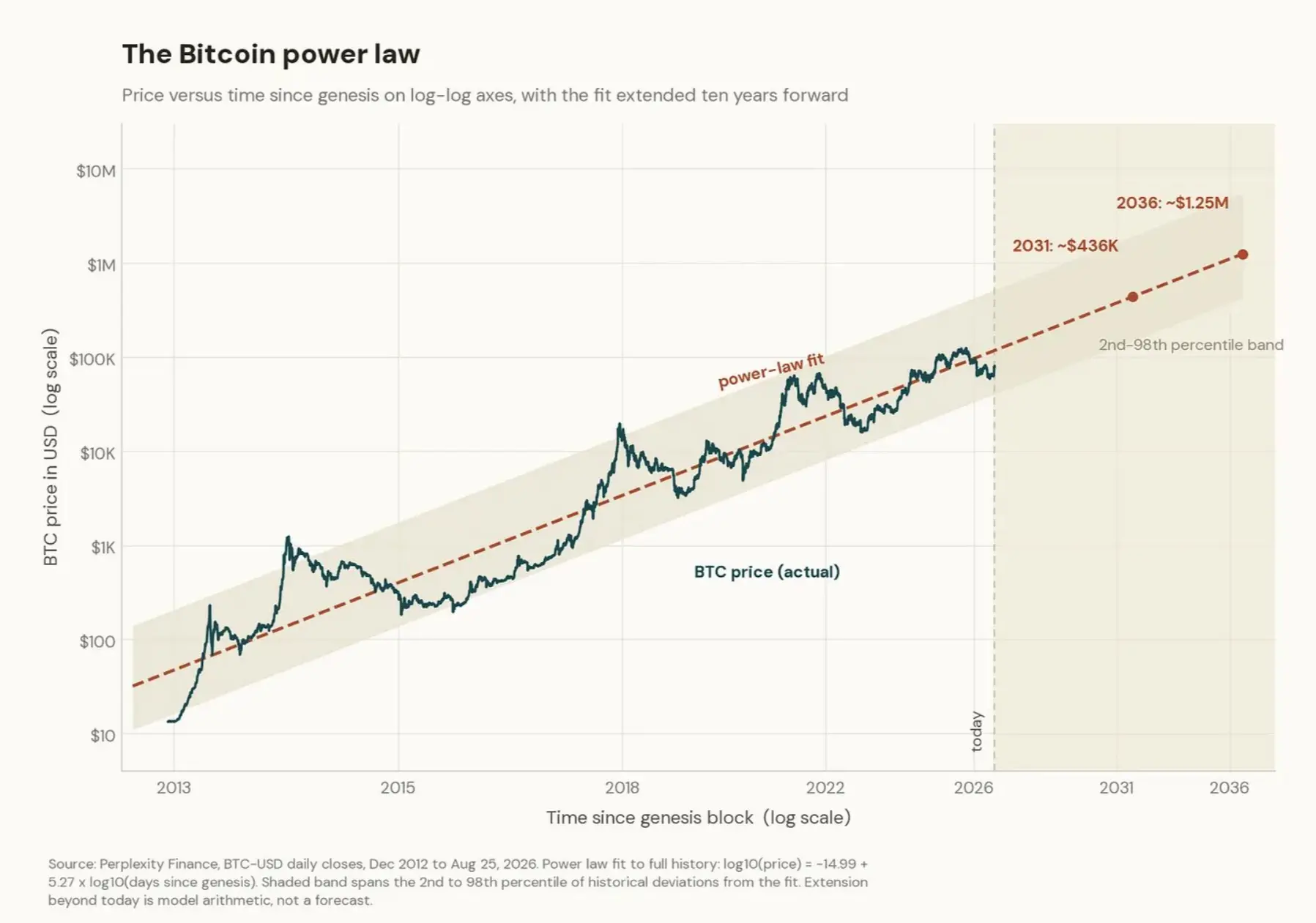
Burnett wrote that when Bitcoin fell more than 50% from its high in the previous quarter, he argued that a bear market was not a system flaw but part of Bitcoin’s early adoption process. Earlier this year, he also laid out why Bitcoin could reach $11 million in 2036. He said he still considers that scenario possible, yet now focuses more on the path than the endpoint.
His starting point is the visible compression in cycle returns. Bitcoin’s early cycles produced 100x gains, while more recent cycles have delivered much smaller upside. If that pattern continues without interruption, Bitcoin would increasingly resemble a mature asset, with returns drifting toward normal levels.
Burnett said the power-law framework has captured that shift well. In his telling, Bitcoin’s price and time relationship has followed a relatively stable power function for more than a decade, with growth rates slowing as the asset base expands. He said he still finds the framework useful and expects Bitcoin to broadly track that line for years, but he is no longer convinced that power law is sufficient to describe the end state.
Power law may explain the middle, not the finish
As Bitcoin matures, Burnett said, both returns and volatility fall. That matters not only for how much capital Bitcoin can absorb, but also for what the asset can do inside the financial system. Lower volatility improves risk-adjusted returns and makes Bitcoin easier to finance against.
His argument is that once Bitcoin becomes high-quality collateral in global finance, the amount of dollar credit built on top of that collateral could expand sharply. In that setup, diminishing returns do not simply weaken the asset. They compress volatility, and lower volatility can attract more capital and expand the financing capacity Bitcoin can support. In the end, he said, those same forces could re-accelerate Bitcoin’s price and push it above the power-law trajectory.
A metal-fatigue analogy for Bitcoin monetization
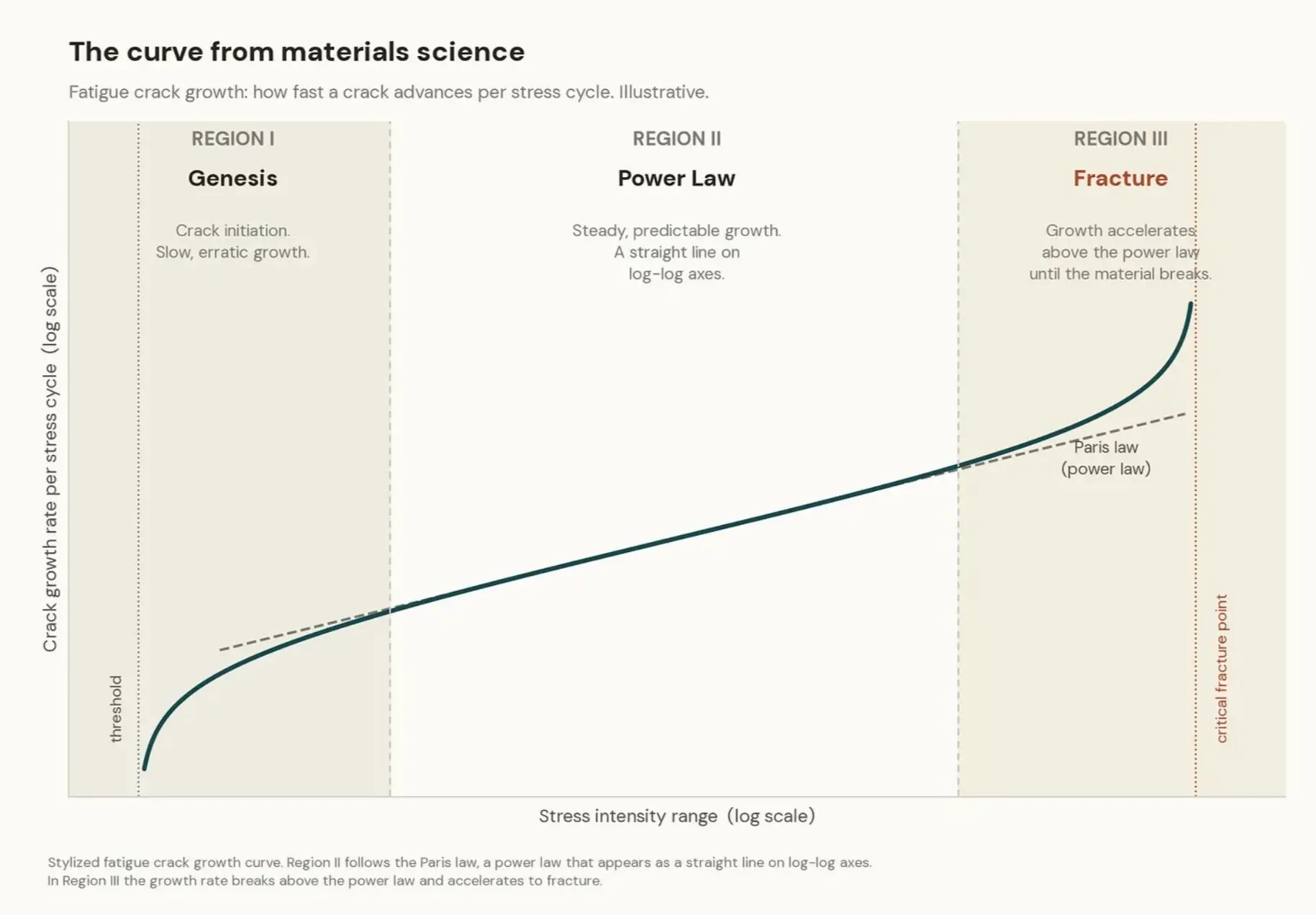
To explain the idea, Burnett used an analogy from materials science. Engineers studying metal fatigue watch how cracks grow under repeated stress. An airplane wing bends slightly on every flight, and a bridge deck is repeatedly compressed and released as cars pass over it. Each stress event causes only minor damage, but the damage builds over time until a crack expands.
He said engineers often divide crack propagation into three regions. The first is the crack initiation stage, where growth is irregular and difficult to model. The second is the Paris law region, where crack growth becomes regular and follows a power-law relationship with stress intensity; on a log-log chart, it approximates a straight line. The third begins when the crack reaches a critical point and expands rapidly, at which point the earlier power-law description no longer holds and the material ultimately breaks.
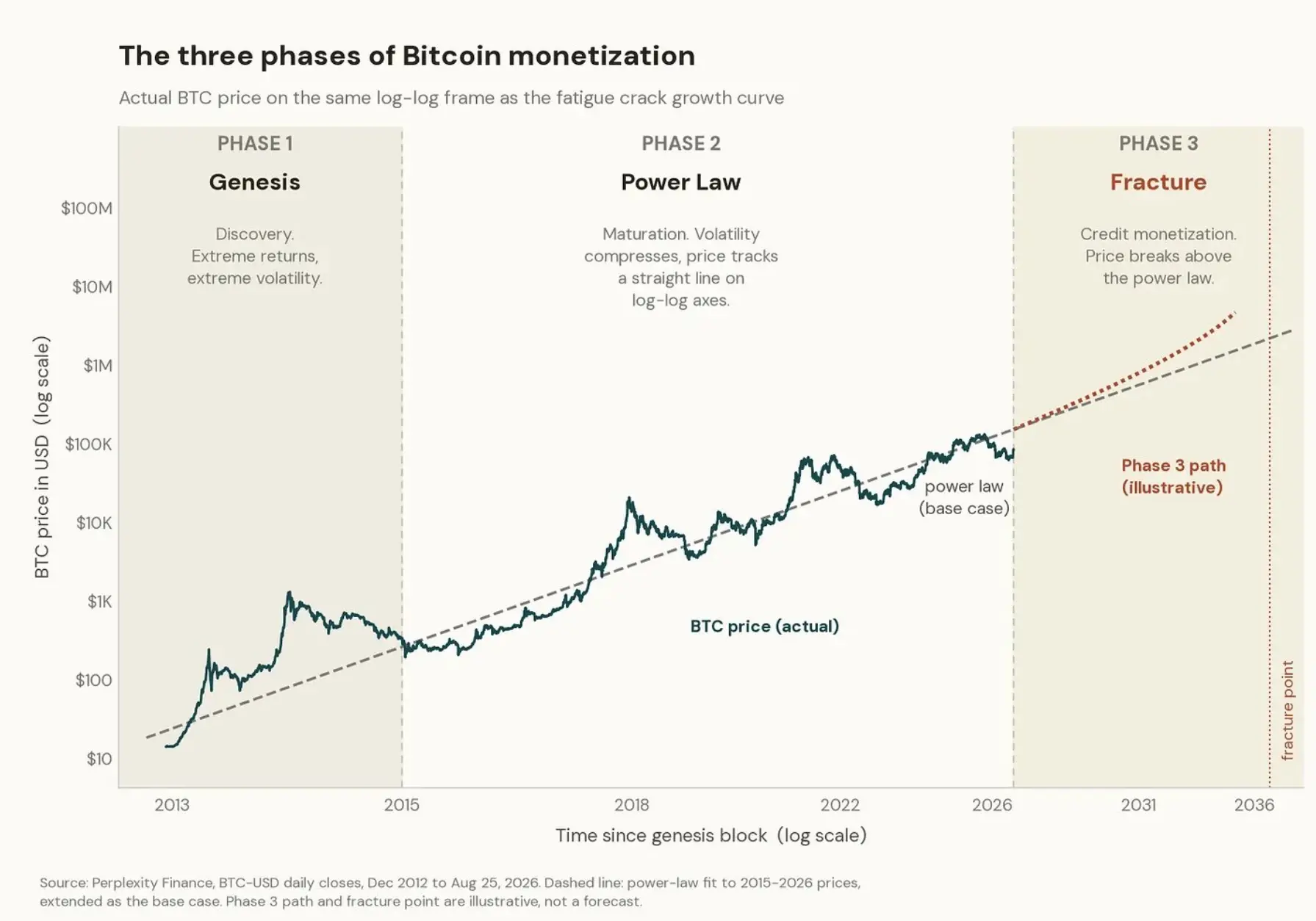
Burnett said Bitcoin’s monetization process may follow a similar path, with the dollar credit system occupying the role of the stressed material.
In his framework, stage one is discovery. Returns and volatility are both extremely high, which limits large pools of capital from allocating to Bitcoin and also limits its use as collateral.
Stage two is maturity. Returns and volatility both narrow, Bitcoin’s risk-adjusted return profile improves, investors can size larger allocations, and the asset becomes more attractive as collateral.
Stage three is financial-system-driven monetization. At that point, purchases funded by internal capital and purchases funded by credit begin entering the Bitcoin market at scale. A self-reinforcing loop starts, price appreciation accelerates again, and Bitcoin breaks above the power-law path.
Burnett said many people look at stage two and assume diminishing returns will continue forever. His view is different: stage two creates the conditions for stage three. As Bitcoin matures, falling volatility, better risk-adjusted returns and stronger collateral quality make it easier both to allocate existing capital and to buy Bitcoin with financing.
Falling volatility is changing Bitcoin’s asset profile
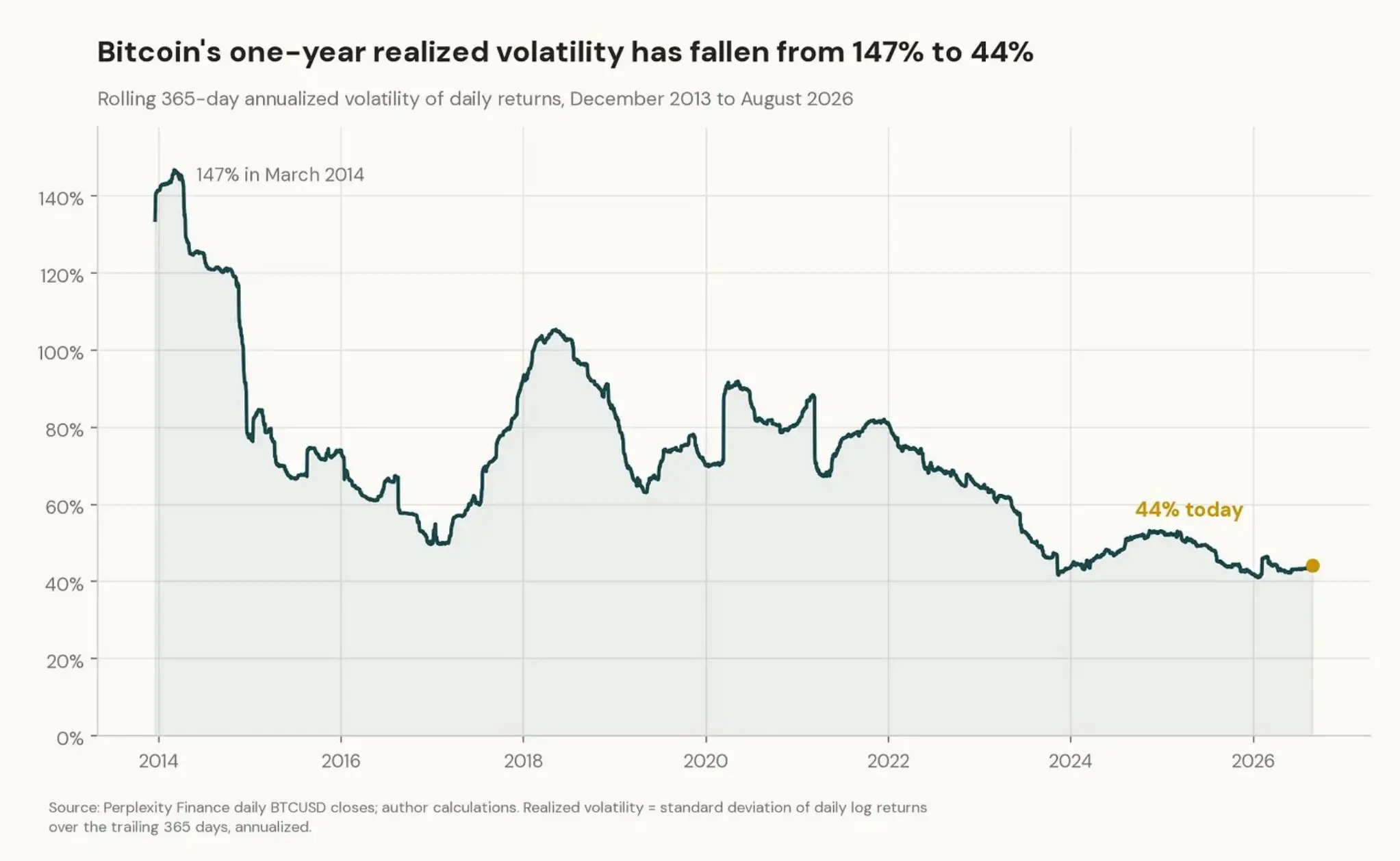
Burnett pointed to a pronounced decline in Bitcoin volatility. In March 2014, Bitcoin’s one-year realized volatility was close to 147%. By the time of publication, data from Perplexity Finance showed that figure had fallen to about 44%.
He also cited a recent Fidelity observation that Bitcoin’s current volatility is lower than it was on 98.5% of trading days in its history. With long-term returns still strong and volatility still falling, Burnett said the Sharpe ratio has improved as well. That means Bitcoin can attract more capital simply through stronger risk-reward characteristics, even without relying on new credit creation.
He compared the current setup with the period from 2016 to early 2017, when volatility narrowed materially and strong performance began drawing in more money.
Burnett also described volatility as a kind of hidden tax on position sizing. For an investor operating with a fixed risk budget, if Bitcoin volatility is cut in half, the investor could theoretically double the position size without increasing the asset’s contribution to overall portfolio risk. In other words, lower volatility alone can expand the room for existing capital to allocate to Bitcoin, even if no new credit is created.
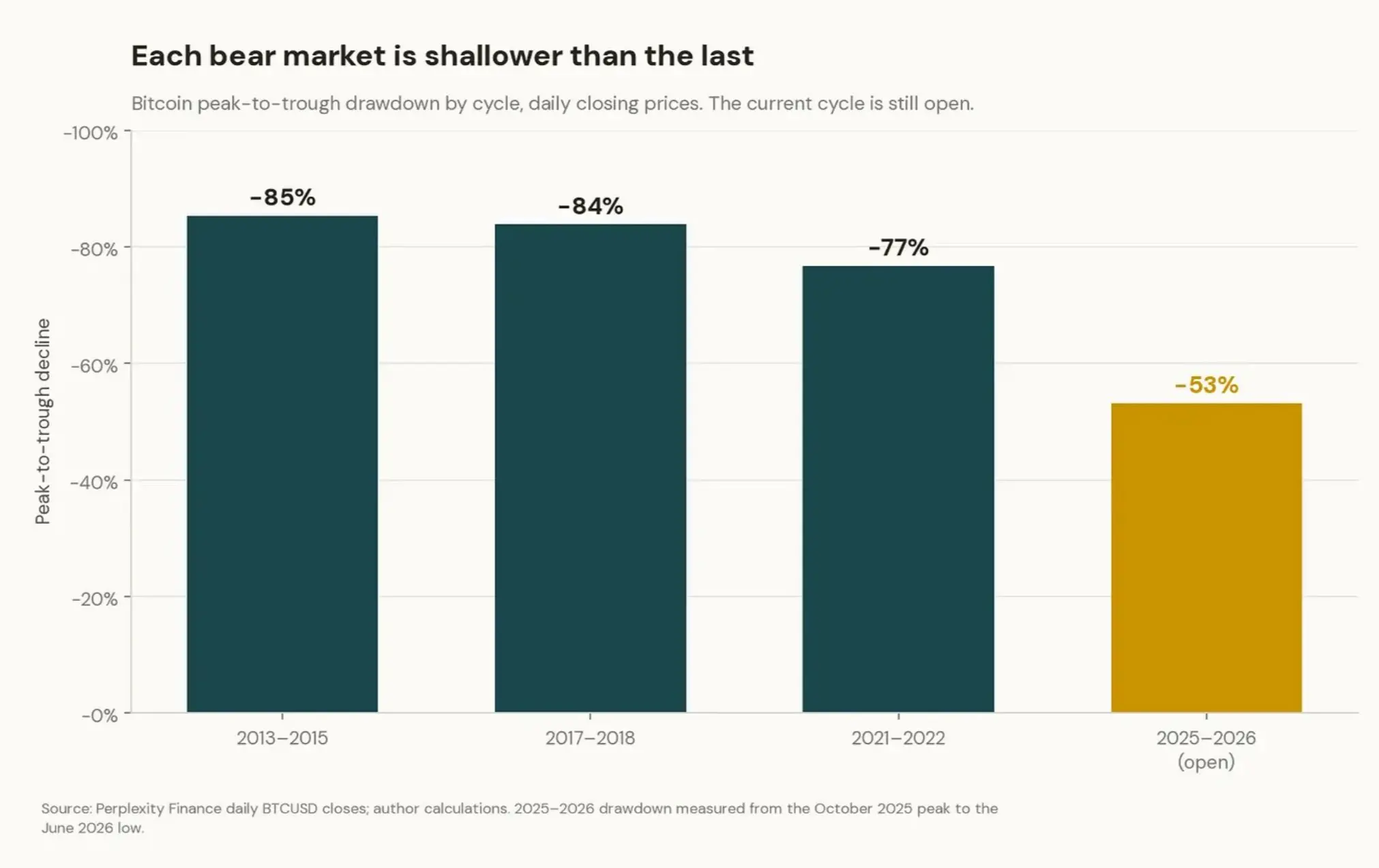
He said the pattern also shows up in maximum drawdowns. Across Bitcoin’s prior three major bear markets, the largest drawdowns were about 85%, 84% and 77%. In the current cycle, Bitcoin fell from a high of about $125,000 in October 2025 to a low of about $58,500 in June 2026, a drawdown of roughly 53%.
Burnett also cited NYDIG, which reached a similar conclusion near the June low. According to NYDIG, the current cycle drawdown was 52.7%, compared with 77.6% in 2021 to 2022 and 84% to 94% in earlier cycles. Each cycle has seen smaller declines and higher bottoms, and NYDIG described the long-term decline in volatility as one of the clearest features of the current phase.
Burnett acknowledged that this shift may disappoint some Bitcoin holders because bull-market upside is smaller, bear-market downside is smaller, and overall returns are lower. But from a lender’s perspective, he said, the same trend is highly attractive because Bitcoin is turning into better collateral.
Lower volatility can support more credit against Bitcoin
Burnett framed the lender’s core question this way: how far can Bitcoin fall before collateral value approaches the loan balance?
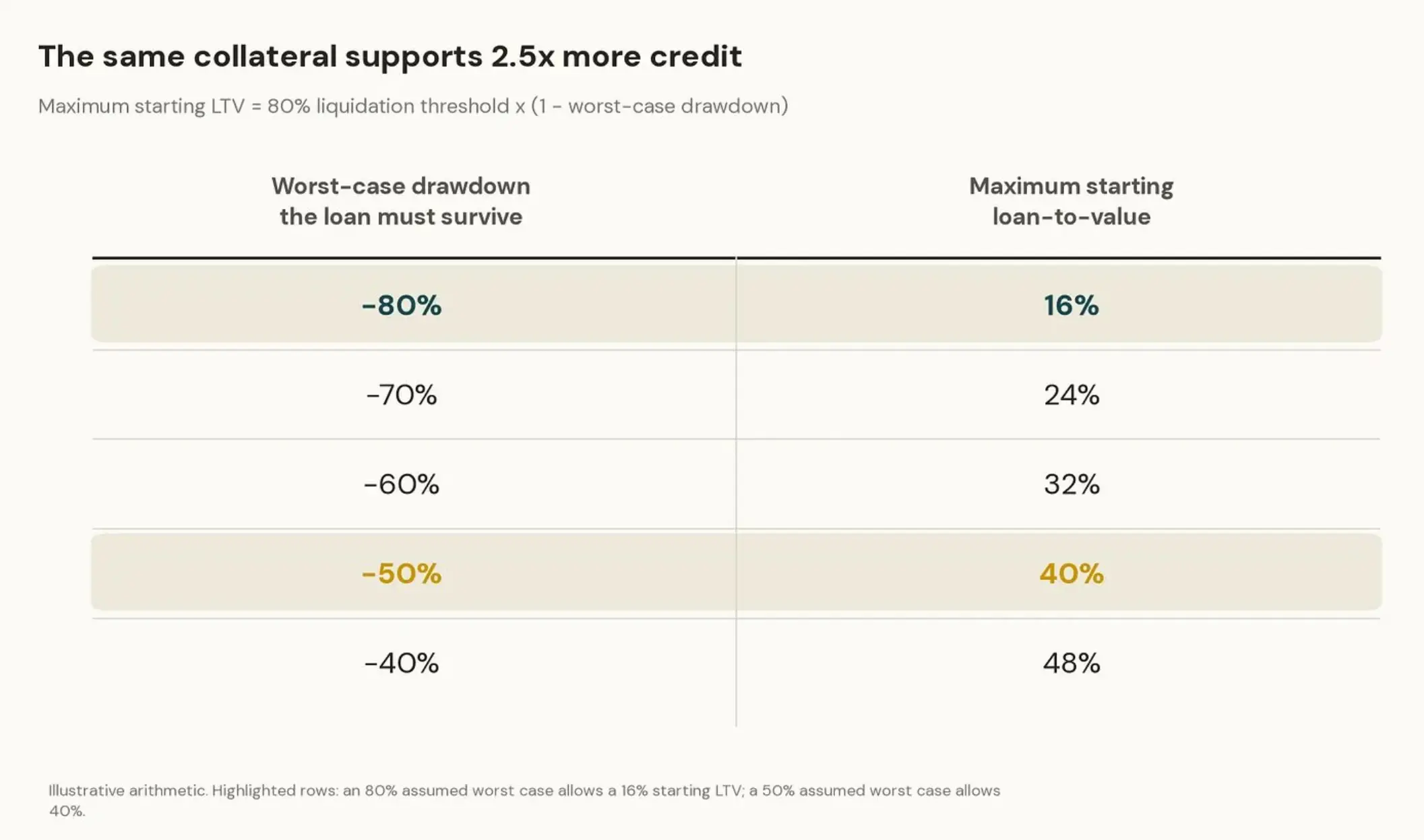
He used a simple example. Suppose someone holds $100,000 worth of Bitcoin and borrows $20,000 against it, starting at a 20% loan-to-value ratio. If LTV rises to 80%, the lender liquidates the collateral.
Under that structure, the smaller the worst expected drawdown, the larger the loan a lender can safely extend against the same collateral. If liquidation rules stay unchanged and the worst expected drawdown falls from 80% to 50%, the amount of safely extendable credit rises by 2.5x.
Burnett said the same logic applies to borrowers. Financing structures used by companies such as Strategy and Strive can expand Bitcoin exposure without taking near-term forced-liquidation risk, and those structures become more resilient when drawdowns are shallower. Lower volatility, in his view, reduces credit risk and supports a larger financing base at the same time.
Rising prices amplify the effect. If Bitcoin doubles while the related dollar debt stays unchanged, LTV is cut in half. The same amount of Bitcoin can then support more borrowing and provide funding for additional purchases.
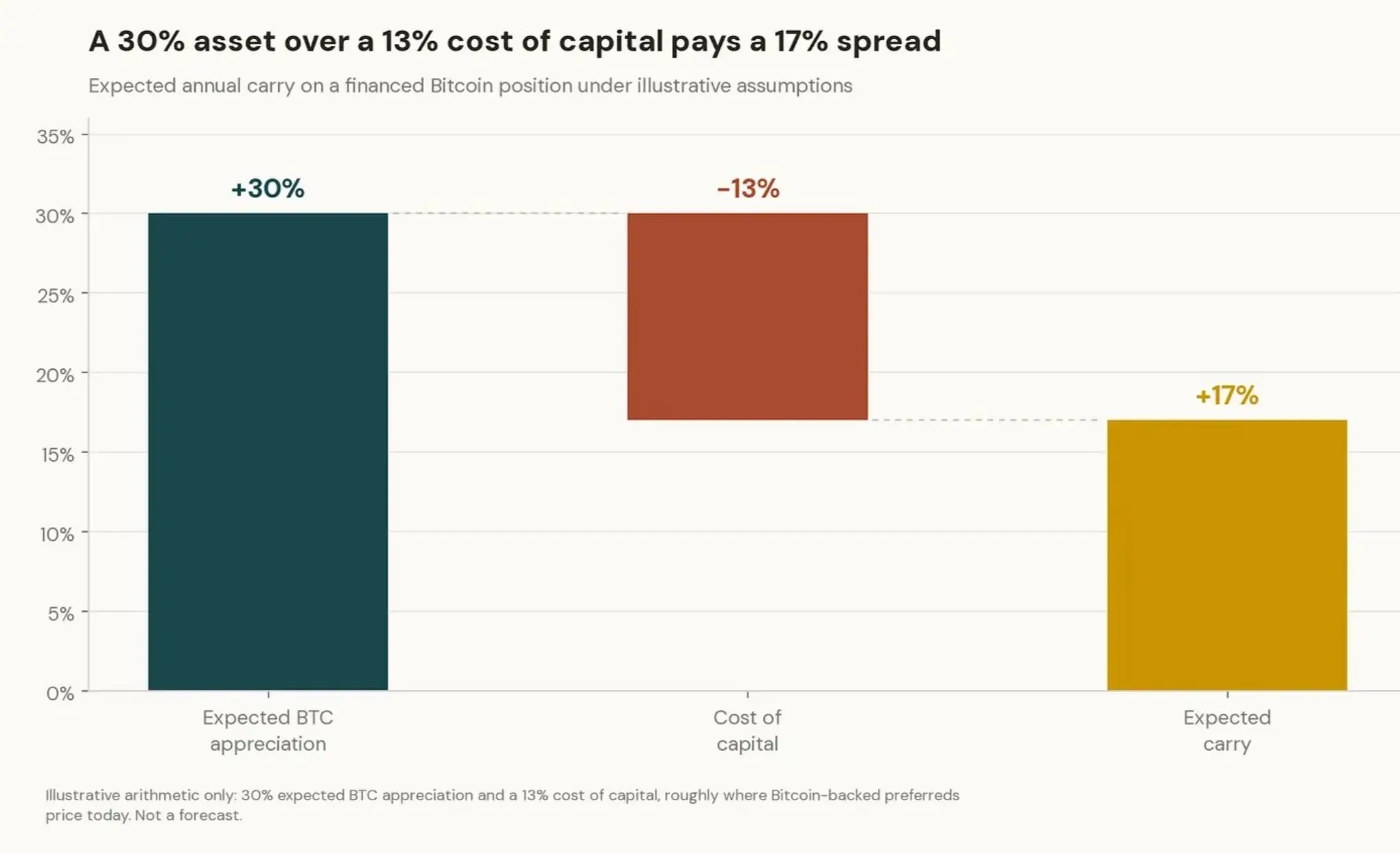
He argued that this financing logic can still work even if Bitcoin matures and annual returns no longer reach 100%. The pool of credit that could be built on top may still be very large.
Burnett gave a numerical example: if Bitcoin’s expected annual return falls to 30% and financing costs for Bitcoin-linked preferred shares are around 13%, there is still an expected spread of about 17 percentage points. If extreme collateral drawdowns keep narrowing, he said, that spread could still support large-scale financing.
As markets assign lower risk to the collateral, cheaper funding channels could also open over time, including bank credit lines, investment-grade bonds and securitization of Bitcoin-backed loans, according to Burnett.
What the public-market credit model shows
Burnett said this mechanism is already beginning to show up in public markets. He pointed to an illustrative credit model published by Strategy that derives credit spreads for its preferred shares using assumed Bitcoin volatility inputs.
Holding other assumptions constant, the model assigns STRC a credit spread of 360 basis points when Bitcoin volatility is 60%, placing it in non-investment-grade territory. When volatility falls to 40%, close to current realized levels, the spread tightens to 56 basis points, which moves it into investment-grade territory. At 30% volatility, the spread narrows to just 6 basis points.
At the same time, the probability that collateral assets fail to cover creditor claims drops from about 26% to less than 0.5% in the model. Burnett’s takeaway is direct: lower volatility makes the same instrument look materially safer from a credit standpoint, and lower credit risk usually means the financial system is willing to supply more capital.
So the starting point may be lower returns and lower volatility, yet the outcome could still be a renewed rise in returns.
The capital-and-credit flywheel
Burnett said the combined effect is a self-reinforcing loop. As Bitcoin grows and matures, volatility falls. Better risk-adjusted returns allow investors to allocate more capital. Better collateral quality makes financing cheaper and more abundant.
Existing capital and purchases backed by new dollar credit then compete for Bitcoin’s fixed 21 million supply, lifting the price. Higher prices raise collateral values, which unlock more financing capacity, and the cycle continues.
Viewed through the lens of credit expansion, Burnett said the loop resembles a speculative attack in macro finance: borrowing a relatively weaker currency to buy an asset that is harder to dilute, then letting the trade reinforce itself.
He outlined more than one path for that credit expansion. Banks can issue Bitcoin-backed loans and, as the Bank of England explained in “Money Creation in the Modern Economy,” commercial bank lending simultaneously creates deposit money. Companies can also issue convertible bonds and perpetual preferred stock, then use the proceeds to buy Bitcoin. Both routes expand dollar-denominated credit while pulling more Bitcoin out of liquid circulation.
Where a break above power law could come from
Burnett said new technologies are often adopted along an S-curve: slow at first, then rapid, and eventually saturated. Many people therefore assume Bitcoin’s price should follow a similar curve and flatten over time.
He argued that this misses a key point: the dollar side of BTC/USD is not static. The pool of dollars and dollar credit available to buy Bitcoin or finance Bitcoin purchases can keep expanding. Bitcoin supply is fixed, but the size of dollar capital and credit that can chase it does not have a fixed ceiling.
In his framework, lower volatility allows more existing capital to hold Bitcoin in size, while better collateral quality allows the financial system to create more dollar credit against it. Even if Bitcoin adoption eventually saturates, the amount of money willing to hold Bitcoin directly, or willing to finance Bitcoin purchases, may continue to grow.
That is why he believes Bitcoin’s dollar price could re-accelerate and break above the power-law path that described the second stage. This corresponds to the third region in the metal-fatigue analogy: cracks do not expand forever at the pace described by Paris law. Once they hit a critical threshold, they speed up and end in fracture.
Burnett’s final point is that lower volatility first widens the room for capital allocation and credit creation. Once those forces begin competing for a supply-capped asset, returns and upside volatility could both start rising again.
In the analogy, the stressed material is the dollar credit system, and the “fracture” is the moment when Bitcoin’s dollar price breaks upward through the power-law line.