
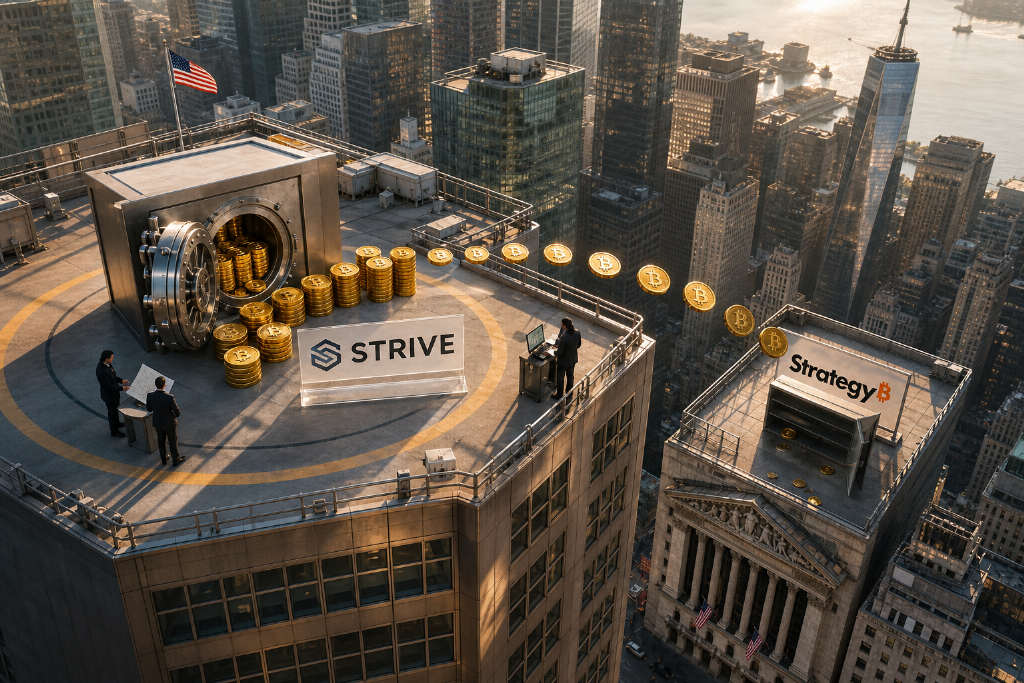
Bitcoin’s rebound from about $62,000 to above $80,000 has lifted listed Bitcoin treasury companies, but the gains have not been evenly distributed. Over the last four trading days, Strive climbed about 54%, compared with roughly 32% for Strategy. Smaller names including Twenty One Capital also posted double-digit rebounds.
The broader picture in 2026 is a sector that is no longer moving in lockstep. Strategy, still the largest player, is no longer operating on a pure buy-and-never-sell approach and has sold nearly 7,000 BTC since late June. At the same time, nearly 40% of companies in the segment are trading below net asset value, and some have chosen to deleverage or pause large-scale accumulation. Against that backdrop, Strive stands out as one of the few public-market names still disclosing ongoing purchases, with total holdings now at 21,356 BTC.
The company’s perpetual preferred stock, SATA, carries a 13% annualized dividend and was adjusted in June 2026 into what the article describes as the first U.S.-listed security to pay dividends daily. Strive remains much smaller than Strategy, but its buying cadence and capital structure have given it a more distinct profile in the current phase of the Bitcoin treasury trade. Chief executive Matt Cole has also repeatedly made public statements stressing his long-term conviction on Bitcoin.
From an anti-ESG fund manager to a Bitcoin treasury company
Strive did not begin as a crypto-focused business.
The company was founded in 2022 by Vivek Ramaswamy and former Anheuser-Busch executive Anson Frericks. Early on, Strive built around DRLL, an anti-ESG energy index fund that explicitly did not center environmental, social and governance factors in its investment approach. That positioning quickly attracted capital from investors aligned with that thesis.
In February 2023, Ramaswamy stepped down as executive chairman as he ran for U.S. president. Matt Cole became CEO in April that year and went on to shape the company’s strategic direction.
The turning point came in 2025, after Strategy’s Bitcoin accumulation model had already been reflected to a large extent in its share price. Between May and September 2025, Strive used a reverse merger with Dallas-listed Asset Entities to remake itself into a public company focused on a Bitcoin treasury strategy. The transaction also included a $750 million PIPE financing. The company kept the ticker ASST and traded on Nasdaq.
After the transition, Strive moved quickly. From September 2025 to January 2026, it acquired another Bitcoin treasury company, Semler Scientific, in an all-stock deal, folding roughly 5,000 BTC from Semler into its balance sheet. When the transaction closed, the combined company held about 12,798 BTC, ranking 11th globally among public companies by Bitcoin holdings.
The deal also reshaped management. Avik Roy became chief strategy officer, former Semler Scientific chairman Eric Semler joined the board, and Joe Burnett took the role of vice president of Bitcoin strategy, becoming another key public-facing executive for the company.
Share performance tracked the swings in market sentiment. In the early phase after the transformation story took hold, ASST traded above $200 at one point. It later fell back into the teens after a reverse split and valuation normalization.
As of Aug. 21, Strive held 21,356 BTC, 505,000 shares of Strategy’s STRC preferred stock with a fair value of about $48.57 million, and roughly $171.9 million in cash.
Financing is straightforward, but SATA sits at the center
Strive relies on two main funding tools. One is at-the-market issuance of its common stock, ASST. The other is SATA, its perpetual preferred stock. In May, alongside first-quarter results, the company said it had bought back and eliminated all long-term notes, leaving it with no debt, no margin and no pledged Bitcoin.
SATA is described in the article as the first listed U.S. security to pay dividends daily. It has a $100 par value and a 13% annual dividend. On that basis, the payment comes to about $0.0516 per share each trading day. Across 252 trading days, that adds up to about $13 annually, matching the 13% coupon.
SATA dropped to around $75, or roughly three-quarters of par, on two occasions this year, once early in the year and again in June. It has since moved back above par as Bitcoin recovered.
Like Strategy’s STRC, SATA has no maturity date. Dividends are discretionary and can be deferred, and the instrument has no hard redemption or liquidation trigger tied to Bitcoin falling below a preset price line. This year, Strive increased the capacity of both its ASST and SATA ATM programs by $2.1 billion each.
The market price of SATA has had a direct effect on the company’s ability to keep buying Bitcoin. During the deep drop in the first half of the year, Strive’s accumulation paused for more than two months. It resumed buying only after SATA returned to par in August and the issuance channel reopened.
How Strive differs from Strategy
The market often compares Strive with Strategy, and the differences outlined in the article fall into four areas.
Debt profile
Strategy accumulated a meaningful amount of convertible debt between 2020 and 2024, including a $3 billion zero-coupon convertible note issued in November 2024 and due in 2029. Over the past two years, Strategy has not continued issuing large amounts of convertibles and has shifted toward buying back debt. Strive has no convertible debt. Chief investment officer Ben Werkman said the company relied only on equity financing and avoided convertibles, which allowed it to keep operating through a bear market.
Accumulation model
Strategy is deleveraging. It is repurchasing convertibles, buying back STRC, and has sold nearly 7,000 BTC this year. Strive is still in expansion mode, issuing SATA and buying more Bitcoin.
Dividend structure
STRC currently carries a 12% annualized payout and pays semi-monthly, at $0.50 per share each time. SATA offers a 13% annualized payout and pays daily.
Cross-holdings
Strive owns about 505,000 shares of Strategy’s STRC preferred stock, with a book value of about $48.6 million. In effect, it is holding a rival’s preferred shares as an income-generating reserve and using the roughly 12% yield from STRC to help support payouts on its own SATA preferred stock.
The story has shifted from buy-and-never-sell to balance-sheet design
The core narrative around Bitcoin treasury companies is changing. For years, the central promise was to buy Bitcoin, lock it on the balance sheet and never touch it. In 2026, that premise was broken by the sector’s biggest player. Strategy’s sales amount to less than 1% of its 840,000 BTC position, but the symbolic impact is still notable.
Strive remains earlier in the cycle and has not reached the point of selling Bitcoin. Cole has repeatedly argued for Bitcoin on a long-term basis, citing structural weakness in the U.S. dollar, capital moving toward scarce assets in the AI era, and what he described as a leading bottom in the Bitcoin-to-gold ratio. He has also said that even if Bitcoin fell to $0.01 and stayed there for 18 months, Strive would not need to sell a single BTC.
Beyond macro arguments, internal buying has been presented as a stronger signal. Cole wrote that Feb. 19 marked the bear-market bottom for ASST, when the company’s CFO, CLO, and several executives and directors bought shares in the open market. He also said three independent directors had moved into full-time roles within six months, and that the team remained highly confident in the company’s Bitcoin exposure, leveraged structure and internal coordination.
Common shareholders do not capture the full headline growth in BTC holdings
A more practical issue sits behind the buying story: how much Bitcoin common shareholders are actually gaining exposure to after issuance and preferred claims are taken into account.
Looking only at aggregate holdings can overstate the result. During the week of Aug. 17 to Aug. 21, Strive’s Bitcoin reserves grew about 5.48%. But the purchases were funded mainly through new share issuance. Over the same period, common shares outstanding expanded from about 86.04 million to about 89.68 million, creating dilution of about 4.24%. At the same time, the size of SATA preferred stock, which sits ahead of common equity in the capital stack, was also increasing.
After adjusting for dilution and preferred seniority, the article says the CEBE measure — the amount of Bitcoin value represented by each common share — rose only about 1.73% that week, from roughly 14,767 satoshis to 15,023 satoshis. The improvement was materially smaller than the headline increase in total Bitcoin holdings.
How much downside can it absorb, and how much upside can it keep?
Strive is dealing with a problem that extends beyond one company. The article frames it as the risk that the treasury flywheel stalls in a bear market.
Its answer is digital credit. Rather than treating Bitcoin only as an asset that may appreciate, Strive’s framework treats it as a credit asset that can support a steady income stream.
Burnett cited Saylor’s formula and said that if Bitcoin grows at an average annual rate of 3.3%, capital gains alone would be enough to cover preferred dividends. In that framing, holding Bitcoin becomes a business capable of paying out continuously, and SATA’s daily dividend is the product expression of that idea.
Cole has said the goal is to maximize expected total return for ASST by increasing participation in Bitcoin upside as much as the company can responsibly bear, while keeping strict capital discipline.
The challenge is that both sides of the market matter. On the downside, the question is how large a drawdown the company can absorb. On the upside, the question is whether a structure that is too conservative could cap returns if Bitcoin rises sharply.
On the downside, Strive avoids hard liquidation risk by not using debt, not using margin, and not adopting financing structures that could trigger forced selling. But its funding model depends heavily on SATA and ASST trading above par or above net asset value. The first-half episode, when SATA fell to about three-quarters of par and buying stopped for more than two months, offered a preview of that constraint.
On the upside, Cole has described ASST’s capital structure as a leverage framework built on three reinforcing layers: the pool of scarce assets grows, the company’s Bitcoin share grows with it, and the ASST structure adds another layer of amplification.
Strive’s smaller size and thinner liquidity make it a higher-beta, more elastic Bitcoin proxy. This year, ASST is up about 34%, while Strategy’s MSTR is down about 19%. In terms of trading range, ASST has seen about 111% volatility in the interval cited, versus about 76% for MSTR.
More alternatives are now available to investors
On one level, Strive has introduced a set of variations on the Strategy model: no debt, daily dividends and a digital-credit framing. But stripped down, it is still a high-volatility Bitcoin exposure vehicle.
That exposure now competes with a growing number of alternatives. Spot Bitcoin ETFs, structured ETFs and other Bitcoin-linked products have expanded the ways investors can access the asset, making competition tougher for treasury-company stocks.
For a smaller company like Strive, the limitations are sharper. Its market capitalization is smaller, liquidity is thinner, and large capital flows are harder to move in and out. That naturally narrows the investor base.
Its appeal, though, is just as clear. The stock offers more elasticity and higher beta. For investors willing to absorb that volatility and specifically looking for this kind of exposure, that is exactly the draw.