
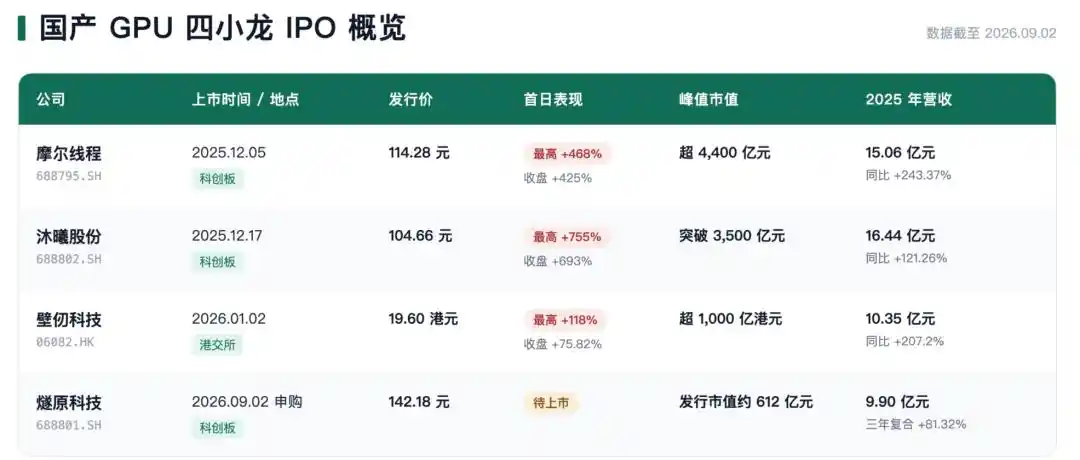
Suiyuan Technology opened subscription for its STAR Market offering on Sept. 2 at 142.18 yuan per share. Based on the exchange’s 500-share lot size, a successful applicant would need to pay about 71,100 yuan. The offer price implies a market capitalization of roughly 61.2 billion yuan. The company has reported losses approaching 5 billion yuan over three and a half years, making valuation and the path to profitability central issues as the eight-year-old GPU developer enters the public market.

Heavy institutional demand
The preliminary inquiry attracted 337 off-market investors and 11,805 placement accounts. After invalid bids and the highest quotes were excluded, the proposed off-market subscription volume reached 72.959 billion shares. That was 2,648.93 times the initial off-market allocation.
Xiaomi, GigaDevice, Fullhan Microelectronics, ZTE and the National Social Security Fund were included in the strategic placement list. Suiyuan is the oldest-founded and last-listed member of what the source describes as China’s four leading GPU companies.
Moore Threads was the first of the group to reach the STAR Market, listing on Dec. 5, 2025, at 114.28 yuan per share. Its maximum first-day gain reached 425%, and its market capitalization briefly topped 300 billion yuan. At 500 shares per lot, the maximum paper gain for a successful applicant exceeded 200,000 yuan.
Moore Threads was followed by MetaX, whose maximum first-day gain briefly exceeded 700%. The maximum gain on one successful lot approached 400,000 yuan, setting a record for first-day profit on a single lot among A-share listings in nearly a decade. Biren Technology, which listed in Hong Kong on Jan. 2, 2026, did not match those gains, but still rose 75.82% on its first day and briefly exceeded a market capitalization of HK$100 billion.
Those performances left the market with an association between new Chinese GPU listings and quick gains. Whether Suiyuan can extend that run will depend on its post-listing price and operating results.

Revenue is rising, with a stated break-even timetable
Suiyuan’s revenue was 301 million yuan in 2023, 722 million yuan in 2024 and 990 million yuan in 2025, representing a three-year compound growth rate of 81.36%. Revenue reached 1.12 billion yuan in the first half of 2026, already exceeding the full-year figure for 2025.
The company expects revenue of 2.3 billion yuan to 3 billion yuan for the first three quarters of 2026, with the year-on-year growth rate reaching as high as 455%. Its losses have also narrowed. According to the prospectus, Suiyuan expects to basically reach break-even in 2026 and become profitable by 2027 at the latest.
At the 142.18 yuan offer price, Suiyuan’s static price-to-sales ratio based on diluted 2025 figures is about 61.8 times. That is below the average for comparable companies in the sector. Whether the multiple is expensive still depends on whether future operating results keep pace.
Recent trading in Yushu Technology shows how far an IPO valuation can diverge from the secondary-market price. Before listing, Yushu had an offering market capitalization of about 61 billion yuan, while optimistic expectations in the market had reached around 200 billion yuan. After opening on Aug. 19, its share price briefly climbed to 1,100 yuan, corresponding to a market capitalization of 444.9 billion yuan. By the Sept. 2 open, the market capitalization had fallen back to roughly 221 billion yuan, nearly half below the peak.
That case does not determine Suiyuan’s future trading path. It does show that a stock’s price on listing day can differ sharply from what institutions regard as fair value.
Tencent is both investor and major customer
Tencent is inseparable from Suiyuan’s financing and commercial history. Before the offering, Tencent Technology directly held about 19.95% of Suiyuan. Tencent-related entities held a combined 20.26%, making them the largest institutional shareholder group. Tencent also accounted for 83.79% of Suiyuan’s revenue in 2025, compared with 33.34% in 2023.
The relationship began in 2018. Suiyuan was established in March that year, and Tencent led its pre-Series A round. The source says Chinese internet companies became increasingly concerned about their reliance on Nvidia as technology tensions between China and the United States intensified. Tencent’s WeChat, advertising recommendations, content security systems and later its Hunyuan large model all require computing power, giving the company a reason to seek domestic supply.
At the time, Moore Threads, MetaX and Biren Technology had not yet been established. There were few mature targets available, and Suiyuan was one of the small number of teams already working on the products. Suiyuan founder Zhao Lidong’s background also mattered to Tencent. He graduated from Tsinghua University’s 1985 class of the Department of Radio Engineering, later renamed the Department of Electronic Engineering, a group compared in the source with Tsinghua’s Yao Class in the artificial-intelligence sector.
Zhao left Tsinghua in 1992 for further study in the United States and later spent many years working on chips in Silicon Valley. He served as a senior director in AMD’s Computing Business Unit and Product Engineering Department and helped establish AMD’s China research and development center. In 2014, when China set up its first large semiconductor fund, Zhao resigned and returned to China. He joined Unisoc Communications Technology Group Co. as a vice president in charge of semiconductor investment-related work.
In 2018, Zhao left Unisoc and brought in another AMD veteran, Zhang Yalin. Zhang had worked in chip design since 2000 before joining AMD. He later served as a senior chip manager and technical director of AMD’s China research and development center. As one of the main leaders of AMD’s global chip research and development work, he led the development and mass production of several products, including the main chip for Microsoft’s Xbox One.
From edge applications to core AI workloads
In Suiyuan’s second year, the company began working with Tencent. Over the following six years, its chips moved from applications such as Tencent Meeting and optical character recognition to Tencent’s core AI business.
At the end of 2024, a 10,000-GPU inference cluster was deployed in Qingyang, Gansu. Suiyuan’s S60 became one of its core computing products. The source describes the deployment as the first time a domestic AI chip had been tested in real business operations at a 10,000-GPU scale.
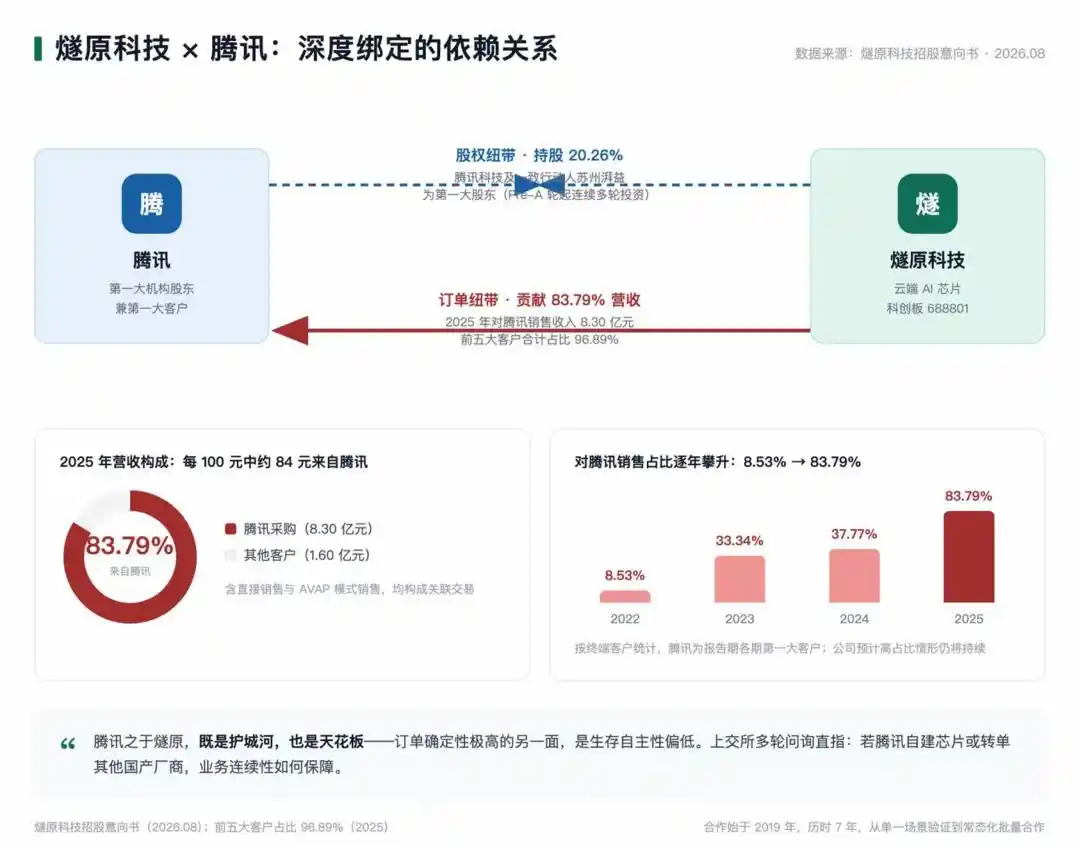
Tencent has been both Suiyuan’s earliest investor and one of its most important customers. For a chip startup, a large customer willing to test products in core business applications can provide sustained engineering validation. Over eight years, Suiyuan completed four architecture generations and five chips, with every chip completing its first tape-out successfully.
The same relationship also creates concentration risk. Suiyuan said in its prospectus that a high proportion of sales to Tencent is expected to continue in the future. The company also acknowledged that a major change in Tencent’s procurement strategy, or slower-than-expected customer expansion, would directly affect its results.
Its product mix presents another issue. Most existing products are used for inference. The fourth-generation L600 product, designed to integrate training and inference, has returned from fabrication but has not yet reached large-scale mass-production delivery. Suiyuan’s position in the larger large-model training market therefore remains to be established.
With Suiyuan’s listing, the four leading domestic GPU companies named in the source are now all public. Suiyuan has a proprietary DSA architecture, does not depend on the CUDA ecosystem, and has Tencent as a major customer. Its profitability timetable is also disclosed. Those factors will need to translate into sustained orders and profits in the company’s next stage.
This article was originally published by Phoenix Technology on WeChat and written by Phoenix Technology.