
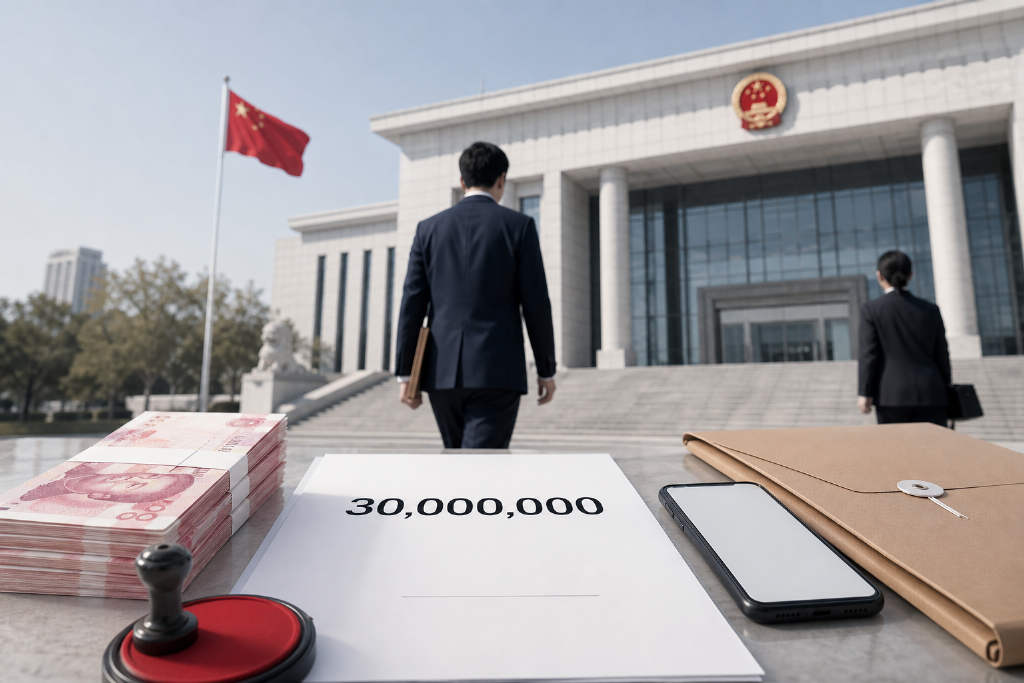
WuBlockchain spent a podcast episode on the legal mess surrounding the publicly revealed 30 million yuan dispute between Sun Yuchen and Jing Tian. The guest was crypto lawyer Jin Jianzhi. He walked through how Chinese courts might look at the payment, what evidence may count, and how issues like property preservation, surrogacy, defamation, and privacy could all intersect with the case.
The program said that on Aug. 27, Sun Yuchen’s lawyer Zhang Qihuai publicly said Sun had sued Jing Tian and her parents over a 30 million yuan dowry dispute and was demanding the money back. According to the program, the case has already been docketed. Sun’s side also sought property preservation. Jing’s side, for its part, challenged jurisdiction. The dispute still has not reached the substantive trial stage.
That same day, Sun published a long piece titled My Girlfriend Jing Tian. It ran through a lot of private material: romance, marriage, childbirth, medical treatment, and overseas surrogacy. The article ended with the line "this article is purely fictional." But the program said many people in the community still passed the content around as if it were factual. Jing Tian’s studio later replied that the matter would be dealt with through the courts.
How courts may decide whether the 30 million yuan was dowry
Jin said the central legal issue is simple: was the payment made for the purpose of marriage? The amount, in his view, is only one reference point. Courts usually look at local custom and at what the parties were actually doing at the time. Things like whether marriage had been clearly discussed, whether parents were involved, whether wedding plans or registration had come up, and whether the payment looked different from ordinary gifts exchanged during a relationship.
Using Sun’s own public account as a reference, Jin said there are facts that may help a dowry argument and facts that may cut against it. The parts that may help Sun: his claim that the 30 million yuan was transferred to Jing Tian’s parents, that he bought a proposal ring, and that Jing met his parents. But there is a problem too. Maybe more than one. In the sequence laid out in the article, the decision to propose came after the transfer had already happened, and the ring was bought only later. That timing could trigger a basic question: was there a clear marriage purpose when the money was paid, or did the idea of marriage only form afterward?
Jin also said a court may examine the couple’s financial background and spending habits. According to Sun’s own public telling, the relationship involved heavy spending on hotels, private jets, and other items. Against that backdrop, Jing’s side could argue that even a 30 million yuan transfer, while enormous, was still just a large gift made during the relationship. And phrases like wanting to have children in the future may be treated as emotional talk, not direct proof that the payment was made for marriage.
A full chain of evidence matters more than one isolated message
The podcast asked whether a plan to register the marriage outside mainland China would change the dowry analysis. Jin said no. Flatly. In his view, the law does not require the parties to plan a marriage registration in China before a payment can count as dowry. The real issue is whether there were objective acts showing marriage preparation.
He said statements like "I want to marry you" or "I want to have your child" do not carry enough weight by themselves. A court would want a fuller chain of proof: were the parties actually preparing for marriage, did they discuss registration or wedding plans, were parents involved, and was the transfer directly tied to those plans?
That chain of evidence, as the program described it, could include transfer records, chat logs, meetings with parents, a proposal, wedding preparation, and what the parties did afterward. If a large payment really was dowry, Jin said, there is often discussion about things like how much dowry would be given or whether the money was meant for the woman’s parents. If there was no transfer note, no relevant chat record, and the dowry claim appeared only after the transfer, then the evidentiary force gets weaker.
AI chat logs may be submitted, but their evidentiary weight is limited
The hosts also asked whether Sun’s conversations with AI about whether he should make the payment could help show that he intended to marry at the time.
Jin said those materials can be submitted as evidence, but he drew a line between admissibility and evidentiary weight. A person’s chats with AI mainly show that person’s one-sided expression. They may help indicate what he says he was thinking at the time, but they are not strong proof of the objective facts between two parties.
So, Jin said, AI chat logs could only be one link in a bigger chain, together with real messages between the parties, transfer records, meetings with parents, a proposal, and other concrete conduct. On their own? Unlikely. He said they would be unlikely to prove that the payment was made for marriage.
Transfer to Jing Tian’s parents could support the claim, but not settle it by itself
The program noted that the 30 million yuan was said to have been transferred to Jing Tian’s parents and that Sun named them as co-defendants. Jin said that is not unusual in dowry disputes. In real life, dowry is often paid to the woman’s parents. When the amount is large, the man’s parents may also contribute, and the money may go directly to the woman, to her parents, or be divided between them.
He added that in a dowry dispute, both the woman and her parents can be sued together. If the man’s parents actually funded part of the payment, there are situations in which they could also appear as co-plaintiffs. So yes, the fact that the money went to Jing Tian’s parents may support calling it dowry. But no, Jin said it still does not decide the issue on its own.
Surrogacy would not directly decide the dowry issue
Sun’s article also touched on surrogacy. Jin said that point does not directly answer whether the 30 million yuan was dowry. The legal test stays the same: was the payment made for the purpose of marriage?
If the money was paid only because one party wanted the other to have a child, and there was no intention to marry, then even a very large payment would not automatically become dowry. On the other hand, if the couple was already planning marriage and also discussing how to have children in the future, then those discussions could be treated as part of the broader marriage plan. In that sense, surrogacy-related discussion is supporting context, not the thing that decides the case.
Past public statements may come in, but they are not decisive on their own
The podcast also brought up Sun’s earlier public remarks about not marrying or not buying a home. Jin said Jing’s side could absolutely submit those comments, but a court would not normally rely only on statements made years earlier to decide that a person could never have changed his mind. Sun could answer that his views on marriage changed with age and with life stage.
Still, Jin said the court would zero in on the parties’ real intention at the moment the 30 million yuan was paid and on whether there were concrete marriage preparations at that time. Based on the public material so far, he said some details remain disputed. The current version does not show clear discussion of where the marriage would be registered or how the wedding would be held. Instead, the large transfer appears first, then a proposal, a ring purchase, and meetings with parents. Jing’s side could use that sequence to argue that the intention to marry had not yet formed when the money was paid.
So old public remarks have limited force by themselves. But, Jin said, they could still become supporting factors when read alongside the parties’ conduct around the transfer.
If the money is found to be dowry and there was no marriage registration or cohabitation, full repayment is possible in principle
On repayment, Jin said that if the court eventually decides the money was dowry, and the parties never registered their marriage and never lived together, the basic rule is that the dowry should be returned. Special circumstances, such as serious fault by one party, could affect the outcome. But the public information now does not show whether any such factors exist.
If the parties did not register a marriage but did live together for a long time, the result could be different. In that situation, the court may order only partial repayment. Jin said the percentage would depend on factors such as the length of cohabitation, whether children were born, how the dowry was used, and whether either side was at fault. No fixed ratio.
But if the court were to find that all 30 million yuan was dowry and that the parties neither registered their marriage nor lived together, Jin said full repayment would be the principle.
Hotels, flights, and other relationship spending are not automatically treated as dowry
The program also asked about the large sums allegedly spent on hotels, planes, and other items during the relationship. Jin said each payment has to be classified separately. If the spending was part of ordinary shared consumption while dating, such as travel or hotel costs that have already been consumed, then repayment is generally hard to demand.
The same logic applies to ordinary gifts between partners. If an item like the ring mentioned in the article is treated by the court as a normal romantic gift, then legally it is different from dowry given for the specific purpose of marriage. So this case is not about totaling every yuan spent during the relationship and trying to claw it all back after a breakup. The dowry return rules would apply only to the portion of property that the court eventually identifies as dowry.
The current public record is only one side of the story
Asked how the case might develop if one looked only at Sun’s public article, Jin said the story was written in a way that pushes many facts toward a dowry theory. According to the program’s description, the article says the other side explicitly said her parents had raised her for many years and asked for dowry; the money was then transferred to the parents’ account; and the story then moved on to a proposal, a ring, a home purchase, and childbirth arrangements.
If all of those details are later backed by real evidence, Jin said the chance that a court would characterize the payment as dowry would be relatively high. Without marriage registration and without cohabitation, that would also bring the case back to the repayment issue.
But he added a warning. The public has mostly seen Sun’s version so far. Jing’s side may argue that those exchanges were only part of a romantic relationship and did not amount to a real mutual intention to marry, or it may offer a different explanation for the nature of the payment. For that reason, the program stressed that the public article cannot be treated as the same thing as facts confirmed by a court.
Several public misconceptions were highlighted in the discussion
Jin used the episode to deal with several recurring misunderstandings.
- First, he said some people assume that if a couple is dating with marriage in mind, then every large transfer during the relationship must be dowry. That is not how courts handle these cases. Courts separate each payment and decide whether it was dowry, a normal gift, or shared spending.
- Second, he said some people think that if what they disclosed is true, then there can be no infringement. The program said truth mainly matters to defamation analysis, but true private information can still be protected under privacy law.
- Third, he said some people leap from a large amount of money to accusations of fraud or extortion. Criminal offenses have specific legal elements. The amount can be one factor, but a high amount alone does not automatically create a crime.
- Fourth, he said the public often reduces surrogacy to something far too simple. Mainland law takes a negative and prohibitive stance on surrogacy, but the legal consequences are not identical for medical institutions, medical personnel, and private individuals.
Foreign-related elements do not automatically block Chinese court jurisdiction
The episode also turned to jurisdiction and enforcement. If Sun’s nationality or status involves foreign-related elements, Jin said that alone would not rule out the jurisdiction of a Chinese court. Jing Tian and her parents have a clear connection to China, so Chinese courts can still hear the case according to law.
He contrasted that with a very different scenario: two foreign nationals, conduct that happened overseas, and a dispute with no connection to China at all. That kind of case might raise real jurisdiction barriers. This case, he said, is not that.
Jurisdiction objections may matter for strategy, cost, and local practice
Jing’s side has already raised a jurisdiction objection. Jin said there can be practical variation among courts in different places even when they are applying the same legal rules in dowry disputes. The governing law may be the same, but local approaches and the scope of judicial discretion can differ from one court to another.
The program said Sun filed the suit in Xi’an and, based on the available information, that may be connected to the fact that Jing Tian’s parents were named as co-defendants and to where they live. If Jing herself has long-term residence somewhere else, there may also be other jurisdictional connecting points. Her lawyers therefore have room to challenge venue.
From a litigation strategy angle, Jin said lawyers do study past published cases from different regions to assess where a particular argument may do better. Travel costs matter too. So does the practical burden of appearing in another city. In that sense, a jurisdiction objection is not just a formality.
Property preservation does not mean the court has endorsed Sun’s claim
The podcast asked whether the court’s approval of property preservation means it has already leaned toward Sun on the merits. Jin said no. Property preservation is a common procedural step meant to prevent a future winning judgment from becoming impossible to enforce because assets were moved beforehand.
He said it is common in high-value cases for applicants to seek preservation. The applicant usually has to provide security, for example by buying litigation property preservation liability insurance from an insurer, which then issues a guarantee. If the preservation later turns out to have been wrongful and causes losses, that guarantee can become relevant.
So, Jin said, the court’s decision to approve preservation does not mean it has already found that the 30 million yuan was dowry, and it does not mean the court has already accepted Sun’s substantive argument. The measure is about preserving the possibility of later enforcement.
Enforcement must wait for an effective judgment, and the case could take a long time
Even if Sun eventually wins, Jin said enforcement cannot begin until there is an effective judgment. A first-instance victory can still be appealed. The second-instance judgment would be final. Only after that point, and only if preserved assets fall within the enforceable scope, could enforcement formally start.
That is where property preservation matters, he said. It can freeze part of the assets ahead of time and reduce the risk that the winning party later finds there is nothing left to enforce against. But preservation does not let either side skip first instance, second instance, or the stage at which the judgment becomes effective.
As for timing, Jin said statutory trial periods do exist, but the real duration depends on case volume, procedural issues, jurisdiction objections, and appeals. In a dispute getting heavy public attention and active litigation from both sides, the process could drag on for quite a while. He said he personally sees about two years as one possible timeframe, while stressing that no one can predict the exact duration now.
Attorney fees are usually difficult to shift fully to the losing side
The discussion also covered legal fees. Jin said that, in general, it is hard in China to make the losing side pay the other party’s full attorney fees unless there is a clear legal basis or a contractual clause. Some contracts specifically say that in the event of breach, the breaching party must bear litigation expenses and attorney fees.
In some tort cases, a court may support a reasonable amount of attorney fees, but that does not mean every yuan actually spent on counsel will be recoverable. The podcast also noted that contingency fee arrangements are, in principle, not allowed in marriage and family matters. That means a lawyer generally cannot simply agree to take 5% or 10% of the amount recovered. The program said such practices may exist in reality, but they carry clear compliance risk under professional rules.
China’s main surrogacy restrictions target medical institutions and personnel
Asked whether the surrogacy allegations, if true, could create legal risk separate from the dowry case, Jin said China’s legal restrictions mainly focus on medical institutions and medical staff. Domestic medical institutions and doctors are not allowed to carry out surrogacy-related activities, and there are also rules governing sperm, eggs, embryos, and related procedures.
For private individuals who commission surrogacy, though, Jin said current law does not provide one highly direct and clearly defined punishment mechanism. That means the conduct may be viewed negatively under law and public order principles, but the specific administrative or criminal consequences for individuals are more complicated.
If the relevant medical conduct took place abroad, then overseas law and cross-border jurisdiction issues would also come into play. Mainland Chinese law cannot simply be extended to every act that happened outside China. Jin added that for public figures, even if there is no immediate criminal or administrative consequence, there may still be effects in terms of industry self-regulation, oversight by competent authorities, and broader public judgment.
"Purely fictional" is not an automatic shield if the article clearly points to a real person
The episode then asked whether Sun’s use of the phrase "this article is purely fictional" at the end of his article could protect him from liability. Jin said it could not automatically do that if the content clearly pointed to a specific real person.
He said wording like that may matter in situations where a work describes an unspecified fictional character and certain plot points merely happen to resemble a real person. But if the article directly names someone and readers plainly understand who is being described, then liability would still turn on the content itself, on whether the statements are false, and on whether publishing them infringes another person’s lawful civil rights.
Jin drew a line between defamation and privacy. If the article contains distorted, fabricated, or otherwise inaccurate material that lowers another person’s social standing, that could support a defamation claim. But even if the content is true, that still does not create a free pass to publish it. The article reportedly includes extensive details about romance, childbirth, medical treatment, and private life. If those details are private information that an ordinary person would not want made public, wide dissemination could still lead to privacy infringement.
Put plainly, the program said this: false content may mainly raise defamation issues, while true content can still create privacy risk if it exposes private life.
Any tort damages would not automatically track the 30 million yuan property dispute
If Jing Tian were to counter with claims based on defamation or privacy infringement, the podcast asked whether any damages would be tied to the 30 million yuan dispute or to other large sums mentioned in Sun’s article. Jin said tort liability generally includes stopping the infringement, issuing an apology, and compensating for losses. Those losses can include actual economic loss and compensation for emotional distress.
For example, if a business cooperation or endorsement deal was canceled because of the disclosures and a causal link could be proved, actual economic loss might be claimed. Emotional distress damages could also be sought.
Even so, Jin said that in domestic judicial practice, emotional distress awards are usually not especially high. Even for public figures, they are generally not in the same range as a multi-million-yuan property dispute. What could materially raise the amount, he said, is proof of actual commercial loss. He also noted that tort cases take time, so even a later court win may arrive only after much of the real-world impact has already happened.
Public opinion may make judges more cautious, but does not automatically change the legal result
The podcast closed by asking whether online criticism of Sun could affect the final ruling. Jin said public opinion can have some effect, but not necessarily in the sense that a court would directly change its legal conclusion because of online commentary. A more direct effect, he said, is that a high-profile case can make the trial judge more cautious because the judgment will get close attention and the court will also consider the case’s social impact.
At the same time, if the legal relationship is clear — for example, if the court eventually finds that the money was dowry and that the parties neither registered a marriage nor lived together — Jin said public debate would not justify casually changing a clear legal rule.
Where public opinion may matter more is in areas where the law leaves room for judicial discretion. If a court has to weigh multiple factors to decide a repayment ratio, for example, social effect could become one of the factors considered.
The episode ended with a disclaimer saying the guest’s comments do not represent WuBlockchain’s views and do not constitute legal or investment advice. It also said the audio transcript was generated by AI and may contain errors, and directed listeners to the full podcast for the complete discussion.