
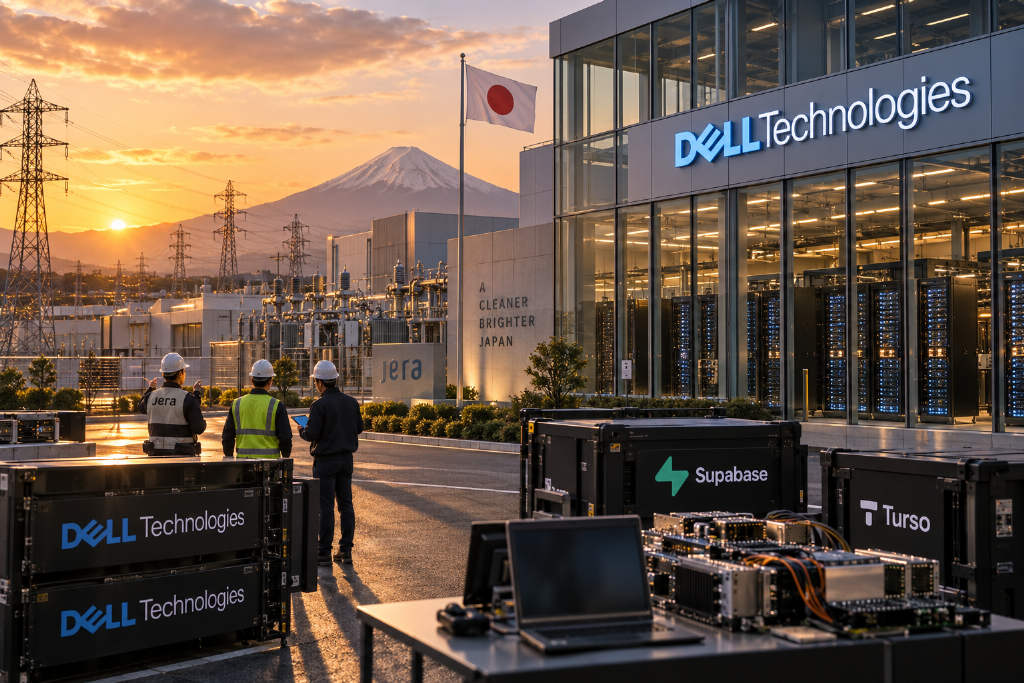
WuBlockchain’s WhiteLine Daily rounded up several AI infrastructure developments across data center capacity, database platform financing and M&A, power-connected compute projects in Japan, and chip interconnect technology.
Applied Digital brings another 75 MW online
Applied Digital, a U.S. AI data center developer, said Phase 2 of Building 2 at its Polaris Forge 1 campus in North Dakota has reached Ready for Service. The update adds three 25 MW data halls, or 75 MW of operational IT load.
That means the full 150 MW in Building 2 is now complete, lifting actual operating capacity at Polaris Forge 1 from 175 MW to 250 MW. The campus is fully leased, and total contracted capacity at full build-out stands at 400 MW. By that measure, 62.5% of contracted capacity has moved into the operating stage.
WhiteLine Daily said the more immediate issue for revenue realization is not signing additional leases, but whether the remaining 150 MW can be delivered on schedule.
Supabase raises $150 million and acquires Turso
Open-source Postgres development platform Supabase said it has raised a new $150 million round led by GIC, with participation from Alphabet’s independent growth fund CapitalG, IronArc, SquarePeg and others. The company also announced the acquisition of database platform Turso to expand database infrastructure built for AI agents.
Supabase said it is adding more than 1 million users and 4 million databases every month. About 70% of new databases, it said, are now created by agents or AI-driven tools. The company also said its database count in June this year was up 600% from a year earlier.
Supabase currently has more than 13 million developer users. After the Turso acquisition, it plans to focus on supporting large numbers of agents that create standalone databases on demand.
WhiteLine Daily’s takeaway was that once 70% of new databases are being created by agents, the incremental effect of AI coding is no longer limited to code generation. It is starting to change database creation frequency, cost structures, and infrastructure design.
JERA, Dell and RHAELM plan a 400 MW AI infrastructure project in Japan
JERA, Japan’s largest power company, Dell Technologies, and U.K.-based AI infrastructure developer RHAELM signed a memorandum of understanding to build a nationwide AI infrastructure development framework in Japan.
The first project is planned near JERA’s Chiba thermal power plant. It is expected to involve more than $15 billion in total capital investment and provide up to 400 MW of power capacity. The project will use a behind-the-meter model, connecting directly to JERA’s existing generation assets to shorten the wait associated with traditional grid interconnection.
RHAELM will handle development, operations and financing. Dell will provide standardized rack-scale AI infrastructure. Apollo Global Management is expected to participate as a strategic investment and financing partner. The project is scheduled to begin phased operations in 2028 and reach full capacity in 2029.
WhiteLine Daily said the key value in the 400 MW project is not simply more data center floor space. The point is to cut one of the main construction bottlenecks by colocating power supply and compute.
Volantis raises $88 million for optical interconnects
San Francisco AI chip startup Volantis has raised $88 million to develop optical interconnect technology that uses lasers to link compute chips with memory chips.
According to the report, high-end GPUs from Nvidia and AMD currently rely on HBM for high-speed memory, but conventional electrical interconnects limit how many memory chips can be connected around a single GPU because of distance constraints. Volantis plans to use VCSEL lasers for data transmission. The company said its approach could allow as many as 220 memory chips to connect around one GPU, versus roughly 8 for today’s top-end GPUs.
Volantis plans to launch its first chip next year and hopes to use the existing VCSEL supply chain to reduce development and manufacturing difficulty. WhiteLine Daily noted that moving from about 8 chips to as many as 220 represents roughly a 27-fold increase, while the real test will come with next year’s product performance and mass production.
Main thread of the day
WhiteLine Daily said Supabase is dealing with infrastructure expansion after agents began creating databases at scale, Applied Digital has already put 250 MW into operation, JERA is planning a 400 MW power-linked project, and Volantis is trying to extend the connection range between GPUs and memory. As AI applications expand, database scaling, available power, and memory interconnects are emerging as the next set of constraints to solve.