
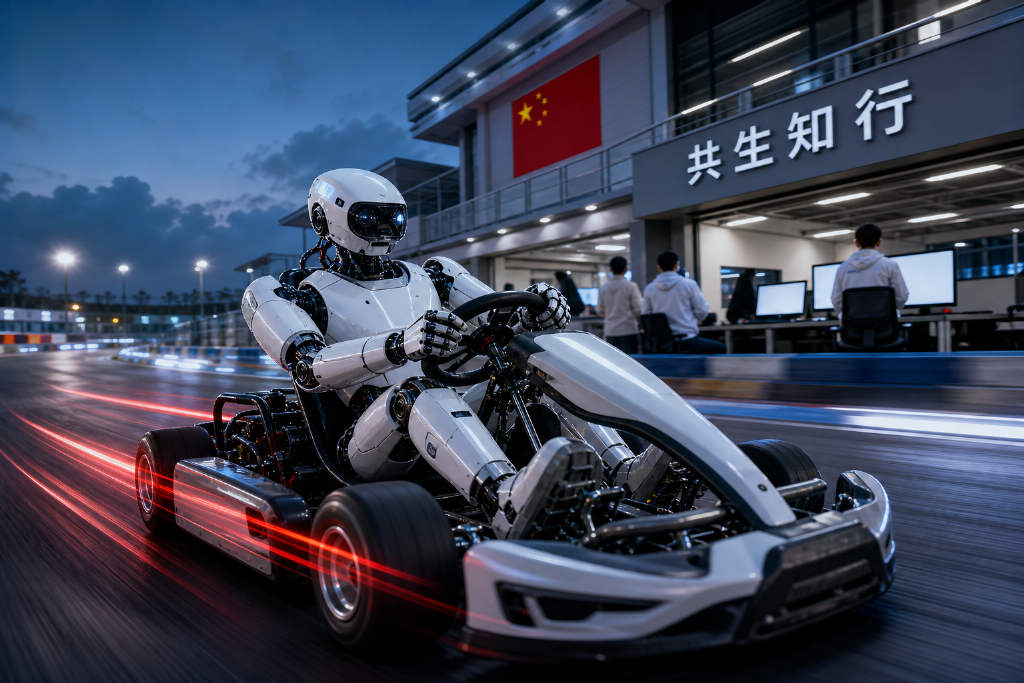
A two-month-old startup is taking aim at one of the hardest problems in humanoid robotics: building an end-to-end integrated sensing-and-control "brain" for biped robots.
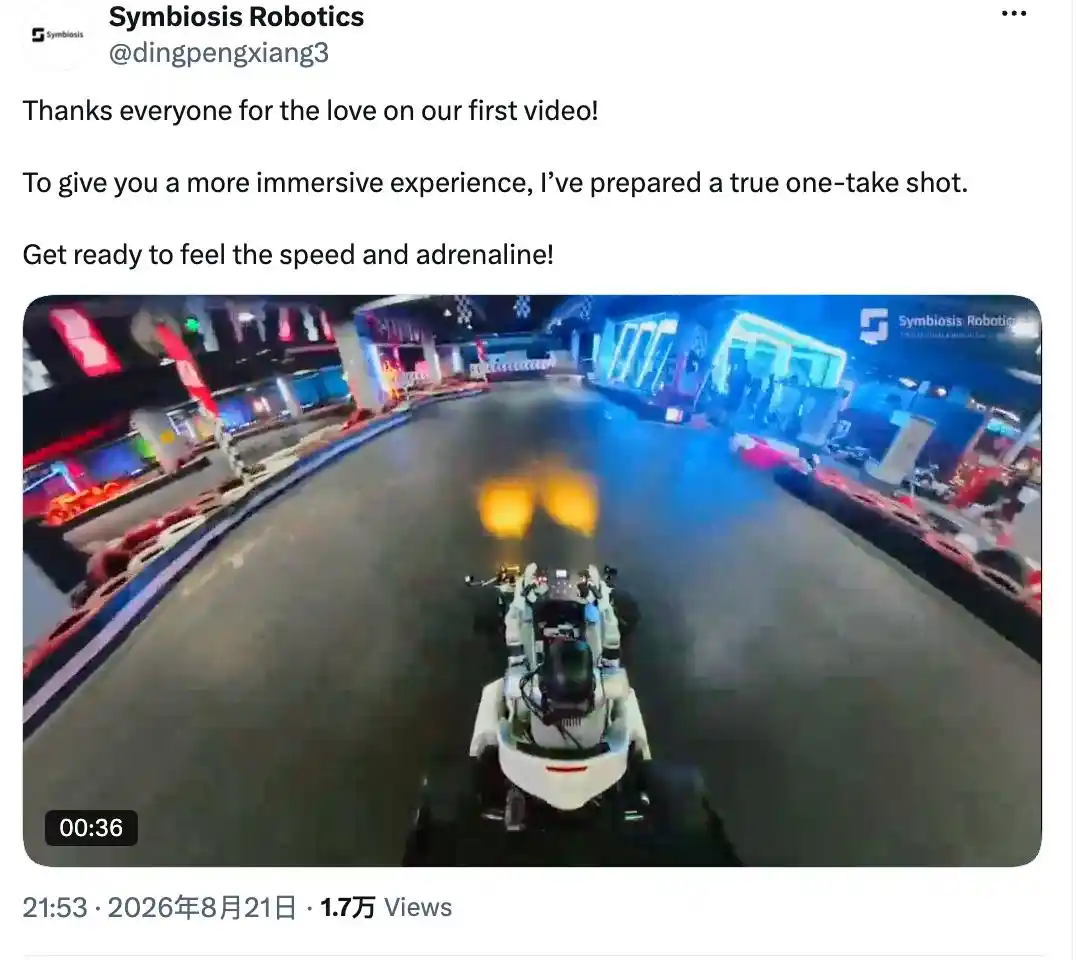
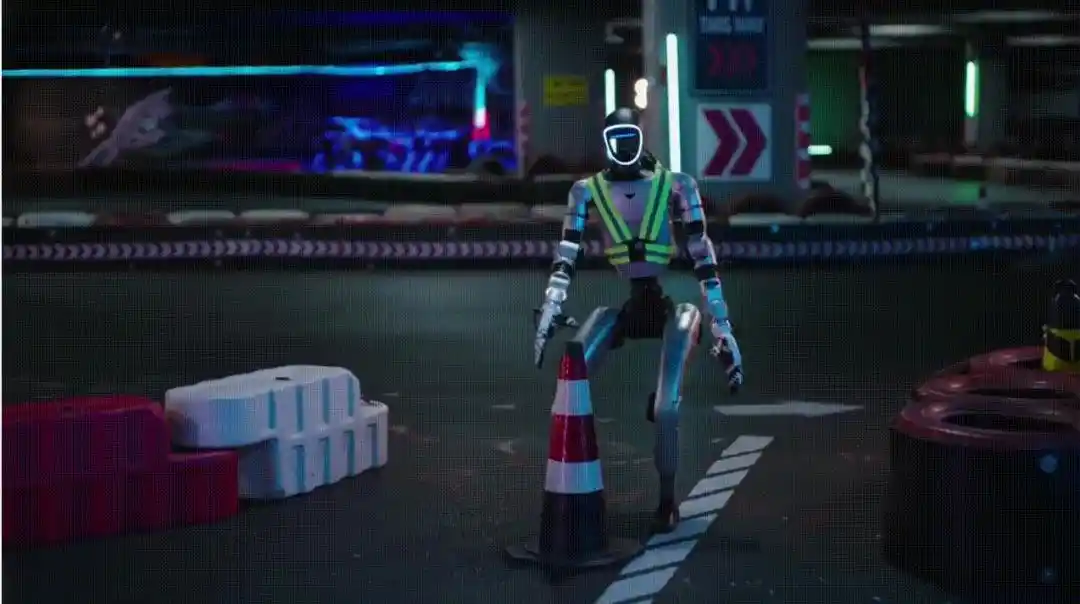
The company, Symbiotic Zhixing, released a demo video showing a robot driving a go-kart around a track, steering, accelerating and taking corners in one continuous shot. The clip stands apart from the more familiar humanoid demos centered on running, staged movement, or slow pick-and-place tasks. In this case, the robot is seated in the vehicle and coordinates eyes, hands and feet while maintaining multi-contact balance and fine force control at speed.
Founder Ding Pengxiang, who was born in 1996, said the point of the demo was not novelty for its own sake. He said he wants robots to behave more like humans rather than only performing rigid service functions, adding that if humans can drive a go-kart, robots should be able to do it as well.
Symbiotic Zhixing is focused on what it calls an end-to-end integrated sensing-and-control base model for biped humanoids. The company’s view is that if robots are expected to operate in real-world environments rather than in tightly scripted settings, they need a unified system that connects perception, understanding and action.
Why the team moved away from layered architectures
Ding said end-to-end models for biped humanoids are still new enough that there is little ready-made talent in the market. In his account, the field only started gaining traction over the past two years, and many of the people with the deepest technical understanding are still PhD students. Researchers who left school years ago may not be moving at the same pace, while those without doctoral-level training often lack enough grounding in the underlying systems.
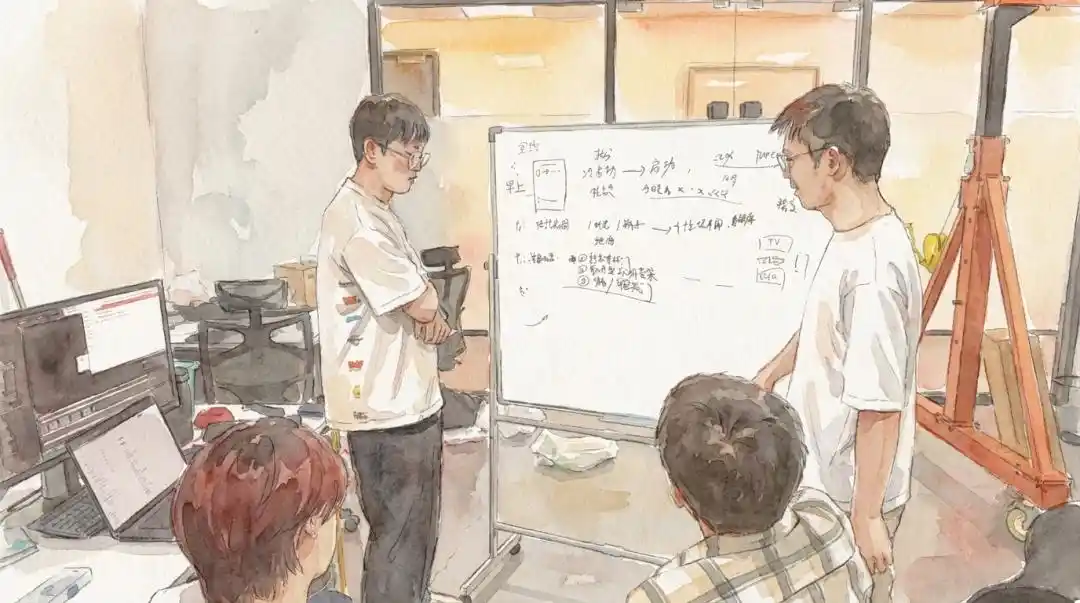
That hiring reality is reflected in the team itself. Ding said the core team beyond him is made up of people born after 2000, all of them current doctoral students. The company says the group has won two Best Paper awards in embodied intelligence in China, had another work selected as a Best Paper Candidate, and built the country’s first embodied foundation model project to exceed 2,000 GitHub stars. It also says team members have published more than 40 papers at top conferences across perception, decision-making, control, data and systems, including work spanning dual-system designs, lightweight architectures and multi-morphology research.
The company’s thesis has two parts. First, it believes biped humanoids will be the form factor most widely integrated into human life. Second, drawing from the paths taken by autonomous driving and large models, it sees end-to-end systems as the more efficient technical route.
Ding did not start from that position. In December 2023, he began working on what he described as giving a "brain" to quadruped robots. As first author, he released QUAR-VLA, which he described as the first VLA task paradigm for quadrupeds. In that setup, a high-level model handled vision, language and task intent, while a lower-level motion system executed the decisions. That split between a decision-making "brain" and an execution-focused "cerebellum" is the layered approach widely used in the field. Ding said companies such as Figure still use similar schemes.
Over time, though, he came to see limitations in that structure. He described layered design as theoretically workable but not elegant. In practice, the upper and lower systems optimize separately, and each new task often requires custom fine-tuning of upstream outputs before performance becomes acceptable.
He also argued the problem is structural. If the "brain" and "cerebellum" are trained separately and only stitched together at deployment, stronger local modules do not guarantee a globally optimal system. Each translation between layers introduces cascade error and information loss. On that basis, Ding said any layered architecture contains an information bottleneck in the middle, and that interface design keeps it from reaching true scaling.
His reasoning also comes from watching autonomous driving and large-model development over time. Early autonomous driving systems depended on separate perception, prediction, planning and control modules. Later work moved toward learning driving behavior directly from data. Ding said Tesla’s Full Self-Driving, or FSD, saw a major performance improvement after shifting to an end-to-end approach. He believes robotics may undergo a similar transition, with models learning the full chain of perception, understanding and action directly from data.
In his view, once a team has repeatedly explored the layered route since 2023, there is little value in taking another detour if data scaling is likely to push the industry toward end-to-end systems anyway.
A more aggressive path in a market that has not converged
Ding said signs of that transition are already visible in 2026. Google’s Gemini Robotics 2 has used a single policy to unify full-body motion from feet to fingertips in one model. At the same time, a consensus statement at RSS 2026 said a single end-to-end model still cannot cover the full complexity of whole-body dynamics, and that modular layered systems remain the best deployment option for now.
That leaves Symbiotic Zhixing on a more aggressive path, one with fewer participants.
Why focus on bipeds rather than wheeled machines or other robot forms? Ding framed the answer as a first-principles question. Human buildings, tools and environments were created around the human body. Wheeled robots can work in fixed places such as production lines and shopping malls, but bipeds can go outdoors, climb stairs, drive vehicles and switch across scenes and tasks. He said that kind of generality spreads cost over a wider range of use cases, while humanoid form also brings a degree of familiarity for people.
Timing matters as well. Ding said that before April 2026, biped humanoids did not even have a general-purpose teleoperation model, which meant there was no stable source of data for training a foundation model. He said the industry only gained a base for large-scale data production after NVIDIA Sonic was open-sourced.
From his perspective, the field is no longer stuck in the phase where teams want to train but do not have the data. It also has not matured to the point where technical paths have fully converged. Symbiotic Zhixing is betting on that middle window.
The real dividing line: from kinematics to dynamics
Ding argues that most current robot foundation models still learn kinematics. Kinematics is concerned with getting from point A to point B: where the hand moves and whether the grasp succeeds. That is workable for a fixed-base robotic arm because the system does not have to worry about falling over.
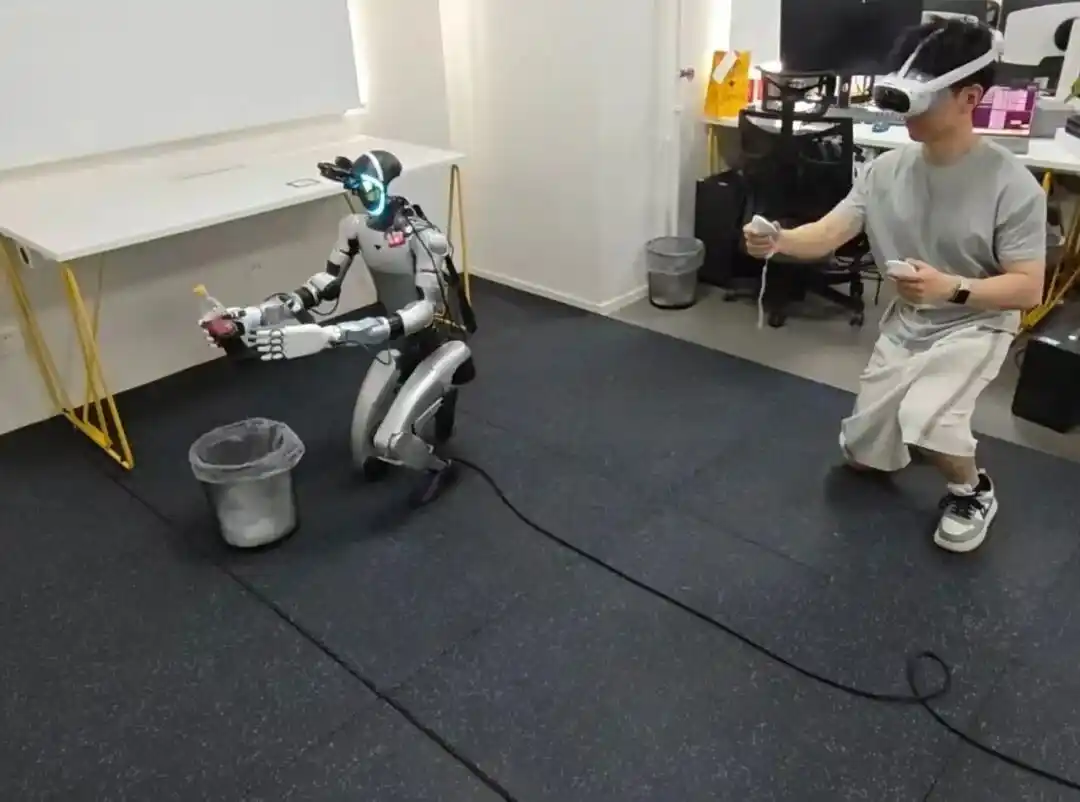
Biped robots face a different problem. When a humanoid reaches for an object, its center of mass changes at the same time. When it squats to pick something up, the torso has to tilt forward, while the ankles and legs redistribute force to preserve balance. Add friction, collision, inertia and contact, and the model is dealing with full-body dynamics rather than isolated movement planning.
Ding said a G1 biped humanoid has 29 degrees of freedom, far more than the seven degrees of freedom in a robotic arm. Older systems learned action trajectories. Humanoids, in his framing, have to learn how a body acts inside the physical world. That shift, from kinematics to dynamics and from task completion to stability maintenance, is what he sees as the real technical boundary in biped robot models.
That explains why Symbiotic Zhixing pushes its model down to the Joint Target layer. In a layered system, the high-level model outputs a kinematic target and the downstream "cerebellum" converts that into joint actions. Symbiotic Zhixing removes that middle step and has the model face the state of dozens of joints directly.
That raises an obvious question: if the cerebellum is removed, can the robot still stay upright? Ding said imitation learning alone is not enough. It teaches the model standard motions, but it does not expose the system to the stumbles, instability and unfamiliar body states that occur during execution. When the model meets a state outside what it has seen, the robot may simply fall. What it lacks is the ability to recover stability after failure.
One model for task intelligence and body intelligence
To deal with that, the company uses what it calls a dual-domain collaborative optimization mechanism that combines task behavior modeling with motion-prior distillation.
One optimization path continues behavior cloning so the model keeps task precision and motion fitting capability. The other uses DriftDistill to transfer stability, disturbance resistance and failure recovery accumulated by low-level controllers into a unified motion prior inside the model.
Ding said this is not just a matter of stacking two loss functions. The idea is to fuse two capabilities in the same model: accurate task execution and stable body control. In his description, that gives the large model both task intelligence and body intelligence.
If DriftDistill keeps scaling with model size and data volume, the issue it is trying to address is larger than cognitive scaling alone. It asks whether motion control can scale as well.
Ding calls the module that aggregates these movement capabilities Motion Expert. He said it is currently close to 1 billion parameters and continues to absorb capabilities from different motion-control models through distillation.
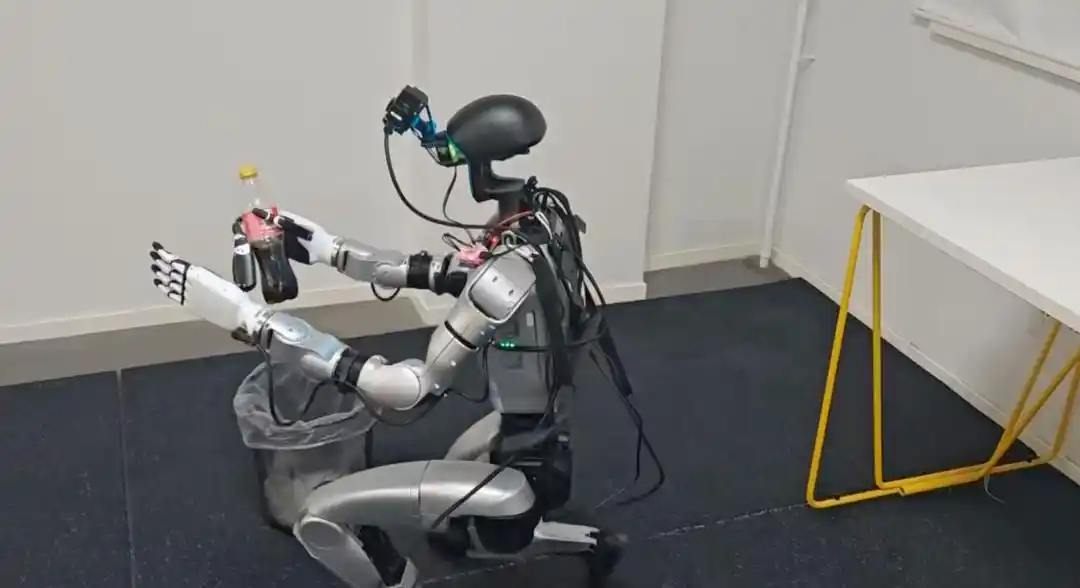
The next layer of the problem is force. Ding said many robot systems today mainly control position, but once robots enter real-world settings, correct position does not guarantee task completion. A hand can reach the drawer handle and still fail to open the drawer if the system does not know how much force to apply. A robot can also hand an object to a person at the right position while still creating a safety issue if the force is too great.
Symbiotic Zhixing’s path is to first build Force Expert as a safe-contact specialist that learns force application, compliance, impedance and contact feedback, then gradually distill those capabilities into Motion Expert and eventually into the end-to-end model. Ding summarized the distinction this way: position determines whether a robot can get there, while force determines whether it can actually get the job done.
That is also what the company means by a full-body physical world model. The model should understand how the body takes force, loses balance and makes contact, then turn those constraints directly into action.
Data remains scarce, and the industry still disagrees on format
The first hard constraint in training is data scarcity. Ding said that by early 2026, total compliant robot data worldwide was about 500,000 hours, less than one twenty-thousandth of the volume available to large language models.
Much of that data, he added, comes from stationary manipulation, where robots work in place in constrained spaces. That offers limited help for full-body mobile manipulation. Symbiotic Zhixing said its blog has released a little over 10,000 hours of data, with several thousand hours collected in-house.
What is really scarce, in his view, is strongly coupled full-body mobile-operation data from real life, such as riding a bicycle, driving a go-kart or inflating a basketball. Those tasks put heavier demands on coordination, balance and contact control, and they provide a better test of where end-to-end models break down.
To address that, the company uses a method called TrajBooster. It extracts end-effector trajectories from robotic arms or wheeled robots, then has a humanoid track those trajectories in simulation while maintaining balance. The goal is to map movements from different robot types into a shared space and reuse the task diversity already defined by robotic arms, giving pretraining data at lower cost.
When discussing model capability, Ding said he rarely uses the word "generalization." He considers it too vague. The word he prefers is "emergence." His example is at the joint-angle level: if the model is trained on walking and jumping, then produces running on its own during testing, that would be the kind of capability he cares about. He argues that only at the joint level can partial motion abilities recombine into an entirely new skill.
A cautious timeline for commercialization
Despite the ambitious technical bet, Ding was cautious on timing. He said around 100,000 hours of data may still support mostly lab-level demos, while large-scale commercial significance may not arrive until data volumes move past 1 million hours.
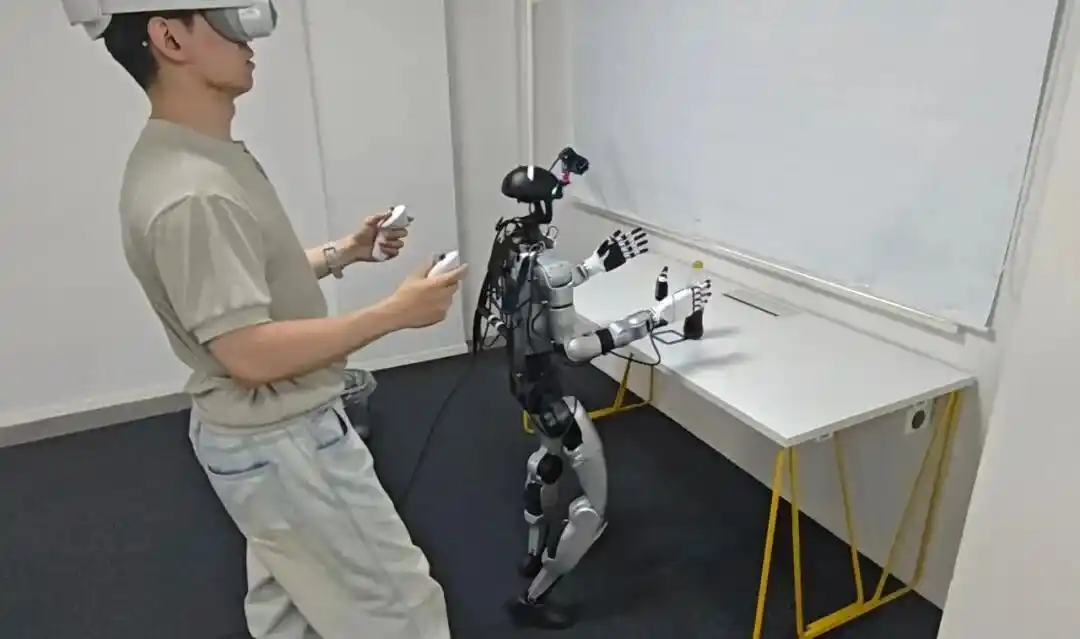
He also said the industry has not even converged on the right data form. Routes based on electromyography, exoskeletons, motion capture and Pico teleoperation are still competing. In his ranking of the hardest problems in humanoid robotics today, the first is how perception and control should be combined, the second is what type of data should be used, and only the third is data scale itself.
Ding said he hopes robot model architectures designed by Chinese teams will one day be widely adopted in North America as well. "We don’t want to be followers. We want to lead the development of the technology," he said.
The go-kart video is the hook, but the company is making a broader claim. Its bet is that end-to-end systems may eventually replace layered ones in biped humanoid robotics, provided the model can learn not only tasks but also stable control of the body and force in the physical world.
Ding also acknowledged that the biped foundation model sector has not yet converged and that no one has proved the final route. For Symbiotic Zhixing, that is exactly the point: it chose to start with the harder problem before the answer is settled.
This article was sourced from the WeChat public account Quantum Positioning (量子位, ID: QbitAI) and written by Qiao Buchi.