
The Taiwan FinTech Association (TFTA) held an online forum in June titled “Financial Cybersecurity and Anti-Fraud — Breaking Down Virtual Asset Scam Tactics,” bringing together BitoGroup founder and CEO Cheng Kuang-tai, Criminal Investigation Bureau officer Hung Cheng-chi, and blockchain YouTuber Shui Feng Dao to examine newer forms of tech-enabled fraud from the standpoints of exchanges, law enforcement, and public education.
Shui Feng Dao breaks down “secondary fraud”
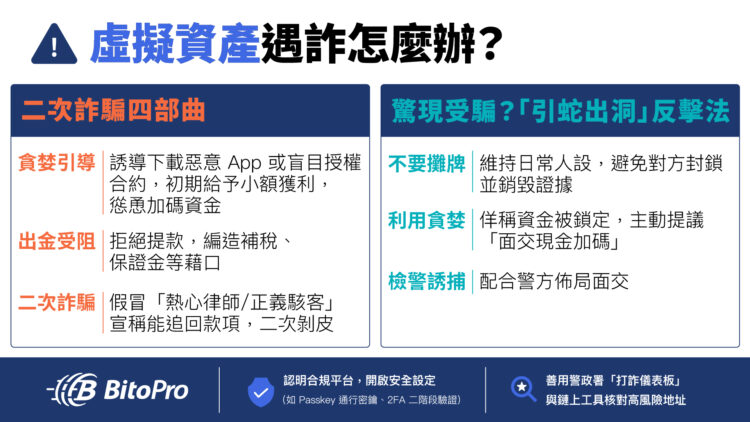
Shui Feng Dao said the end-stage form of virtual asset fraud is “secondary fraud.” He described a four-step pattern often used by scam rings. Victims are first shown small gains, then pushed to commit larger amounts in pursuit of bigger returns. Later, withdrawals are blocked, with scammers citing taxes, deposits, or other pretexts to demand more money. Victims may then be told to move funds into malicious apps or websites that are hard to distinguish from legitimate ones. In the last stage, scammers isolate victims from family and outside help, then impersonate lawyers or hackers and claim they can recover the funds, pulling victims into a second scam.
Cheng Kuang-tai says exchanges have built technical defenses
Cheng said bad actors often exploit information gaps through combined scam tactics. As a compliant trading platform, Bito has invested in technical defense systems that include international-grade know-your-customer modules to identify and monitor customer identities and meet anti-money laundering (AML) and counter-terrorist financing (CFT) requirements. The platform has also deployed suspicious transaction monitoring to detect unusual activity and uses its customer service team to make phone calls to high-risk users.
On cross-sector coordination, Cheng said the exchange has connected with reporting systems used by prosecutors, investigators, and banks in order to share intelligence on suspicious fund flows, while also cooperating with legal authorities in handling abnormal accounts. He added that users can make use of security features offered by platforms, including Passkey and two-factor authentication (2FA), to improve account protection.
Police: more than 70% of cases involve fake relationships tied to investment
Hung, an investigation captain at the Criminal Investigation Bureau’s fraud crime prevention center, said more than 70% of cryptocurrency scam cases fall into the category of “fake relationship combined with investment.” According to him, scam groups often spend months building trust through casual conversation before guiding victims step by step to buy USDT on compliant domestic exchanges and send it to illicit wallets.
Hung also challenged a common misconception. In many cases, he said, victims do not lose assets because their wallets were hacked. Instead, they may lack basic security awareness and accidentally leak screenshots of private keys or seed phrases, or they authorize malicious smart contracts, effectively handing over the keys themselves.
Advice from law enforcement: verify cases and wallet addresses, do not confront scammers right away
For prevention and response, Hung said the public can check the latest scam cases through the Ministry of the Interior National Police Agency’s anti-fraud dashboard. If they come across a suspicious wallet address, they can also use on-chain tools to see whether that address has already been marked as high risk.
If a person realizes they have been scammed, Hung said they should not expose that fact immediately, because doing so may lead the scammers to block contact and destroy evidence. He suggested maintaining the existing persona and claiming the funds are temporarily locked, then using the scammer’s greed to propose an in-person cash handoff and coordinating with investigators to set up that meeting.
Industry plans to introduce the Travel Rule
Cheng said fighting virtual asset crime cannot be left to one party alone. Exchanges, law enforcement agencies, and civil education efforts need to work together, while the public also needs stronger fraud awareness and defensive habits to support a safer digital asset environment.
He also said domestic industry participants plan to introduce the Travel Rule, an international standard that collects and verifies sender and recipient information to strengthen transaction monitoring, reduce money laundering and terrorist financing risks, and improve transparency in the financial system.
The content was provided by Bito. The article was first published by Blockcast.