
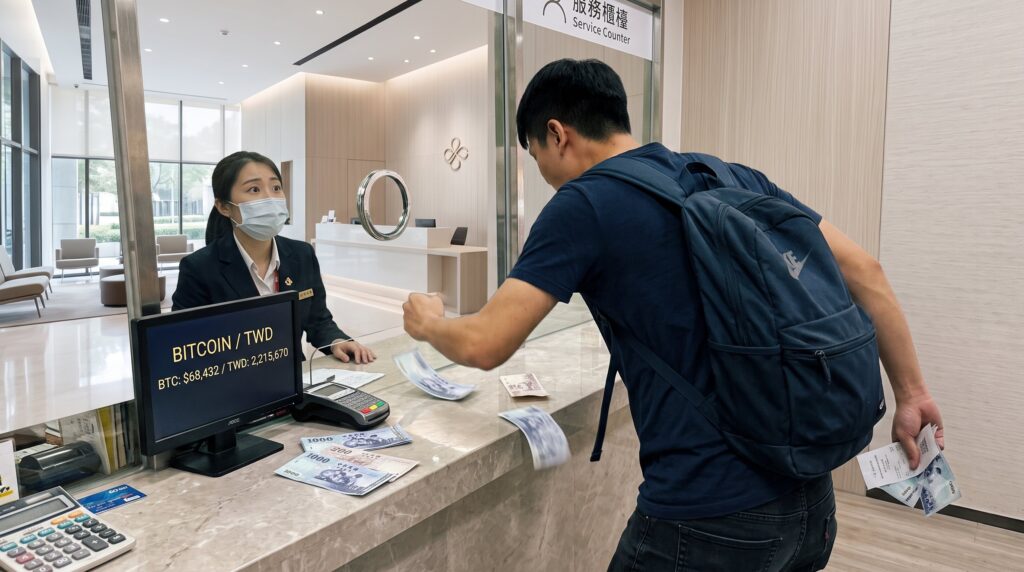
Taiwan’s Financial Supervisory Commission is preparing to introduce the crypto Travel Rule in stages, with added identity requirements for transfers above NT$30,000 conducted through domestic virtual asset service providers, or VASPs.
Huang Chung-hao, deputy director-general of the FSC’s Securities and Futures Bureau, said that when Bitcoin and other virtual assets are transferred through domestic VASPs, individuals will need to provide their date of birth and residential address if a single transaction exceeds NT$30,000. Legal entities will need to provide an official identification code and registered address. The receiving VASP will also have to check the beneficiary information provided by the sending side against its own customer records.
The mechanism is formally known as the Travel Rule. In practice, it requires customer identity data to move with the funds so that both the sending and receiving VASPs know who is on each side of a transfer. Traditional wire transfers already follow this model. In crypto, the rule has been pushed by the Financial Action Task Force, or FATF, because of the sector’s pseudonymous and cross-border features.
Huang said the added birth date and address requirements are intended to deal with people who share the same name.
Why the threshold was set at NT$30,000
FATF sets the de minimis threshold for virtual asset transfers at no more than $1,000 or €1,000. Europe and the United States use that level in their anti-money laundering frameworks, and Taiwan’s FSC used it as a reference point.
The report said NT$30,000 is about $926, placing it just below FATF’s $1,000 benchmark.
Transfers below that threshold are not exempt from information-sharing requirements. Under FATF standards, lower-value transfers still need to carry a simplified data set, including the names of the originator and beneficiary, plus an account number, which in crypto is typically a wallet address, or a transaction identifier. The NT$30,000 line determines whether birth dates and addresses must be added, not whether any information must be shared at all.
The legal basis has existed since 2021
The Travel Rule is not a new concept in Taiwan. The relevant provisions were added in 2021 to the Regulations Governing Anti-Money Laundering and Countering the Financing of Terrorism for Enterprises or Persons Providing Virtual Asset Services, but they were never implemented in practice.
The FSC cited three reasons: inconsistent rules across jurisdictions, non-uniform data transmission standards, and difficulty integrating cross-border systems. The third issue is especially important. The Travel Rule only works if the sending and receiving VASPs can communicate with each other. If the counterparty does not have a compatible system, the information cannot be transmitted to another provider.
With Taiwan’s crypto-specific law having already passed its third reading, the FSC is now moving to bring the Travel Rule into the operating framework for crypto service providers.
Two-stage rollout, with overseas transfers covered later
The implementation plan is split into two phases. The first stage is expected to begin in October 2026 and will apply only to transfers between domestic VASPs, meaning Taiwan’s eight registered providers would connect with each other first. The second stage would cover transfers between domestic and overseas VASPs by the end of 2027.
Taiwan currently has eight VASPs that have completed anti-money laundering registration: HOYA BIT, Tuo Huang Digital Technology, MaiCoin, KryptoGO, TWEX, Chainss, BitoPro and XREX.
On Aug. 4, the Virtual Currency Commercial Association of the Republic of China said it would coordinate member platforms on the required technical integration for both phases. It also noted that major markets including Singapore, Japan and the European Union have already implemented the Travel Rule.
Draft amendment still needs public notice
The report noted that the amendment draft still has to be published in the Executive Yuan Gazette and on the FSC website for a 30-day notice period before the formal amendment process can move ahead. That means the October 2026 timeline remains a plan rather than a finalized effective date.
Based on Huang’s explanation, the FSC still expects the rollout to proceed on that schedule if there are no major changes in the process.
What information would be required
- For transfers above NT$30,000: individuals must provide date of birth and residential address.
- For transfers above NT$30,000: legal entities must provide an official identification code and registered address.
- Receiving VASPs must compare beneficiary information with their own customer records.
- Transfers below the threshold still require simplified data, including names and an account number, wallet address or transaction identifier.