
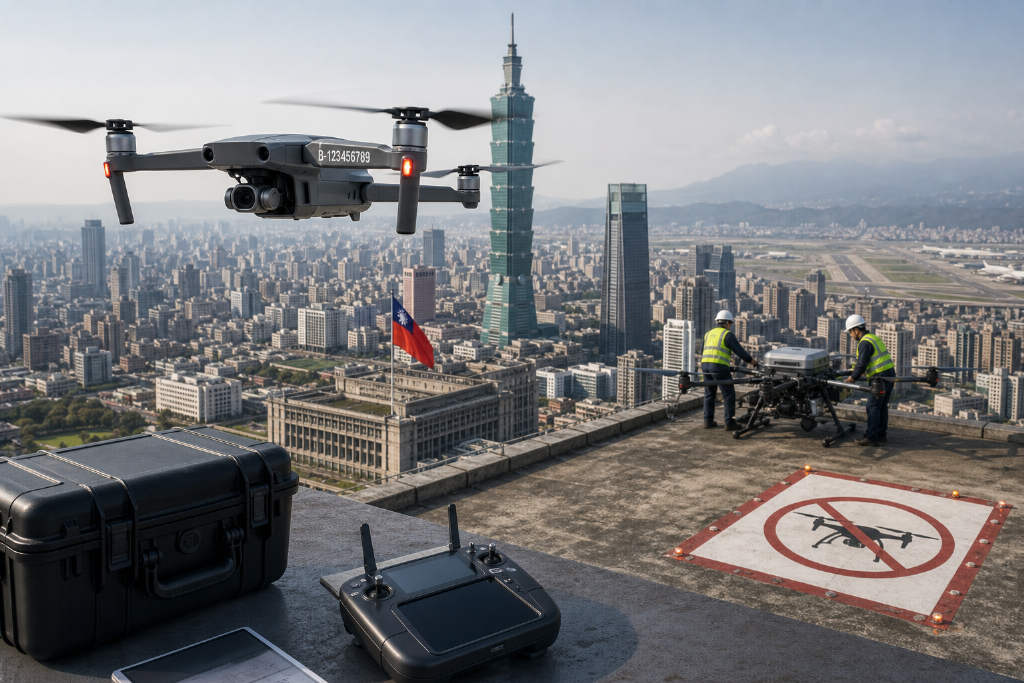
Taiwan’s drone rules now span nearly every part of civilian flight activity, from registration and operator licensing to inspections, airspace controls and legal liability. The framework includes registration for drones weighing 250 grams or more, operator certificate requirements tied to the 2 kg line, mandatory inspection for larger aircraft, a 400-foot airspace split and penalties that can reach NT$1.5 million.
In June 2026, Taiwan’s Executive Yuan proposed a special national defense statute with a NT$210 billion budget. The plan calls for the procurement of about 210,000 unmanned vehicles from August 2026 through the end of 2031, including about 208,200 coastal attack drones, about 1,446 coastal reconnaissance drones and about 1,320 small suicide unmanned boats.
At the same time, civilian hobbyists say operating space is getting tighter. In July 2026, a group of drone players formed the “313 Anti-Unequal Airspace Alliance” and protested at Taiwan’s transport authority, arguing that no-fly and restricted zones were growing “like a virus.” They said areas such as the New Taipei riverbank and Yangmingshan, once used for practice, had been turned into restricted areas one after another.
The group put forward five demands: transparent standards for designating airspace, a full review of the reasonableness of current restricted zones, permission to fly 30 minutes before sunrise and 30 minutes after sunset, public disclosure of airspace management information and a complaint and relief mechanism.
Registration starts at 250 grams
Taiwan’s drone regulators are the Civil Aviation Administration’s drone division and city and county governments. The legal basis is the “Remotely Piloted Drones” chapter of the Civil Aviation Act, Articles 99-9 through 99-19, along with the Rules Governing the Management of Remotely Piloted Drones issued by the Ministry of Transportation.
Under Article 6 of the management rules, drones owned by natural persons must be registered if their maximum takeoff weight is 250 grams or more. Drones owned by government agencies, schools and legal entities must all be registered regardless of weight.
Registration is handled through the drone management information system at drone.caa.gov.tw, using a digital citizen certificate or a national health insurance card. The registration number must be marked on the aircraft. It remains valid for two years and must then be renewed. A November amendment in year 113 lowered the registration age from 16 to 14. Operating an unregistered drone carries a fine of NT$30,000 to NT$150,000 under Article 118-2 of the Civil Aviation Act.
Licenses depend on weight and ownership
For private owners, the 2 kg line determines whether a certificate is required.
If a drone is owned by a natural person, weighs 2 kg or more at maximum takeoff and is equipped with navigation equipment, the operator must hold an operator certificate. Drones under 2 kg are exempt, and model aircraft receive a looser threshold of under 15 kg. For drones owned by government agencies, schools or legal entities, operators must hold a certificate regardless of weight.
Article 20 of the management rules sets out three certificate levels:
- Student operator certificate: available from age 14.
- Standard operator certificate: requires age 18 or older and a written test.
- Professional operator certificate: the highest threshold, requiring a medical check plus both written and practical tests.
A standard operator certificate is valid for three years, and renewal does not require retesting. Operating without a certificate can result in a fine of NT$60,000 to NT$300,000 under Article 118-2.
Drones above 25 kg must be inspected
Drone design, manufacturing and modification require type inspection approval. Imported models may apply either for type inspection or recognition, under Article 13 of the management rules and Article 99-11 of the Civil Aviation Act. Aircraft with simple structural types may be exempt.
Drones with a maximum takeoff weight of 25 kg or more must also undergo physical inspection. The approval certificate is valid for three years. Operators without a valid inspection certificate face fines of NT$60,000 to NT$300,000. Separate violations involving inspection, recognition or maintenance checks can bring fines ranging from NT$10,000 to NT$1.5 million under Article 118-3.
Airspace is split at 400 feet
Taiwan uses a dual-track airspace system shared by central and local authorities. Airspace above 400 feet, no-fly zones, restricted zones and a defined area around airports are managed by the Civil Aviation Administration. Surface airspace below 400 feet is designated by city and county governments under Article 99-13 of the Civil Aviation Act.
Drone operators can check the official airspace map in the drone management information system. The map uses green, yellow and red zones. General users may fly only in green zones, while red zones are not open for applications. Entering a no-fly zone, a restricted zone, an airport perimeter area or flying above 400 feet carries the harshest penalties: NT$300,000 to NT$1.5 million, with possible confiscation of the drone and revocation of the operator certificate under Article 118-1.
Operational rules: five musts, five must-nots
Compliance does not end with registration and licensing. Taiwan’s rules also set flight conduct requirements, described as “five musts” and “five must-nots.”
Operators must fly during daytime, from sunrise to sunset, keep the drone within visual line of sight, remain below 400 feet, continuously monitor the aircraft and surrounding conditions and comply with all other management restrictions.
They must not approach and collide with aircraft, buildings or obstacles, throw or spray objects, carry dangerous goods, operate over crowds or outdoor assemblies and parades or control more than two drones at the same time as a single operator.
Article 28 and related provisions add more limits. Drones must stay at least 30 meters away from highways, railways and buildings. They may not be operated from moving aircraft, vehicles or vessels. Drones equipped with navigation devices may not exceed 87 knots, about 160 kilometers per hour. Extended visual line of sight operations, or EVLOS, are capped at a 900-meter radius and no more than 400 feet in altitude. Operators also may not use tools other than corrective lenses, such as telescopes, to extend visual range. Violating operating rules can trigger fines of NT$30,000 to NT$150,000 under Article 118-2.
Penalty ladder runs from NT$30,000 to NT$1.5 million
The enforcement structure breaks down into several tiers:
- Entering no-fly zones, restricted zones or airport perimeters, or flying above 400 feet: NT$300,000 to NT$1.5 million, with possible confiscation and certificate revocation under Article 118-1.
- Operating without a certificate, or failing to obtain required liability insurance: NT$60,000 to NT$300,000 under Article 118-2.
- Operating without registration, violating local government notices or breaking flight operation rules: NT$30,000 to NT$150,000 under Article 118-2.
- Violations involving inspection, recognition or maintenance checks: NT$10,000 to NT$1.5 million under Article 118-3.
- Drones weighing 25 kg or more without a valid inspection certificate: NT$60,000 to NT$300,000.
2026 changes bring Remote ID and geofencing issues
Additional technical requirements are being phased in during 2026. Article 99-10 of the Civil Aviation Act says drones above a certain weight must have radio-frequency identification, or RF ID, also referred to as Remote ID, when they are manufactured, imported, registered or issued a renewed registration number, and the function must meet Civil Aviation Administration standards.
Separately, drones with a maximum takeoff weight of 1 kg or more and equipped with navigation equipment must include mapping software and active restriction or warning functions to prevent accidental entry into no-fly zones, restricted zones and airport perimeter areas.
The dispute centers on implementation. According to the article, geofencing will be updated dynamically and will require drone firmware to link with the Civil Aviation Administration database. If a temporary no-fly restriction is imposed, such as during military drills, a drone could be locked by the system and prevented from taking off. Aircraft without Remote ID capability would be limited to designated areas.
That concern sits behind one of the alliance’s main demands for public airspace management information. Hobbyists say the issue is not only shrinking airspace, but also the possibility that flight rights could be determined remotely by a database they cannot see.
Liability, insurance and reporting duties
Under Article 99-15 of the Civil Aviation Act, owners are liable for compensation in cases of injury, death or property loss. Government agencies, schools and legal entities must carry liability insurance. Recreational users are not required to do so, but the Civil Aviation Administration recommends buying coverage voluntarily.
Both owners and operators are responsible for safety, risk management and regulatory compliance. Flight safety incidents must also be reported under Article 99-9.
CAA proposes two easing measures
In response to public pushback, the Civil Aviation Administration has outlined two easing steps. First, a notice issued last November that expanded no-fly and restricted zones to 5 kilometers has been rolled back to the previous 3-kilometer range. Second, 23 no-fly and restricted zones added in June this year are being shifted to a “permission in principle, prohibition by exception” model, meaning they are normally flyable and only temporarily restricted during drills or major events.
The new rules are scheduled to take effect on July 24, 2026. As for the request to allow flights 30 minutes before sunrise and 30 minutes after sunset, the administration said that would require amendments to the Civil Aviation Act and that no timetable is currently in place.
Exports rise as tariffs add pressure
On the industry side, Taiwan’s drone exports are also climbing. Export value reached $115 million in the first quarter of 2026, more than the total for all of 2025. The biggest market was the Czech Republic, and most shipments were headed to the war in Ukraine.
At the same time, the United States has imposed additional tariffs on imported drones. Taiwanese products face a 15% rate, adding a new variable for the sector.
Taiwan is now pushing defense production and export growth while tightening civilian operating rules. The balance between safety and available flying space remains at the center of the debate.