
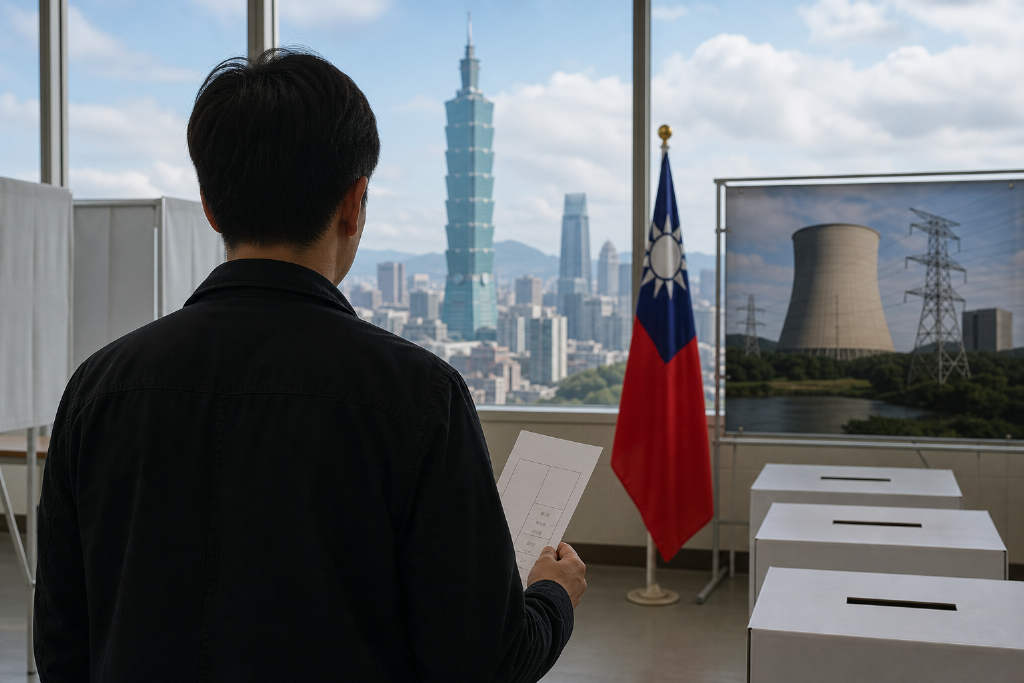
Taiwan’s legislature approved a referendum proposal on restarting nuclear power at a plenary session on Aug. 14, setting the vote for Nov. 28 alongside the island’s nine-in-one local elections.
The measure passed 59-51 and was cleared together with two other referendum proposals, one on caning and another on earmarking traffic fine revenue.
Final referendum wording narrowed during negotiations
According to a report cited from UDN, the Kuomintang caucus originally proposed a much broader text that folded in five themes: health, electricity supply, power prices, defense resilience and AI industry development. After negotiations at the Aug. 14 legislative session, the final wording was condensed to a single question:
「Do you support the government’s use of nuclear power to revitalize the economy, in order to abolish the ‘nuclear-free homeland’ energy policy?」
The proposal then cleared the vote with the numerical advantage held by the KMT and Taiwan People’s Party camp.
Only three of six proposed referendums advanced
The confrontation had at one point featured six proposed referendums. After negotiations, a cooling-off period and seat calculations, only three made it through.
- Passed: the KMT-backed proposals on restarting nuclear power and caning, plus the proposal on earmarking traffic fine revenue
- Failed to advance: the KMT’s anti-abolition-of-death-penalty proposal, along with the Taiwan People’s Party proposals on transfer voting and euthanasia
The report said the two Taiwan People’s Party proposals were mainly blocked because they did not secure KMT backing. Party caucuses also calculated that putting too many questions on the year-end ballot could dilute mobilization efforts and lengthen voting lines, leading them to trim the package and focus on three items.
Threshold for the referendum to take effect
Passing the legislature does not by itself make the referendum effective. The report said yes votes must surpass the legal threshold of 4,887,133, and yes votes must also exceed no votes.
Whether the “nuclear-free homeland” policy is overturned will be decided by the Nov. 28 count.
Power demand from AI became a central talking point
The report said the vote reaches beyond electricity prices and supply stability. It also touches the direction of energy policy at a time when AI data centers are expanding and adding to power demand.
Supporters argued that the nuclear issue has moved beyond the traditional blue-green political divide and is no longer only the position of a single party. They cited a recent survey by the Taiwan Inspiration Association, or TIA, saying 79% of respondents across Taiwan leaned toward supporting the restart of Nuclear Four. That figure was presented as evidence that the public is worried about tightening power supply and rising electricity prices.
Backers of the proposal also argued that, with changes in scientific research and international energy trends, the reasons behind the earlier “nuclear-free homeland” policy no longer match Taiwan’s current security and economic needs.
The original KMT wording had explicitly listed support for the development of the artificial intelligence industry as one of its appeals. The report said that detail points to a larger issue behind the referendum: as AI data centers continue to expand, Taiwan’s power shortfall is becoming harder to ignore.
NVIDIA CEO Jensen Huang, who visited Taiwan ahead of last year’s referendum on restarting Nuclear Three, publicly said that “nuclear is better” and directly linked nuclear power with AI factory capacity. The report said Taiwan’s ability to provide sufficient and stable electricity supply affects whether it can continue to absorb large AI supply-chain orders.
A similar referendum failed last year
This is not the first time a nuclear restart question has gone to a public vote. On Aug. 23, 2025, a referendum on restarting Nuclear Three was put to voters. Although yes votes outnumbered no votes, the measure failed because it did not cross the legal threshold.
One year later, the issue has returned, and this time the proposal directly targets the “nuclear-free homeland” policy itself, raising the stakes of the campaign.
In March this year, President Lai Ching-te said Nuclear Two and Nuclear Three had the conditions required for a restart. Taiwan Power Co. has also submitted a reoperation plan for Nuclear Three to the competent authority for review, and the process would still take about two years at the fastest, according to the report.
The report added that while the Nov. 28 referendum will not directly determine when nuclear plants resume power generation, the result will be an important signal on whether Taiwan’s energy policy is actually shifting.