
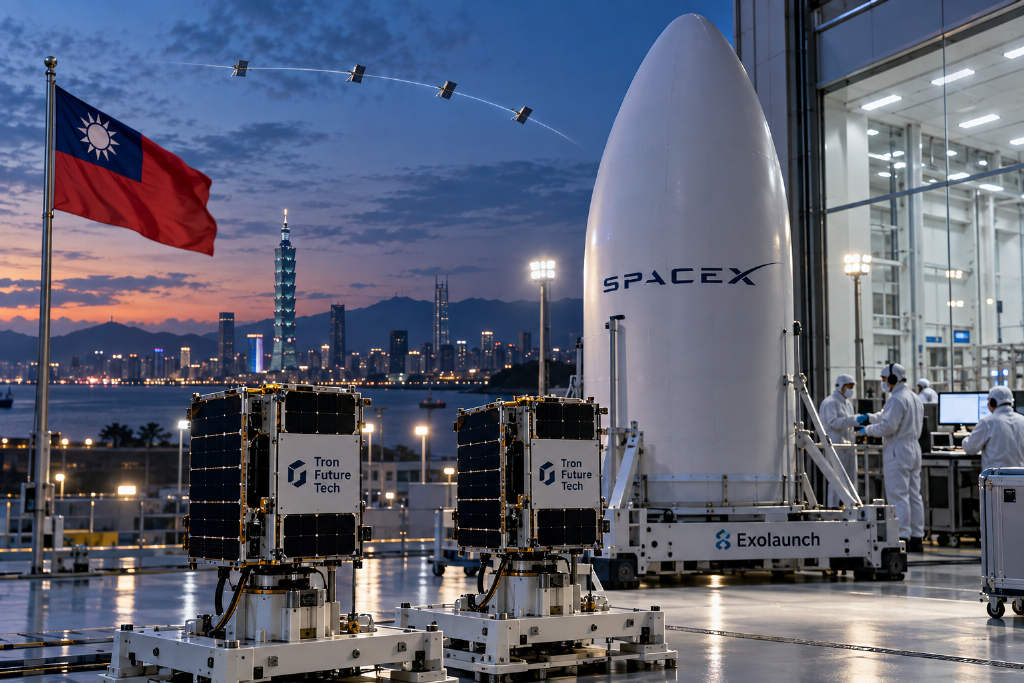
Tron Future Tech, a startup from Taiwan, is set to send its third and fourth low Earth orbit communications satellites, T.MicroSat-3 and T.MicroSat-4, into space on SpaceX’s upcoming Bandwagon-5 rideshare mission. German launch integrator Exolaunch will again handle integration. Once both spacecraft enter orbit, the four-satellite “Zhongque” constellation will be complete.
Exolaunch said on X that it is continuing its partnership with Tron Future Tech for the launch of T.MicroSat-3 and T.MicroSat-4, describing the mission as “Taiwan’s next chapter in low Earth orbit connectivity.”
The final two satellites in a four-spacecraft system
T.MicroSat-3 and T.MicroSat-4 are the last two pieces of the Zhongque constellation. The project is part of the second phase of the Taiwan Space Agency’s startup satellite program. That phase began in 2023 and assigned three domestic companies to each build a constellation made up of four CubeSats. The work covers satellite development, launch, ground station control, and application services, with the stated goal of building a complete low Earth orbit satellite industry chain in Taiwan.
Tron Future Tech is responsible for the broadband communications constellation. The system consists of four 8U CubeSats, and the company is in charge of mission planning, satellite integration, launch, and operations.
The first two satellites are already operating in space
T.MicroSat-1 launched in November 2025 on SpaceX Transporter-15. The primary payload on that flight was the first satellite of FORMOSAT-8, built by TASA. T.MicroSat-2 followed on March 30, 2026, launching on Transporter-16 from Vandenberg Space Force Base in California.
In May this year, Tron Future Tech said the Ka-band communications systems on T.MicroSat-1 and T.MicroSat-2 had completed downlink verification. The company also said it had successfully received signals using its self-developed flat-panel user terminal, moving the project into end-to-end communications service validation. In April, the two satellites passed TASA’s flight operation readiness review and began executing their full mission profile.
Next phase centers on inter-satellite links
According to Tron Future Tech’s previously disclosed plan, the Zhongque constellation is being built in two phases. T.MicroSat-1 and T.MicroSat-2 belong to the first phase, which focused on validating the communications payload itself. After T.MicroSat-3 and T.MicroSat-4 launch, the constellation will enter its second phase and begin testing inter-satellite communications.
Inter-satellite Link, or ISL, is the key new mission item in this stage. Without ISL, data sent from one satellite to another destination would first need to be relayed to a ground station and then forwarded. With ISL in place, satellites can transmit data directly to each other in space. Under the original design specification, the Zhongque satellites have an inter-satellite communication rate of 1 Mbps.
Once all four satellites are in orbit, testing will expand from a single spacecraft to the entire constellation. Tron Future Tech has said one of its goals is to create a B5G/6G technology test platform for low Earth orbit constellations and to verify whether a low Earth orbit CubeSat constellation can be rapidly deployed to provide broadband communications.
Exolaunch remains the launch integrator
Small satellite companies usually do not buy an entire launch vehicle directly from SpaceX. Instead, they often work through launch integrators. Companies such as Exolaunch purchase launch capacity from rocket providers including SpaceX, then resell that capacity to satellite customers and manage integration, testing, transport, regulatory procedures, and separation systems used after orbital insertion.
For startups in Taiwan, joining a rideshare mission through an integrator has become one of the main ways to gain access to space validation at lower cost and on a shorter timeline.
Exolaunch is headquartered in Berlin and originated as a spinout from the Technical University of Berlin. It also has offices in the United States, France, and Japan. Its cooperation with SpaceX began with a first launch agreement signed in 2020, and it later became one of the core partners in SpaceX’s small satellite rideshare business.
In November 2025, Exolaunch integrated three CubeSats under TASA’s startup satellite program, including T.MicroSat-1. On the March 2026 Transporter-16 mission, T.MicroSat-2 was also part of Exolaunch’s launch manifest, alongside satellites from other Taiwan companies. The launch of T.MicroSat-3 and T.MicroSat-4 is the next mission in that continuing partnership.