
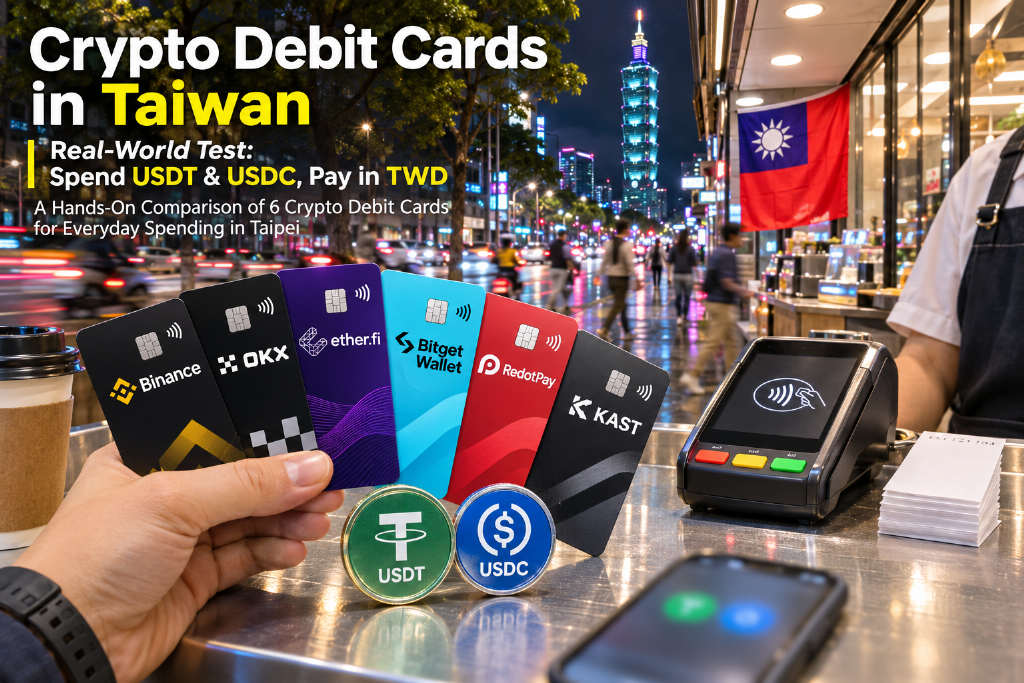
ABMedia has published a Taiwan-focused comparison of six stablecoin debit cards: Binance Card, OKX Card, Ether.fi, Bitget Wallet Card, RedotPay, and KAST. In the article, a "U card" refers to a debit card funded by dollar-backed stablecoins such as USDT and USDC. When a user pays, the issuer converts the stablecoin balance into fiat and settles with the merchant in money rather than crypto.
The comparison uses official help-center material and ChainNews hands-on tests. Fee schedules and reward terms were checked on Nov. 2, 2026. ABMedia said card rules change often and users should rely on what appears in the app at the time of application.
Key takeaways by use case
For users looking for no annual fee and rewards on TWD spending, the article points to Ether.fi’s free Core tier. It offers 3% rewards on the first $2,000 of monthly spending, but adds a 0.5% FX charge on TWD transactions, and rewards are paid in ETHFI.
For users already holding assets on Binance, Binance Card has no annual fee and charges only 0.1% conversion when spending USDC. TWD spending, however, carries a 2% foreign exchange fee. Rewards start at 1.5%, and 3% applies only after monthly spending reaches $1,000.
For users already active on OKX, existing members do not need to complete identity verification again. ChainNews said it took about eight minutes to get a virtual card. OKX states that foreign currency conversion fees are waived, and ChainNews found the card could be linked to both Apple Pay and LINE Pay. The entry-level reward rate is 2% with a monthly cap of $5, while the advertised "up to 5%" requires $75,000 in monthly spending.
For users who want a physical card available in Taiwan and rewards paid in BTC or gold, Bitget Wallet Card is listed by the company as available in Taiwan. Base rewards are 2%, while TWD spending carries a 1.7% FX fee plus a 0.05% to 0.2% conversion fee. ChainNews said the card worked with LINE Pay but could not be added to Apple Pay.
For users spending mainly in U.S. dollars, KAST charges no fee on USD transactions and its free Standard tier offers 1.5% rewards. TWD spending comes with a 0.5% to 1.75% FX charge, and the company does not clearly state whether Taiwan residents can apply.
RedotPay charges $10 to open a virtual card, offers no base rewards, and limits its 3% reward program to paid Pro members and only for Apple Pay and Google Pay purchases.
ABMedia also stresses that total TWD spending cost cannot be judged from reward rates alone. In one ChainNews test, a NT$1,527 Binance Card purchase cost about 3% more than first selling USDT into TWD on a Taiwan exchange and then paying in cash.
What a U card is
The article says most U cards are debit cards, not credit cards. Users spend what they hold, with no credit line and no revolving interest. These cards typically run on Visa or Mastercard networks, so merchant acceptance is broadly similar to ordinary bank cards, and many can also be linked to Apple Pay for contactless payments.
ChainNews said Binance Card, OKX Card, Ether.fi, and Bitget Wallet Card could all be linked to LINE Pay and used at Taiwan merchants that accept LINE Pay.
Most U cards are denominated in U.S. dollars. When used in Taiwan for TWD purchases, the issuer treats the transaction as foreign currency spending, which can trigger FX or conversion charges.
Asset custody also differs by product. Binance Card, OKX Card, RedotPay, and KAST draw from platform account balances. Ether.fi links to what the company calls a non-custodial on-chain Vault account. Bitget Wallet Card is tied to a Bitget Wallet account, and the company warns that if the seed phrase is lost, the card may still work for spending but can no longer be topped up or used for withdrawals.
Market size reached $1.37 billion in October
ABMedia cited Paymentscan, which tracks spending across 30 card programs. In October 2026, tracked U-card spending totaled about $1.37 billion across 12.94 million transactions and roughly 363,000 active addresses. In October 2025, the figure was $464 million, implying about threefold growth. Cumulative spending since March 2023 has reached $13.87 billion.
The top three programs by October spending were RedotPay at $424 million, Ether.fi at $142 million, and KAST at $121 million. Bitget Wallet Card, one of the products in the comparison, recorded $1.78 million. USDC was the main spending asset at about half of the total, while USDT accounted for about one-fifth.
The article adds two caveats. RedotPay’s spending figure was provided by the RedotPay team and is not on-chain verifiable. Exchange-issued cards are also not fully included: OKX Card is marked as having no data, and Binance Card is not on the tracking list. ABMedia said the real market is therefore larger than the figures shown above.
Official terms across six cards
ABMedia compiled the official terms for each card as of Nov. 2, 2026, and noted that "not disclosed" means the fee could not be found on the official page, not that the fee does not exist.
| Category | Binance Card | OKX Card | Ether.fi | Bitget Wallet Card | RedotPay | KAST |
|---|---|---|---|---|---|---|
| Available in Taiwan | Yes, according to ChainNews testing | Yes, according to ChainNews testing; existing members do not need to verify again | Yes, tested by ChainNews with a Taiwan passport | Yes, Taiwan appears on the official availability list | Taiwan is not on the official restricted list | Taiwan appears only on the Apple Pay eligible residence list |
| Network | Mastercard | Mastercard, according to ChainNews testing | Visa | Visa, according to ChainNews testing | Not disclosed | Visa |
| Annual fee | 0 | Not disclosed | Core 0; Luxe $199; Pinnacle $999, or unlocked with points, deposits, or staking | 0, no monthly fee, free top-up | 0; Pro membership $12.9 per month or $129 per year | Standard 0; Premium $1,000; Private $10,000 |
| Issuance fee | 0, virtual only | Not disclosed | First virtual card free; extra Core cards cost $10 each | Virtual 0; physical card $25 including shipping at a promotional price | Virtual $10; physical $100 | Includes two virtual cards; in some regions $2 each; physical card 0 plus $40 shipping |
| TWD spending cost | 2% FX fee plus 0.1% conversion for USDC or 0.9% for other assets | Official payment card page says no transaction fee and no foreign currency conversion fee | Core adds 0.5%; Luxe 0.25%; Pinnacle 0 | 1.7% FX fee on non-USD spending plus 0.05% to 0.2% conversion, with possible gas fees | 1.2% for non-card-currency spending plus 1% crypto conversion | 0.5% to 1.75%, plus $0.1 per transaction under $25 |
| Base rewards | From 1.5%; 3% after $1,000 monthly spending; $100 monthly cap; paid in USDC | 2% entry level with a $5 monthly cap; up to 10% at higher tiers | 3% on the first $2,000 each month for Core; paid in ETHFI | Officially 2%; ChainNews test account showed 3% on the first $400 each month, with 3% maintained next month after $200 monthly spending; rewards can be taken in USDC, BTC, gold, or tokenized U.S. stocks | None; Pro members get 3% on Apple Pay and Google Pay spending, capped at 18 USDs per month | 1.5% on the first $2,000 each month for Standard; paid in dollars |
| Apple Pay | Yes, according to ChainNews testing | Yes, according to ChainNews testing | Yes, according to ChainNews testing | Officially supported, but ChainNews could not add it | Officially supported, but Taiwan support was not specified | Yes, Taiwan appears on the official list |
| LINE Pay | Yes, according to ChainNews testing | Yes, according to ChainNews testing | Yes, according to ChainNews testing | Yes, according to ChainNews testing | Not tested by ChainNews | Not tested by ChainNews |
| Physical card in Taiwan | No, official page says virtual only | Not disclosed | Yes, the Core checkout page showed $50 | Yes, optional, $25 | Taiwan is not on the official no-shipping list | Taiwan shipping not disclosed |
Binance Card
Binance Card is a Mastercard virtual card issued by New Zealand-registered Immersve, with Binance handling the front end and crypto conversion. The official page says the product is currently virtual only, with no annual fee and no issuance fee. Applicants submit basic information and a residential address, and the card is issued within 15 minutes after approval.
Spending follows a user-defined payment priority order across at least three and up to 12 crypto assets. The official fee table lists a 0.1% conversion fee for USDC and 0.9% for other assets, plus a 2% FX fee charged on top of Mastercard fees.
Since June 2026, rewards have been split into three tiers: 1.5% for monthly spending below $100, 2% for $100 to $1,000, and 3% once spending reaches $1,000. The monthly cap is $100, and rewards are paid in USDC before the 10th day of the following month.
OKX Card
OKX says on its Traditional Chinese application page that users can get an OKX Card in three minutes, with up to 5% cashback and "zero fees, full transparency." Its payment card page says there is no transaction fee and no foreign currency conversion fee, and that stablecoin balances can be spent directly.
ChainNews tested the card with a Taiwan account and said existing OKX members did not need to complete identity verification again. After entering an English name, Taiwan mobile number, and billing address, the user received a Mastercard virtual card within minutes, saw no issuance fee, and added it to Apple Pay with one tap. Physical cards are still on a waitlist.
On the evening of Nov. 3, ChainNews linked OKX Card to LINE Pay and used it for a NT$220 purchase at 7-Eleven. The card deducted 6.76 USDG, with network fees paid by OKX. Using a market USD/TWD rate of about 32.79 at the time, NT$220 was about $6.71, implying an extra cost of roughly 0.7% to 0.8%. On Nov. 4, another purchase of NT$1,169 through Apple Pay deducted 35.67 USDG, only about 0.1% to 0.2% above the market rate. That transaction generated about 0.14 USDG in 2% rewards, shown in the app as pending and usually credited within one to five business days.
The card spends from a "Pay balance" held on OKX’s X Layer chain. Users can fund it with USDG, USDT, or USDC without converting into a single required asset first. ChainNews said a transfer of USDG from an OKX exchange account arrived in about three minutes, with network fees covered by OKX.
The article also breaks down the reward tiers behind the advertised "up to 5% cashback." The app shows five loyalty levels. The entry tier pays 2% with a $5 monthly cap, which means rewards apply to only about the first $250 of spending. A user can move to the 4% tier with a $100 cap the next day by meeting any one of three conditions: a $40,000 average balance over the past 30 days, $10,000 in spending, or OKX VIP 1 status. The 5% tier requires either $75,000 in spending or a $320,000 balance. The highest tier pays 10%. USDG held in the Pay balance also earns 4% to 10% APY on the first 10,000 USDG, though the app says the rate may be changed or stopped at any time.
Ether.fi
Ether.fi Cash is a Visa card. Applicants must complete phone, ID, and selfie verification. The company says approval usually takes place within 48 hours, while ChainNews said its application using a Taiwan passport was approved in under five minutes.
The free Core tier pays 3% rewards on the first $2,000 of monthly spending, with lower rates after that. Luxe and Pinnacle can be purchased as annual plans or unlocked through points, deposits, or staking.
Rewards are paid in ETHFI. They can be claimed seven days after a transaction settles, and only once the accumulated amount reaches $5. Their value moves with the token price. TWD spending on the Core tier carries a 0.5% FX charge.
Bitget Wallet Card
Bitget Wallet Card is issued by Bitget Wallet and is separate from the exchange product called Bitget Card. ABMedia said the comparison covers Bitget Wallet Card only.
The official Bitget card page lists Taiwan among supported regions, and Taiwan also appears on the physical card availability list. Applications are submitted through the Wallet and Card pages in the Bitget Wallet app. ChainNews said Taiwan users could apply with either a national ID card or a passport. In addition to facial recognition, applicants must upload proof of address from the past three months showing their English name. The example used in the article was a Firstrade statement. Once the documents were ready, a Visa virtual card was issued in about two and a half minutes. The app says more than 50 tokens can be used for top-ups.
According to the official Asia-Pacific fee schedule, the card has no monthly fee and no annual fee, and top-ups are free. Each transaction carries a 0.05% to 0.2% crypto-to-fiat conversion fee. USD spending has no extra FX fee, while other currencies add 1.7%, settled at Visa’s real-time exchange rate, with possible gas fees on top.
The official base reward is 2%, but ChainNews said its test account was receiving 3% on only the first $400 of monthly spending. That threshold rises to $600 after applying for a physical card. To keep the 3% rate for the following month, spending must reach $200 in the current month. Rewards can be taken in USDC, BTC, gold, or tokenized U.S. equities such as the S&P 500 and Tesla, and the selection can be changed once a month.
ATM withdrawals cost 1%, and the daily spending limit is $50,000. The physical card is optional and costs $25, down from the regular $49 through Dec. 31, with shipping included.
On Nov. 3, ChainNews tested a NT$770 restaurant purchase. Bitget Wallet deducted 24.06 USDC. Using a market USD/TWD rate of about 32.75 at the time, NT$770 was about $23.51, implying an extra cost of about 2.3%. That was slightly above the official 1.7% FX fee plus the 0.05% to 0.2% conversion fee. The article says the gap may reflect a difference between Visa’s settlement rate and the market rate, and notes that this was only a single transaction test. The purchase earned 3% rewards, paid in the tokenized S&P 500 asset SPYx, worth about $0.72, and the app showed the reward as pending immediately after payment.
At checkout, users can choose which chain and which asset to spend. The app lists assets such as USDC, USDT, and ETH on Ethereum, Arbitrum, Base, and BNB Chain. USDC on Ethereum and Base is marked as having zero network fee.
For mobile wallet support, ChainNews said Bitget Wallet Card could be linked to LINE Pay but not to Apple Pay, which differs from the official card page that says Apple Pay is supported. By contrast, Binance Card, OKX Card, and Ether.fi were all successfully linked to Apple Pay in testing.
RedotPay
RedotPay’s help center does not list Taiwan on either its unsupported-country list or its card issuance restriction list. The virtual card issuance fee is $10 and the physical card fee is $100, both deducted from the account balance. The company says it does not charge card management fees, monthly fees, or annual fees. Since Jan. 21, 2026, all newly issued cards have been denominated in U.S. dollars.
Transactions in assets other than the card currency are charged 1.2%, and crypto conversion adds another 1%. Regular users receive no base rewards. Pro membership costs $12.9 per month or $129 per year, and gives 3% rewards on Apple Pay and Google Pay spending, capped at 18 USDs per month. Those rewards can only be spent through the card and expire after 30 days.
KAST
KAST does not separately state whether Taiwan residents can apply. Taiwan appears only on the Apple Pay eligible-country list, which is determined by the registered country of residence. After stablecoins are deposited, they are converted 1:1 into a U.S. dollar balance, and the company says there is no spread.
The free Standard tier includes two virtual cards and pays 1.5% rewards on the first $2,000 of monthly spending, with rewards paid in dollars. Non-USD transactions carry an FX fee of 0.5% to 1.75%, depending on the country of residence, transaction location, and card plan. Non-USD transactions below $25 add another $0.1 per transaction, and declined transactions caused by insufficient balance cost $0.5 each. Using Standard as an example, KAST says the net effect after subtracting FX fees from the 1.5% reward is at most 1%.
Actual TWD spending costs in five ChainNews tests
ABMedia summarized several ChainNews tests from August through November 2026 and said real TWD spending costs can differ from headline fee schedules.
In August 2026, ChainNews used Binance Card for a NT$1,527 purchase at Eslite. The bill was about $48.34, and the card deducted 20.88 USDC and 27.83 USDT. Compared with a Taiwan exchange quote of about NT$32.3 per USDT at the time, the purchase cost about 3.1% more than selling the crypto first and then paying in cash. One reason cited in the article was that USDT was valued at only $0.987 when deducted.
In October 2026, Ether.fi was used for a NT$2,244 restaurant purchase in Taipei. The card deducted $69.96, implying an exchange rate of about 32.08. The 3% reward was about $2.09, and the deducted amount did not change after the reward was credited.
In November 2026, Bitget Wallet Card’s NT$770 restaurant purchase came in about 2.3% above the market rate. OKX Card was tested twice: a NT$220 convenience-store purchase through LINE Pay cost about 0.7% to 0.8% above market, while a Nov. 4 Apple Pay purchase of NT$1,169 deducted 35.67 USDG, implying a rate of about 32.77, only around 0.1% to 0.2% above the market quote of about 32.80 to 32.82 at the time. ABMedia said the detailed calculations appear in the individual card sections and that all comparisons used market rates at the time of payment.
Three things to know before applying
First is the platform itself. Dispute handling and user protections depend on the issuer and the platform’s own rules. To check whether an operator has completed anti-money laundering registration in Taiwan, the article says users can review the list published by the Securities and Futures Bureau of the Financial Supervisory Commission.
Second, rewards can be clawed back. The terms for Binance Card, Ether.fi, and RedotPay all say rewards may be reversed after refunds or successful disputes. Binance Card also states that fees charged at the time of purchase are not refunded. If rewards are paid in tokens, their value can also change with the market price before they are claimed.
Third is tax treatment. Taiwan does not currently have an explicit rule on how U-card spending should be taxed. Hung Ming-hung, a practicing CPA at KPMG Taiwan, said in ChainNews’ crypto tax analysis that paying with cryptocurrency is equivalent to realizing income, and he recommended keeping records of the amount of crypto used in each purchase and the market price at the time.
Frequently asked questions
What is a U card?
A U card is a debit card funded by dollar-backed stablecoins such as USDT and USDC. At the time of payment, the issuer converts the stablecoin into fiat and pays the merchant. These cards can be used at merchants that accept Visa or Mastercard, and many can also be linked to Apple Pay.
How is a U card different from a credit card?
Most U cards are debit cards. Users spend from their own balance, with no credit line and no revolving interest. Because the account is usually denominated in U.S. dollars, TWD spending in Taiwan is treated as a foreign currency transaction and may incur FX or conversion charges.
Which U cards can Taiwan residents apply for?
Based on official information or ChainNews testing, Taiwan residents can apply for Binance Card, Ether.fi, Bitget Wallet Card, and OKX Card. Taiwan does not appear on RedotPay’s official restricted list, while KAST lists Taiwan only on its Apple Pay eligible residence list. Availability can change, and the app display at the time of application remains the final reference.
How much does it cost to spend TWD with a U card?
Using official data checked on Nov. 2, 2026, Binance Card charges a 2% FX fee plus 0.1% to 0.9% conversion, Bitget Wallet Card charges 1.7% FX plus 0.05% to 0.2% conversion, Ether.fi Core adds 0.5%, KAST charges 0.5% to 1.75%, and RedotPay charges 1.2% for non-card-currency spending plus 1% conversion. OKX says on its payment card page that foreign currency conversion fees are waived, while ChainNews’ two tests showed effective extra costs of about 0.7% to 0.8% and 0.1% to 0.2%.
Does U-card spending need to be reported for tax?
Taiwan does not currently have an explicit rule. Hung Ming-hung of KPMG Taiwan said paying with cryptocurrency is equivalent to realized income, and suggested keeping records of the amount of crypto spent and the market price for each transaction. He advised consulting an accountant for actual filing.
What if a U card is used fraudulently or a refund is needed?
The article says users should first freeze the card in the app and then file a dispute with the issuer. Binance Card and Ether.fi both allow users to freeze the card directly in the app. The rules for Binance Card, Ether.fi, and RedotPay say rewards originally granted may be clawed back after a refund or a successful dispute.



