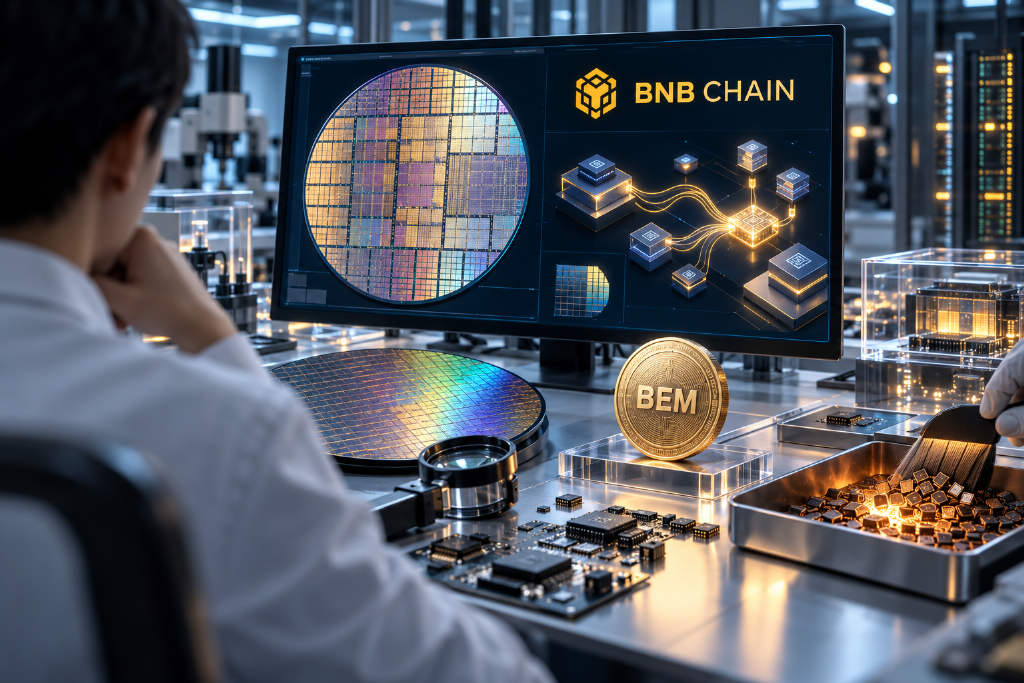
A Foresight column focused on a question around Tapeout, a project on BNB Chain that brings the chip "tape-out" concept on-chain: if the project keeps developing, where does the eventual value end up, in component tokens or in BEM?
The discussion began with a reader comment cited in the article. The reader said they had missed an earlier piece on the on-chain chip tapeout project, became increasingly interested after studying it, and wanted to invest but did not know where to start. The main point of confusion was whether, under a normal evolution of the project, value would ultimately accrue to transistor-style component tokens or to the mined BEM token.
How Tapeout works on-chain
The article describes Tapeout as a highly watched on-chain experiment and infrastructure project on BNB Chain. It takes the chip manufacturing idea of a "tape-out" and puts it on-chain, allowing users to build and run digital logic circuits on-chain.
According to the column, the project has two main categories of tokens.
The first is a set of basic component tokens. Users buy these component tokens, use them to design circuits freely on a canvas, and then complete a tape-out. Once the tape-out is done, those component tokens are permanently burned.
The second is BEM, the project’s mining reward token. The article says BEM effectively represents the project’s cash flow and core value. Circuits deployed on-chain through the destruction of component tokens act as "on-chain mining machines," and BEM output is split according to the efficiency weighting of those circuits.
The author’s view on where value settles
On long-term value, the column argues that component tokens may go through sharp speculation in the project’s early phase. But once the project moves into a mature stage and a longer period of development, the price of component tokens should be constrained by mining yields and tend to stabilize.
From there, the author gives a direct answer: if the project continues to evolve normally, the final destination of value should be BEM. The piece also makes clear that this is the author’s own interpretation.
The bigger point was investor mindset
The article then moved away from trade execution and toward psychology. Rather than spending most of the time on how to operate around the project itself, the author said the more important suggestion for readers was to stay level-headed.
In response to the reader’s feeling of having "missed" the opportunity, the author recommended getting rid of that fear as early as possible. The piece says people often feel they missed something only because they compare the current price with an earlier one, and that comparison is itself a trap.
The author’s argument is that investing should be about the future. What matters is what the asset may become. If it still has substantial room for appreciation and growth from here, then the current price is not necessarily expensive, joining now is not necessarily late, and the opportunity has not necessarily passed.
Under that logic, the article says there is little value in fixating on what an asset used to cost or on how much more expensive it looks now than before.
Bitcoin and Ethereum were used as examples
To illustrate the point, the author returned to examples used before: Bitcoin and Ethereum. When BTC and ETH were at $10, the article says, only a small number of the people who bought them actually went on to make 100x returns.
The explanation offered is that very few people truly understood their value at the time. If someone did not understand them and therefore did not buy, or failed to hold on, the author says there is no reason to feel regret. Not making money on something you do not understand is a normal outcome. By contrast, making a large amount of money on something you never really understood may not be a good thing.
The article extends that logic with another example. If someone understands Bitcoin today and believes it can reach $1 million in the future, for example within 20 years, then buying Bitcoin now and holding it until it reaches that level would still make the current price look cheap and worthwhile, rather than evidence that the opportunity has already been missed.
Curiosity is fine, but not with an oversized position
On the reader’s comment that they were becoming increasingly absorbed in the project, the author said curiosity itself is a good thing. Still, if the motivation is exploration and learning, the article advises against taking a heavy position. A small amount of capital can be used to experiment more boldly, without becoming overly focused on gains and losses, while paying closer attention to one’s own reactions.
The author also included a personal disclosure: up to now, they have never bought any component token from the project, nor any BEM token.
The reason, the article says, is straightforward. The author is still not sure whether the project can generate sustainable profits in the future and whether it can truly achieve large-scale implementation and adoption.
The piece ends with a disclaimer that markets carry risk and investment requires caution. It says the article does not constitute investment advice, and readers should consider whether any opinion, view, or conclusion in the piece fits their own circumstances before making investment decisions at their own risk.