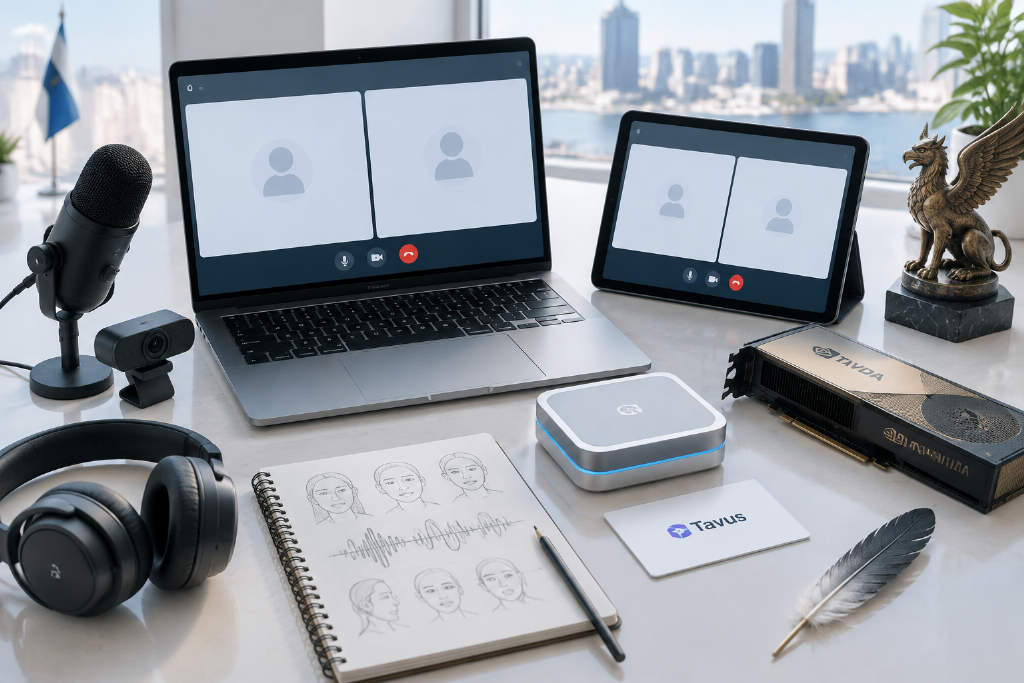
Tavus unveils Griffin and says the model can understand and generate face-to-face conversation

Tavus unveils Griffin and says the model can understand and generate face-to-face conversation

N
News Editor
2026-10-02 19:13:02
AI startup Tavus said on Oct. 1 that it has launched Griffin, which it describes as the first "human interaction model" built to understand and generate face-to-face conversation. According to the company, the system tracks not only wording but also facial expressions and pauses during exchanges. Tavus said that in a test involving one-minute video calls with Griffin-Lite, 26 out of 54 participants, or 48%, believed they were speaking with a real person. The company said its previous-generation system convinced just 1 of 41 participants in a similar setup. Participants were told they would have a one-minute video call with another person about something they were looking forward to this year, and were only asked at the end whether they suspected the other side was not human. The company also said Griffin-Lite ranked first on Nvidia's VideoFDB benchmark. Tavus reported a generation score of 3.83 versus 2.8 for the next-best system and 3.92 for the human reference, along with a perception score of 3.73 versus a strongest baseline of 3.44 and a human reference of 4.2. Tavus added that Griffin supports full-duplex interaction and posts average audio-video latency of 0.43 seconds on Nvidia H100 chips.

AI startup Tavus on Oct. 1 released a new model called Griffin, describing it as the first "human interaction model" that can understand and generate face-to-face conversation. The company said the system pays attention not only to wording, but also to facial expressions and pauses.

Results from Tavus' video call test

Tavus said that in testing, 26 of 54 participants, or 48%, believed they were speaking to a real person after a one-minute video call with Griffin-Lite. The company's previous-generation system persuaded only 1 of 41 participants, according to Tavus.

Participants were told they would have a one-minute video call with another person and discuss something they were looking forward to this year. Only after the call ended were they asked whether they suspected the other side was not human. Tavus said people who became suspicious usually noticed within 20 seconds.

The result came from Tavus' own research page, with participants recruited through what the company described as an independent research platform. A community note on X said the findings had not been independently verified and did not follow standard protocols.

Benchmark scores and latency

On Nvidia's VideoFDB benchmark, Tavus said Griffin-Lite ranked first. In the generation category, Griffin-Lite scored 3.83, compared with 2.8 for the next-best system and 3.92 for the human reference. In the perception category, it scored 3.73, versus 3.44 for the strongest baseline and 4.2 for the human reference. Tavus said Nvidia conducted the evaluation independently.

Tavus also said Griffin supports full-duplex interaction, allowing it to listen, watch, and speak at the same time. On Nvidia H100 chips, the model posted average audio-video latency of 0.43 seconds.

Funding

Tavus completed a $40 million Series B round in November 2025, led by CRV.

This article was originally published by Bit.Fan. For more cryptocurrency news and market insights, visit www.bit.fan.
100

Disclaimer:

The market information, project data, and third-party content displayed on this platform are for industry information sharing only and do not constitute any form of investment advice or return commitment.

Cryptocurrency trading carries high risks. Users should fully assess their risk tolerance and make independent decisions. All profits, losses, and legal responsibilities are borne by the users themselves.