
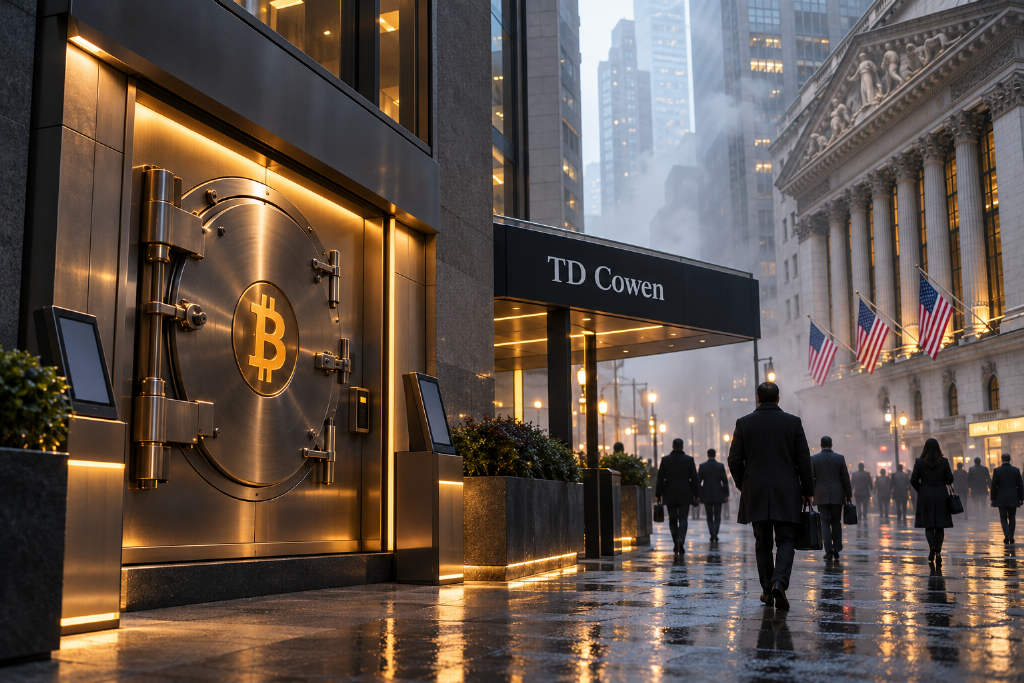
Investment bank TD Cowen said Bitcoin is becoming more than a standalone asset and is increasingly being positioned as financial infrastructure that could support institutional products.
In a Tuesday note, the firm said that after attending this week’s BitcoinTreasuries Conference in New York, it came away with the view that institutions were interested in more than simply accumulating the largest cryptocurrency.
Focus shifts beyond simple Bitcoin exposure
TD Cowen wrote that 「Bitcoin increasingly appears to be moving beyond its role as an investable asset and toward a broader role as financial infrastructure capable of supporting new capital-markets activity.」
The note added: 「In our view, the most interesting conversations were not necessarily about bitcoin itself, but about the ecosystem being built around it.」
According to the firm, Bitcoin’s next phase could include a role in 「supporting capital markets infrastructure.」
Strategy cited as an example of the thesis
TD Cowen’s comments line up with a long-running argument from Nasdaq-listed Bitcoin treasury company Strategy, which has said Bitcoin will serve as a base layer for other financial products. Strategy is currently the largest corporate holder of Bitcoin and offers preferred stock that pays dividends to investors.
Custody services are becoming more institutional
TD Cowen also said Bitcoin custody is becoming more institutional as 「larger pools of capital enter the ecosystem.」
Major banks in the U.S. and Europe have either discussed or begun offering Bitcoin custody services in recent years. BNY Mellon became the first major U.S. bank to offer digital asset custody services in 2022. This month, German multinational Deutsche Bank said it would launch a Bitcoin custody service for European corporate and institutional clients later in 2026.
TD Cowen’s broader view
The firm said these developments suggest Bitcoin is continuing to evolve from a standalone asset into a broader financial ecosystem that can support increasingly sophisticated institutional participation.
TD Cowen is a division of TD Securities. The original report was published by Bitcoin Magazine and written by Mathew Di Salvo.