
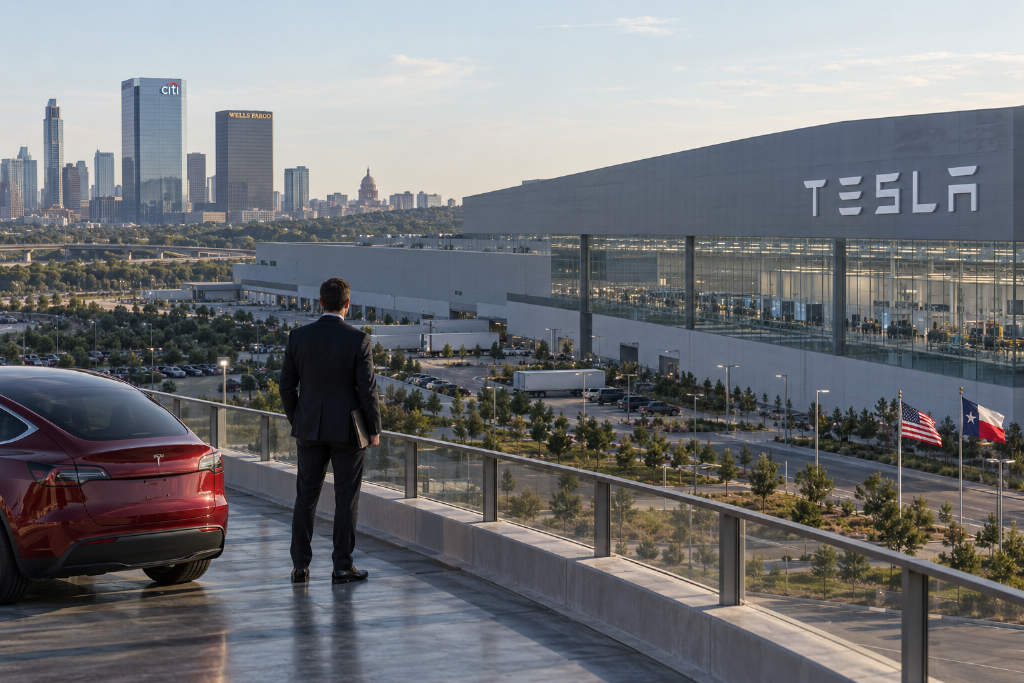
Tesla signed three credit agreements on Sept. 29, 2026, giving the company a combined $30 billion in committed borrowing capacity. Citibank and Wells Fargo are listed as administrative agents. In its 8-K filing, Tesla said it had no outstanding borrowings under the facilities as of the signing date and stated that it does not currently plan to use the commitments in 2026.
At least from the timing, the package looks more like financing kept in reserve than money already put to work.
$30 billion split across three agreements
The package is made up of facilities worth $20 billion, $8 billion, and $2 billion.
The largest is a $20 billion unsecured three-year term loan facility, with Citibank acting as administrative agent. It carries an 18-month availability period and can be drawn up to 10 times during that window. Any unused commitment steps down over time: it falls to $10 billion on the first anniversary, to $5 billion in month 15, and terminates in full at month 18. Any funded loans mature on Sept. 29, 2029.
The second agreement is an $8 billion five-year revolving credit facility, with Wells Fargo as administrative agent. It matures on Sept. 29, 2031, includes two one-year extension options, and allows for up to $500 million in letters of credit.
The third is a $2 billion 364-day revolving credit facility, also led by Wells Fargo. It matures on Sept. 28, 2027, and can be converted into a term loan for an additional year if conditions are met.
The two revolving facilities can also be upsized by as much as $4 billion in total, taking their combined commitment ceiling to $14 billion.
Pricing and stated use of proceeds
Borrowing costs are based on Term SOFR or an alternative base rate, plus an applicable margin. That margin adjusts with Tesla’s long-term unsecured credit ratings. The company would also owe commitment fees and a ticking fee on unused amounts.
The filing says the proceeds may be used for “general corporate purposes” or any other purpose not prohibited by the agreements. The 8-K does not name a specific project.
Q2 results show record revenue, weaker margins, and negative free cash flow
The credit package arrived against the backdrop of Tesla’s second-quarter results, released on July 22, 2026. Revenue reached $28.24 billion, up 26% year over year and a record high. Deliveries totaled 480,126 vehicles.
Profitability, however, narrowed sharply. Operating income fell 57% from a year earlier to $398 million, and operating margin dropped to 1.4% from 4.1% in the same period last year. Tesla remained profitable on a GAAP basis, posting net income of $1.11 billion, down 5% year over year.
Cash flow shifted more dramatically. Free cash flow in the second quarter was negative $1.09 billion, compared with positive $150 million a year earlier. The report described this as the first move back into negative territory since early 2025.
Capital expenditures were about $5.8 billion in the quarter, up 142% from roughly $2.4 billion in the year-earlier period.
Capex outlook and other financial changes
Tesla expects full-year 2026 capital expenditures to exceed $25 billion, versus $8.5 billion in 2025. The source article also said analysts expect spending in 2027 to be at a similar scale.
Revenue from regulatory credits fell from $439 million to $146 million, a decline of 67%. The federal EV tax credit had already expired in September 2025.
Electrek takes a critical view
Electrek, the U.S. technology commentary site cited in the source article, framed the facilities more critically. It argued that Tesla’s declining profitability and expanding capital spending created a need for a large credit backstop.
Electrek also said Tesla still had about $43 billion in cash on hand, citing the prior quarter’s financial statements, yet still moved to establish the new facilities.
On where the spending is going, Electrek said the focus appears to be on early-stage ideas with uncertain commercialization, including a steering-wheel-free vehicle, a flying Roadster, and a large-scale robot vision.
It also pointed to Cybercab, Semi, and Roadster, all reintroduced in September, as concepts first announced a decade ago. Electrek described Cybercab as still not functioning properly, said Semi production is ramping slowly, and noted that the Roadster demonstration has been pushed to Oct. 15.
The real test may come in 2027
Whether the $30 billion package is simply financing held in reserve or a response to weaker cash generation cannot be settled by the agreements alone.
Structurally, the $20 billion term loan facility gives Tesla a limited window. Its unused commitment is cut in half after one year, reduced again to $5 billion in month 15, and falls to zero at month 18. If Tesla intends to use it, the practical draw period is concentrated in the year and a half after signing. Since the company has already said it does not plan to draw in 2026, attention shifts to 2027.
The source article highlighted three things to watch next: whether Tesla includes the full agreements in its third-quarter 10-Q, whether free cash flow stays negative for a second straight quarter, and whether 2026 capital spending tracks the company’s forecast of more than $25 billion and leads to actual drawdowns in 2027.
What the 8-K confirms today is straightforward: Tesla has secured $30 billion in committed credit capacity. Whether that proves to be precautionary planning or a response to softer cash flow will depend on later earnings reports and any future borrowing activity.