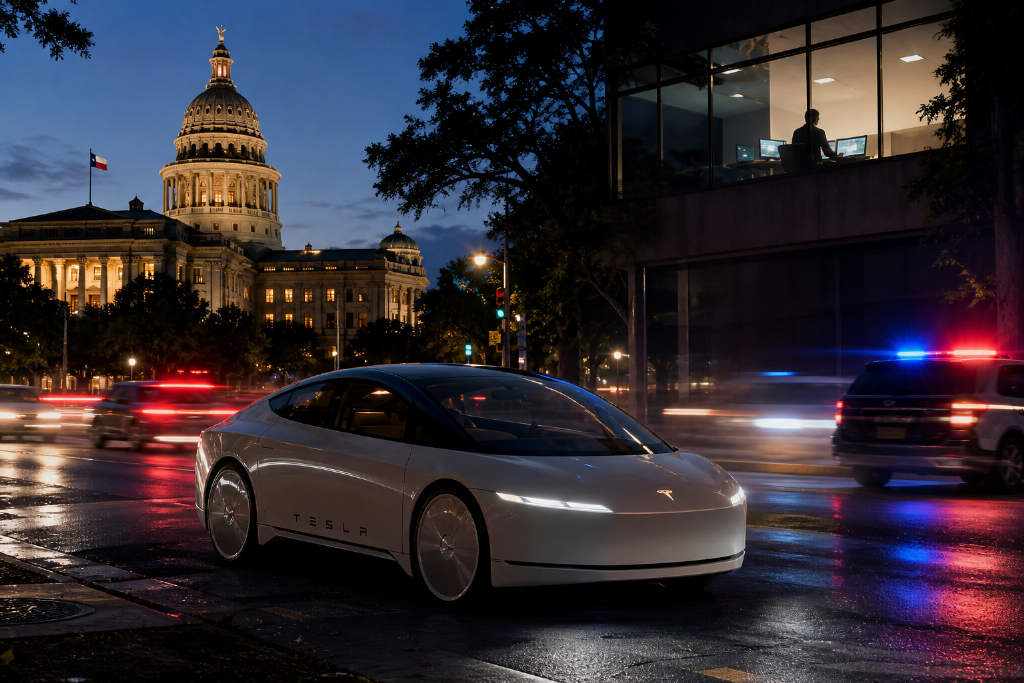
Tesla plans to publicly unveil its autonomous taxi, the Cybercab, as early as this month in Austin, Texas, according to a report cited by BlockBeats. The vehicle is designed without a steering wheel or pedals, and Tesla employees have already tested a fully driverless version on private roads inside the company campus. The report said the Cybercab runs on Tesla’s Full Self-Driving, or FSD, software, though doubts remain over both the system’s capabilities and its safety record. The U.S. National Highway Traffic Safety Administration is still investigating how Tesla FSD handles compliance with traffic rules, while existing robotaxi services in some markets continue to rely on human safety operators. Tesla’s Cybercab is intended to operate without anyone inside intervening, with remote operators expected to handle emergencies, and the company has started adding Starlink connectivity to the vehicles. Data collection is another hurdle. Tesla said in July that it still needs dedicated driving data for Cybercab. So far, Tesla’s unsupervised Robotaxi service has logged about 380,000 miles across six cities, compared with more than 220 million fully driverless miles on public roads completed by Waymo since 2020. The report also noted that the lack of traditional driving controls could put Cybercab under federal vehicle safety restrictions, and it remains unclear whether Tesla is seeking a regulatory exemption.
Tesla plans to publicly launch its autonomous taxi, Cybercab, as early as this month in Austin, Texas, according to a U.S. media report cited by BlockBeats.
The vehicle has no steering wheel and no pedals. Tesla employees have already tested a fully driverless version on private roads inside the company’s campus.
The report said Cybercab runs on Tesla’s Full Self-Driving, or FSD, software, but questions remain over both the system’s autonomous driving capability and its safety. The U.S. National Highway Traffic Safety Administration, or NHTSA, is still investigating issues tied to how Tesla FSD complies with traffic rules. At the same time, existing robotaxi services in some markets still use human safety operators.
Cybercab, by design, is meant to operate without intervention from anyone inside the vehicle. Tesla plans to rely on remote operators for emergency situations and has already started adding Starlink connectivity to the cars.
Scale of data is also an issue raised in the report. Tesla said in July that it needs to build up dedicated driving data for Cybercab. So far, Tesla’s unsupervised Robotaxi service has logged about 380,000 miles across six cities. By comparison, Waymo has completed more than 220 million fully driverless miles on public roads since 2020.
Cybercab may also face limits under U.S. federal vehicle safety rules because it lacks traditional driving controls. The report said it is still unclear whether Tesla is seeking a regulatory exemption.
The Verge said that, as Cybercab moves closer to launch, major uncertainty remains around the level of autonomous driving safety and the regulatory approvals needed for commercial operation.
This article was originally published by Bit.Fan. For more cryptocurrency news and market insights, visit www.bit.fan. Disclaimer:
The market information, project data, and third-party content displayed on this platform are for industry information sharing only and do not constitute any form of investment advice or return commitment.
Cryptocurrency trading carries high risks. Users should fully assess their risk tolerance and make independent decisions. All profits, losses, and legal responsibilities are borne by the users themselves.