
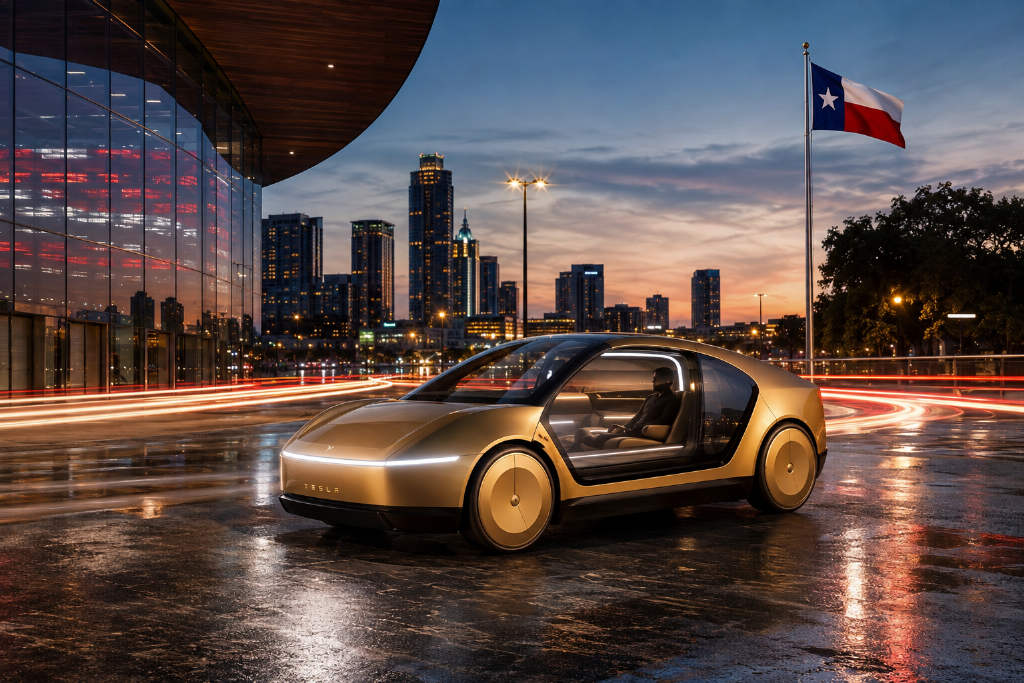
Tesla on Sept. 3, 2026, unveiled the Cybercab robotaxi at an invitation-only event at ACL Live in Austin, Texas, and began limited public service in parts of the city on Sept. 4. The gold-colored two-seat vehicle has no steering wheel and no pedals, underscoring Tesla’s push to move beyond conventional electric cars into autonomous ride services.
Guests at the event became the first passengers to ride in a fully driverless Cybercab. Tesla shares, listed under TSLA, rose more than 5% after the launch, according to the report.
Purpose-built robotaxi with no traditional driving controls
Tesla described Cybercab as its first purpose-built autonomous vehicle, designed around passenger experience and operating efficiency rather than manual driving. The car uses a two-seat layout, a gold exterior and gull-wing doors.
The vehicle is front-wheel drive and uses a single motor producing about 163 kW, or 219 horsepower. It carries a roughly 48 kWh lithium-ion battery, with an EPA-estimated range of about 293 miles, or around 472 kilometers. Energy consumption was listed at about 165 Wh per mile, and the report described Cybercab as one of the most efficient mass-produced electric vehicles currently available. Curb weight was put at about 1,412 kilograms, or 3,113 pounds.
Inside, the car features a 22-inch touchscreen that supports video entertainment, gaming and productivity applications. Tesla also plans to integrate Starlink V5 for high-speed connectivity. The doors can open and close automatically, the electric seat belts tighten on their own, and an in-cabin camera checks for cleanliness and items left behind. The vehicle also supports wireless inductive charging and emphasizes safety and accessibility.
Tesla called Cybercab "the safest car on the road" and a "super comfortable mobile lounge," pitching it as a space where riders can relax, watch videos or play games.
Invite-only event draws online reaction
The launch event was limited to invited attendees, mainly lottery winners among frequent Robotaxi users and selected guests. There was no full public livestream, but experience videos had already started circulating on X, the report said.
Those videos showed door buttons integrated into the bodywork, with the doors closing automatically after passengers fastened their seat belts. With no pedals, the cabin felt more spacious. The report also noted an unusually large rear trunk, where some guests posed for photos with the vehicle.
Early reactions centered on comfort and the surprise of a completely driverless ride, not just on the transportation function itself.
About 45 Cybercab vehicles registered in Texas
Tesla’s Robotaxi service had already launched in Austin in 2025 and later expanded to Dallas, Houston and several cities in Florida, primarily using Model Y vehicles. The report said the fleet of unsupervised vehicles now exceeds 200 and has accumulated hundreds of thousands of miles without a safety driver.
For Cybercab specifically, Tesla has registered about 45 vehicles in Texas, with service currently restricted to a limited operating zone in Austin. The Robotaxi app has also been updated, allowing riders to request either a two-seat Cybercab or a four-seat Model Y.
Musk points to lower costs and wider rollout
Elon Musk has repeatedly said Cybercab will usher in a "golden age of transportation" and predicted that a "Cybercab storm" is about to begin. Tesla is aiming to cut operating costs to below $0.3 per mile, a level the report said would sit well below traditional taxis and rival services.
In the near term, service is expected to expand to more U.S. cities, including Arizona and Nevada, where permits are already in place, according to the report. Over the longer run, Tesla plans to sell Cybercab directly to consumers. The article added that Musk had previously mentioned a target price below $30,000 by the end of 2026, while also expanding fleet size to compete with companies such as Waymo.
The formal rollout of Cybercab marks a commercial step in Tesla’s autonomous driving strategy. As public test rides broaden and the fleet grows, everyday robotaxi use is moving closer to regular deployment.