
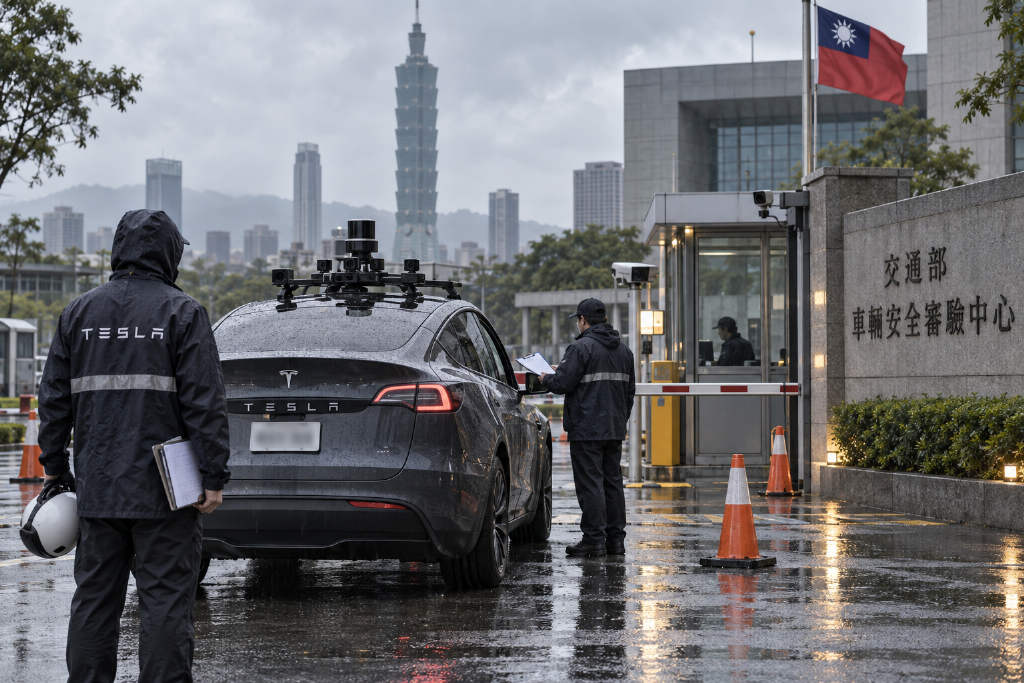
Tesla’s Full Self-Driving (Supervised) review in Taiwan remains stuck in the document confirmation and supplementary filing stage, according to the Vehicle Safety Certification Center. The case has not yet passed the technical review meeting. After checking that update against its own four-stage approval model published on July 15, BlockTempo said the first stage is now running more than two months behind schedule, pushing the earliest certification timeline from late 2026 to the second quarter of 2027. In a more conservative case, completion could slip into the second half of 2027.
Tesla Taiwan has also recently posted Vehicle Operator openings in both Taipei and Kaohsiung under its vehicle software division. The job description calls for driving prototype test vehicles for 6 to 8 hours a day on fixed routes and public roads, covering different weather conditions and time periods.
The first stage is still in supplemental filing
In a July 15 report, BlockTempo broke the review path into four stages using a July 9 announcement from the Vehicle Safety Certification Center and records from a June 10 discussion involving legislator Ko Ju-Chun. Those stages were: technical review after filing, Ministry of Transportation approval to begin road testing, review of the safety validation report after testing, and final issuance of the certificate.
When Tesla Taiwan filed on June 16, the case was still in the first stage. Based on the usual 2-to-4-week window after filing, BlockTempo had estimated that the first step should have been completed by mid-to-late July at the latest.
As of Oct. 1, the filing had been pending for 15 weeks, or roughly three and a half months. The Vehicle Safety Certification Center did not indicate that the case had moved into formal review. Instead, it confirmed that many materials were still awaiting response, confirmation, and supplementary submissions from Tesla Taiwan. Against the original 2-to-4-week estimate, the first stage has already taken more than three times the upper bound. BlockTempo said a conservative reading puts the delay at about 10 weeks, or roughly two and a half months.
Revised timeline now points to 2027
Using Oct. 1 as the new reference point, BlockTempo recalculated the process under the same four-stage framework.
- Completion of the technical review meeting: as early as mid-November, or as late as January 2027 because the Vehicle Safety Certification Center gave no deadline.
- Submission for ministry approval: usually about two weeks, putting the earliest result in late November and the conservative case in early February 2027.
- Road testing: previously estimated at around three months. Because Tesla is hiring in both Taipei and Kaohsiung and the roles include day and night shifts as well as cross-region travel, the testing program appears broader than a single-city rollout. The fastest scenario keeps testing at three months, from December to February 2027. A more cautious case extends that to four or five months, from February to June or July 2027.
- Review of the safety validation report: one month at the earliest, two months in the conservative case.
- Issuance of the type safety certification certificate: as early as the turn between March and April 2027, or in September or October 2027 in the conservative scenario.
Stacking those windows together, BlockTempo said the earliest outcome points to certification at the start of the second quarter of 2027, while the slower case moves into the second half of the year. On that calculation, approval and an OTA rollout before the end of 2026 can be ruled out.
Hiring supports testing plans, not near-term approval
The simultaneous hiring in Taipei and Kaohsiung may look like a positive signal, but BlockTempo said it should not be read as proof that regulatory review is close to completion. The positions require at least three years of driving experience, sustained attention over long periods, English writing and communication ability, and flexibility for day or night shifts and travel when needed. That points to real-world road data collection.
Still, hiring itself takes time. Posting the jobs, interviewing candidates, onboarding them, training them, and getting them on the road would likely take at least one to two months. The fact that the openings cover both Taipei and Kaohsiung, plus travel to other regions when needed and night-shift coverage, also suggests a wider test program. A broader set of traffic situations would tend to keep road testing near the upper end of the original three-month estimate, or even longer.
Job duties line up with regulator requirements
BlockTempo said the Vehicle Operator posting closely matches what the Vehicle Safety Certification Center wants to see in the review. The role includes validating active and passive safety systems, analyzing road scenarios, logging issues, and writing daily driving reports.
Under the center’s rules, Tesla Taiwan must submit a statement on domestic road-environment suitability and related safety validation test reports to verify traffic situations specific to Taiwan. The report said local hiring alongside that requirement suggests the team is being built to gather road-test data for those submissions, rather than simply to add mileage.
Subscription sales have shifted, but activation still depends on approval
The report also drew a line between Tesla’s commercial rollout and the regulatory timeline. The one-time FSD purchase option in Taiwan was discontinued on June 30. Starting July 1, the company moved fully to a subscription model, with the monthly fee estimated at TWD 2,990 to TWD 3,190. Owners with HW3.0 who completed a new vehicle order by Sept. 30 could transfer their FSD rights at no extra charge.
That commercial shift does not mean the feature is ready to be turned on. Activation still depends on clearing the supplementary filing process and the full review path.
Even after approval, FSD would remain a Level 2 system
One point that does not change with the review timeline is the system’s regulatory classification. FSD (Supervised) is still an SAE Level 2 system, meaning the driver remains fully responsible for the result of vehicle operation. BlockTempo said Taiwan is handling the product under its existing review mechanism for new technology driving systems, with no legislative amendment required.
Even if the fastest scenario plays out and the system clears review in the second quarter of 2027, driver liability would not be reduced. The report added that the same logic applies across the 12 countries or regions where the system has already been opened: availability does not remove driver responsibility.