
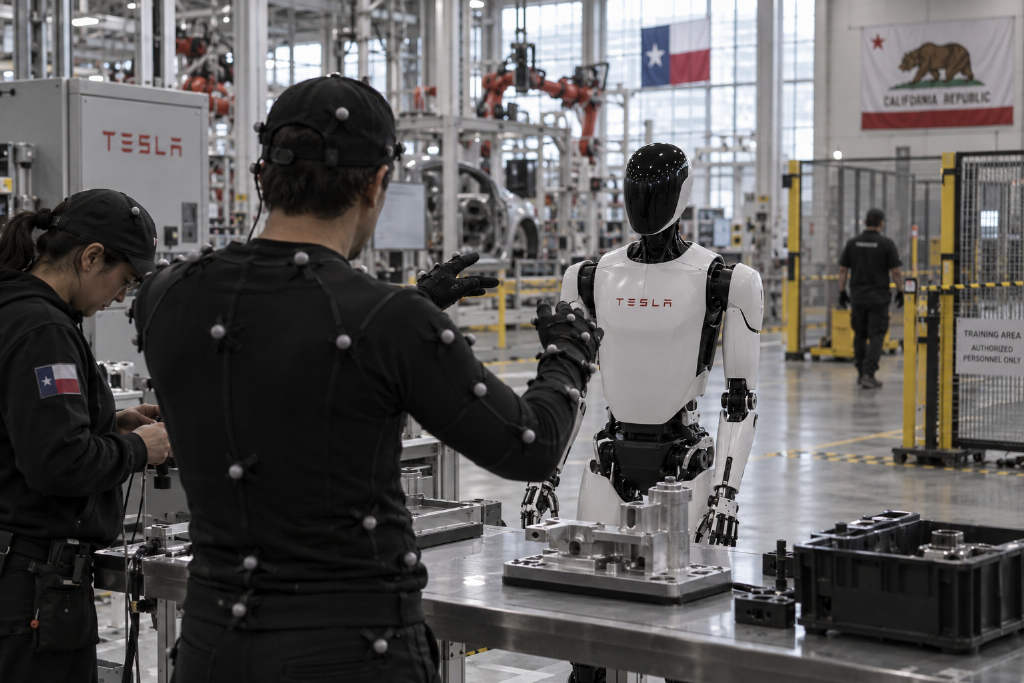
Tesla asked workers at its Texas and California factories earlier this year to wear motion-capture gear and show Optimus how to do their jobs step by step, according to The Information. Some employees complained for a simple reason: they knew the robots were ultimately meant to replace human labor.
Workers were asked to demonstrate tasks for robot training
The report says Optimus still lacks examples of how people physically carry out factory work, including how fingers close around a part and how the body turns when moving to the next station. That process falls under imitation learning, where a robot watches human actions and then learns to repeat them.
Motion-capture equipment records those demonstrations as data, giving the robot not just video footage but detailed movement information.
Tesla shifted the work to dedicated data collectors
Tesla did not drop the process after the complaints. The Information, citing anonymous sources, reported that the company instead hired dedicated data collectors and moved the work away from active production lines.
Tesla has posted dedicated Optimus data-collection jobs that include moving objects, walking along assigned routes, and completing specified actions while wearing motion-capture equipment.
The issue is sharper when the people doing the demonstrations are current line workers. In that case, each action shown to the robot can also be read as a task the robot may eventually take over.
Training centers expanded over the summer
The Information said Tesla also began installing cameras in factories to record operations, with most of the work taking place outside active production lines.
By summer, Tesla had also set up training centers in Colorado, Arizona, and Florida, according to a roundup by Electrek. Those data collectors wore camera helmets and motion-capture suits. Tesla had accumulated more than 500,000 hours of training data and aimed to double that amount by the end of the year.
Optimus still needs manual assembly and task-specific programming
That does not mean people are about to leave the process. The report says Optimus hands and forearms contain more than 100 small parts, including screws, and those parts still require manual assembly. Some robots coming off the line also need immediate fixes.
For specific tasks, the robots still need programs written for particular settings. The broader hurdle for the humanoid robotics sector remains the same: if machines are expected to operate reliably in varied environments, they first need large amounts of human behavioral data that people usually take for granted.