
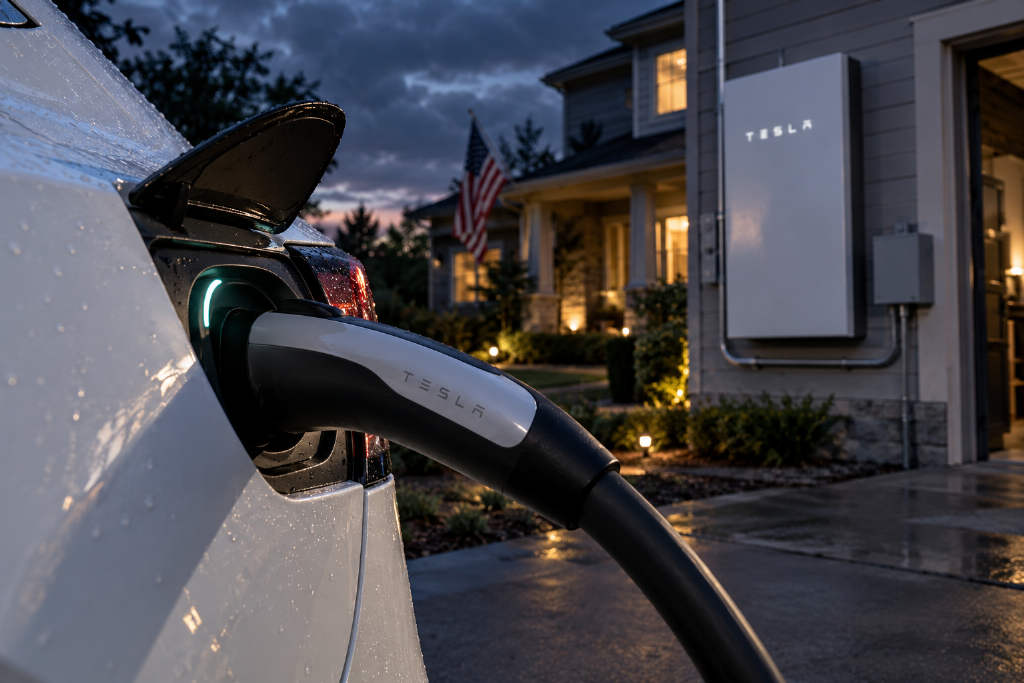
Tesla has formally expanded the scope of its bidirectional charging technology, saying the Model 3 and Model Y will also support its Powershare home backup feature. The function had previously been limited to the Cybertruck.
According to the company’s specifications cited by ABMedia, the feature currently applies only to new vehicles ordered on or after Oct. 1, 2026, in the United States and Puerto Rico. If a blackout occurs and the vehicle is connected to an approved charger, the system can automatically route power from the car battery back into a home electrical distribution system.
Powershare reaches Model 3 and Model Y
Tesla recently extended the Powershare home backup function from the Cybertruck to the Model 3 and Model Y. The update adds to the use case of electric vehicles as small household energy storage nodes during grid interruptions.
The report said higher-end versions of the Model 3 and Model Y can stretch backup supply to more than two days, allowing power-hungry home appliances to keep running during an outage.
Powerwall 3 and wall charger are required
To activate the bidirectional power function, users need Tesla’s third-generation home storage system, Powerwall 3, along with either the Universal Wall Connector or the Wall Connector Gen 3. The setup supports as much as 11.52 kW of continuous output, based on the details in the report.
Tesla’s figures show that with a starting charge level of 90% and household electricity use of 30 kWh per day, higher-end Model 3 and Model Y vehicles can supply backup power for more than two days. That configuration is positioned as a way to improve energy stability during unexpected outages.
Broader home energy push, but with limits
The move also expands Tesla’s hardware footprint in the Home Energy Management System market by tying its vehicles more closely to the Powerwall 3 ecosystem. It reflects the company’s effort to combine electric vehicles with home energy systems under a single setup.
At the same time, the application still carries several barriers. The feature is limited to recently ordered vehicles, and buyers must also absorb the fixed costs tied to storage equipment and installation. The report added that Powerwall 3 is not available for sale in Taiwan, leaving the longer-term impact on revenue and the broader market unclear.