
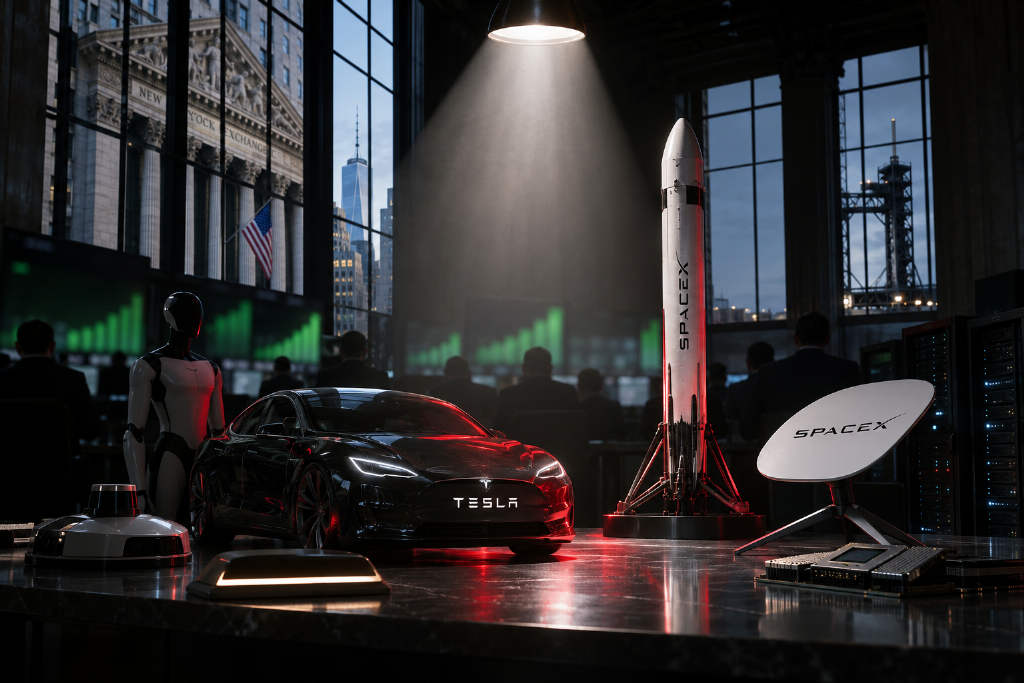
U.S. stocks pushed higher on Nov. 4 as the midterm picture came into focus. Tesla and SpaceX, though, went the other way.
BiyaPay market data showed the Dow Jones Industrial Average up 3.03%, the S&P 500 ahead 1.58%, and the Nasdaq gaining 1.44%.
Tesla (TSLA) finished at $385.19, down 3.34%, while SpaceX (SPCX) closed at $135.92, off 3.81%. By 19:59 that evening, some after-hours quotes had both names sliding further, to $381.30 and $134.01.
That split — a stronger broad market, weaker Musk-linked stocks — sent investors back to a bigger question: what might change for Musk’s business empire after the U.S. midterms?
Musk had been active in U.S. politics and supported Republican candidates. Democrats made important gains in the election, the balance of power in Congress shifted, and markets started looking for possible changes in government oversight, AI data center construction, and corporate project approvals.
But the report argues the drop cannot be written off as nothing more than Musk making the wrong political call. The larger issue is whether the new political backdrop changes business operations, and whether the AI businesses behind expectations for Tesla and SpaceX can become revenue and cash flow on schedule.
Why Tesla and SpaceX lagged while the market rose
The Nov. 4 session made one thing plain: a broad rally in U.S. equities was not enough to pull up every tech stock at once.
Large platform companies, plus some consumer and defensive names, held up relatively well that day. Data center-linked companies and parts of the tech supply chain, by contrast, were under pressure. Money did not rush into all of tech in one sweep. Investors were repricing growth expectations and policy risk business by business.
Tesla and SpaceX landed on the weak side of that trade.
Yes, the two companies operate in electric vehicles, commercial space, and satellite internet. But in recent years, both have become more tightly connected to AI infrastructure and to Musk’s wider business web.
Tesla is pressing forward with autonomous driving, Robotaxi, and the Optimus humanoid robot. SpaceX is expanding Starlink, commercial space operations, and spending on AI computing infrastructure. Long-term growth? Maybe. But these businesses also need ongoing investment, and their progress depends on the technology, the approvals, and how quickly they can be commercialized.
So investors are not just staring at current revenue and profit. They are asking whether future growth can actually be delivered. Once the market starts worrying about tighter regulation, slower execution, or higher capital expenditure, valuation pressure can show up before any real downturn appears in reported results.
Seen that way, the Nov. 4 pullback looked more like a reset in growth expectations than proof that the core businesses had already rolled over.
For investors following U.S. equities, the article says stock picking is only one piece of the job. Funding channels and currency exchange matter too. Users who track both digital assets and traditional financial markets can use BiyaPay, described in the report as a global one-stop asset allocation platform, to link multi-currency exchange with investment services for U.S. and Hong Kong stocks. The article says USDT can serve as a funding entry point, be converted on the platform into U.S. dollars or Hong Kong dollars, and then be allocated under the relevant account and trading rules. For users running diversified portfolios, that arrangement can cut down the number of steps across platforms and make capital planning easier to read.
Tesla’s real test is when AI can produce profit
Tesla’s valuation story is not just about selling cars anymore.
Automotive operations are still the core business. But autonomous driving, Robotaxi, the Optimus humanoid robot, and energy now sit near the center of how the market prices Tesla’s long-term value.
Here’s the problem. These businesses are at different stages, and they do not share the same route to profit.
The car business gives investors relatively clean data — deliveries, pricing, gross margin, inventory — all visible through quarterly filings. Autonomous driving and robotics still need more technical proof, more real-world rollout, and more scaled operating data.
Take Robotaxi. Investors are not just asking if the vehicles can drive themselves. They are also tracking service coverage, operating efficiency, accident liability, maintenance costs, and whether users will pay. Even if the technology improves, stable revenue could take a while to form.
Same story with Optimus. Product demos and flashy technical presentations can grab attention. But commercial adoption in manufacturing, logistics, and other settings will depend on mass-production capacity, unit cost, and actual customer demand.
And then there is capital expenditure.
Tesla said in an earlier quarterly filing that capital expenditure in 2026 is expected to top $20 billion, with spending aimed at computing infrastructure, data centers, production facilities, and research and development. That points to a bigger push into AI and automation. It also means investors have to keep an eye on the gap between spending and returns.
If commercialization stays on schedule, that investment could open fresh growth paths. If technical validation or market expansion comes in slower than expected, capital expenditure could add financial pressure for a stretch.
That is why Tesla’s next chapter cannot be measured only by whether the stock bounces. Investors are also watching vehicle deliveries, gross margin, energy performance, the speed of autonomous driving commercialization, and shifts in capital spending.
SpaceX has a large AI narrative, but data center expansion still has to pay off
SpaceX has a broader business mix than Tesla.
Commercial space and launch services remain major operations, while Starlink is producing a growing stream of connectivity revenue. At the same time, the company is putting more money into AI-related business lines and computing infrastructure, with the goal of combining satellite networks, computing power, and AI services.
Its latest results suggest this growth story is not just market fantasy.
According to Reuters’ report on the company’s third-quarter results, SpaceX generated about $14.58 billion in revenue for the quarter, up 161% year over year and ahead of analyst expectations, with net profit of about $4.4 billion. Revenue growth came mainly from expansion in AI business and growth in Starlink connectivity services.
By segment, the AI-related superintelligence business has become an important growth driver, while connectivity services such as Starlink have supported both revenue and operating profit.
Fast revenue growth, however, does not mean expansion is cheap.
SpaceX reported about $19.593 billion in capital expenditure in the third quarter, and AI-related spending made up a large share. Capital expenditure is money used to build or buy long-term assets. It is not the same as current operating expense, and you cannot simply subtract it from revenue to decide if the company is losing money.
The real issue is timing: can those investments turn into lasting revenue and cash flow fast enough?
AI data center construction needs computing chips, servers, power, cooling systems, and sites. And even after the equipment is in place, the company still needs customer orders and ongoing usage before returns start to build. If construction schedules, chip supply, or power support slip, the spending may already be locked in while revenue recognition gets pushed back.
That is one reason the market began reassessing the policy backdrop for AI infrastructure projects in the United States after Democrats made progress in the election.
Data center construction touches energy consumption, land use, community impact, and environmental oversight. If local governments impose tougher approval requirements on new projects, construction timelines and operating costs could be affected.
That does not mean projects are bound to stop. SpaceX still has commercial space and Starlink, among other businesses, and the report says policy uncertainty around AI infrastructure should not wipe out the value of those operations.
Why the stock stayed under pressure even as forecasts improved
There was another striking contrast in this move: SpaceX shares fell even while some institutions lifted their long-term growth forecasts.
According to a summary carried by Investing.com, Morgan Stanley analyst Adam Jonas recently raised his projections for SpaceX revenue and operating profit. He also pulled forward his forecast for the company to become free cash flow positive, from 2035 to 2031, while cutting his earlier estimate for external financing needs.
That revision rested mainly on expected growth in AI business, satellite connectivity services, and commercial space operations.
But forecasts are not the same thing as delivered operating performance. A shorter path to positive free cash flow does not mean SpaceX can already pay for all future expansion entirely through internal cash generation.
Institutional models are built on assumptions about revenue growth, margins, capital expenditure, and financing needs. Change one major assumption, and valuation can move with it.
So yes, higher forecasts and a short-term stock drop can happen at the same time.
Investors may still believe in SpaceX’s long-term opportunity while worrying about near-term regulation, AI infrastructure spending, and the time needed to earn back the capital. For companies whose valuations already price in a lot of future growth, the market usually watches execution very closely.
As a result, the next move in SpaceX cannot be judged only by institutional price targets. Investors are also tracking whether AI revenue keeps rising, whether Starlink users and service revenue continue to expand, and whether capital expenditure begins turning into stable operating returns.
What shareholders are really watching in any Tesla-SpaceX tie-up
Beyond the election and AI infrastructure, talk of closer integration between Tesla and SpaceX has also drawn market attention.
Both companies sit near Musk’s broader business network, and that leaves room for speculation about operating synergies. AI computing capacity, energy supply, automation technology, and infrastructure development are among the areas often mentioned when people discuss a possible combination.
But the report is clear: discussing a potential merger does not mean a transaction has been completed, or even finalized.
For investors, the value of any merger cannot be judged by simply adding the size of the two businesses together. Deal structure, share-swap terms, asset valuation, and future funding needs would all matter.
If a transaction involved issuing new shares, existing shareholders could see their ownership stakes change. If the businesses have different capital expenditure profiles and liability structures, resource allocation after a merger would also become a major issue.
Technology synergies may create long-term value. Fine. But they still need to show up in operating efficiency, customer growth, margins, and earnings per share.
Until deal terms are clear, investors should not treat possible synergies as gains already in hand. For both Tesla and SpaceX, future stock performance still comes back to their own operations and valuation bases.
Three signals the market is watching next
After the Nov. 4 decline, the market is not just looking for a rebound in the two stocks. It is also watching for changes in fundamentals and in the outside environment.
Whether policy changes actually affect projects
The U.S. midterms changed the balance of power in Congress, but policy shifts still have to move through legislation, regulation, and implementation. For Tesla, the focus is autonomous driving, auto regulation, and project approvals. For SpaceX, investors are watching AI data center construction, energy support, and the setting for government-linked projects.
The election result by itself is not enough to say either company has already lost a business opportunity.
Whether AI businesses can keep turning into revenue
Tesla needs real progress in autonomous driving, Robotaxi, and robotics to support long-term growth expectations. SpaceX needs to show continued AI revenue growth, stronger Starlink connectivity services, and efficient operation of its computing infrastructure.
If these newer businesses keep expanding and begin producing stable profit, long-term valuation may get firmer support. If capital expenditure keeps climbing while revenue and cash flow do not keep up, valuation pressure may stick around.
Whether the stocks can regain volume support and fundamental backing
In the short run, investors can watch prior lows in Tesla and SpaceX, changes in trading volume, and the level of participation during any rebound. If prices recover without enough volume, confidence may still be thin. If the stocks retake key price areas on stronger volume, the market can then judge whether the recovery has real staying power.
The gap between a rally in major U.S. technology stocks and declines in Tesla and SpaceX reflects more than political feeling tied to the midterm elections.
For Tesla, the market is waiting for autonomous driving, robotics, and energy to deliver more of the growth already priced into the stock. For SpaceX, rapid AI expansion has created new revenue openings while also lifting the bar on capital spending and the timing of returns.
Musk’s companies still have business lines that support their long-term development. But whether current valuations can hold will depend on technology progress, project approvals, profitability, and cash flow.



