
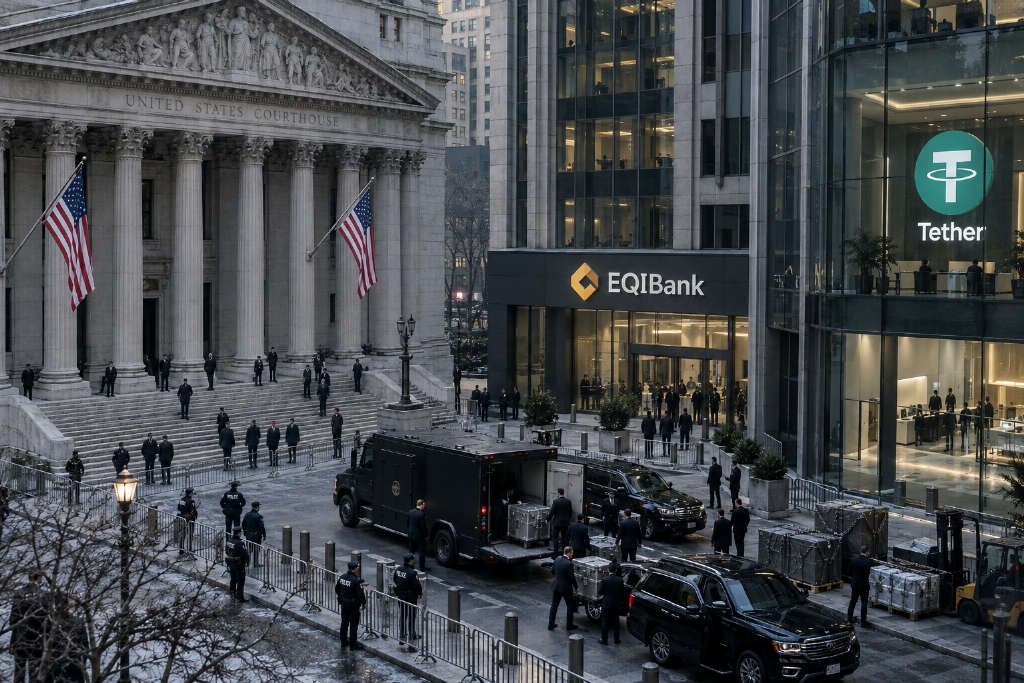
Tether said on Thursday that U.S. prosecutors froze $89 million tied to EQIBank, a digital bank that handled remittance flows for the stablecoin issuer. The amount represented about 80% of EQIBank’s cash holdings, according to the report.
A Tether representative said the group’s assets held with EQIBank amounted to less than 0.034% of its $18.775 billion in total assets. On that basis, the exposure would be about $64 million. Tether said the seizure had little effect on its reserve ratio and posed no direct threat to USDT’s peg to the U.S. dollar.
Still, the Financial Times and The Information said the case exposed a less visible risk in the stablecoin business. Issuers do not simply hold dollars directly; they rely on layers of banks and payment processors to handle customer deposits and redemptions.
How EQIBank funds were frozen
The funds in question came from Capstone, a payment processor that held money in the United States for EQIBank and scheduled customer fund flows through accounts at Wells Fargo and JPMorgan.
Court filings said Capstone concealed the true nature of its business from banks. U.S. prosecutors then seized funds from those accounts and filed a civil forfeiture action, alleging that Capstone misrepresented its business model to banks.
EQIBank later said the $89 million included crypto assets such as 450,000 BTC and 150,000 ETH.
In an email, a Tether representative said, 「Tether did not know about Capstone’s actions」 and added that the group’s EQIBank exposure was 「less than 0.034% of group assets.」
Where Tether keeps its reserves
Tether reported total assets of $18.775 billion in June. About 50% of that was held in short-term U.S. Treasuries with maturities of less than one year, while the rest was placed with custody banks in New York and other partner institutions.
The report said EQIBank handled wire transfers for USDT subscriptions and redemptions, but it did not hold Tether’s main reserves.
By comparison, USD Coin issuer Circle uses a more direct setup, placing assets with several national banks and clearing institutions and disclosing reserve details every month.
Shared banking channels across crypto platforms
EQIBank also provided banking services to multiple crypto exchanges, including transactions tied to Binance, Kraken and Coinbase. That means stress at one banking channel could hit liquidity across several platforms at the same time.
What the case shows about stablecoin banking risk
The incident shows that even a stablecoin issuer the size of Tether is not fully insulated from banking risk. Stablecoin operations depend on a chain of deposit banks, payment processors and clearing institutions, and each point in that chain can introduce counterparty exposure.
The report said this kind of risk is more institutional than the risks tied to Bitcoin holders cashing out. It is tied to how money moves through financial channels, not to market sentiment alone.
If EQIBank were to fail, Tether’s reserve ratio would fall by 0.034%, according to the article, while USDT’s dollar peg would not face a material impact. Even so, the case served as a reminder that stablecoin reserves are not removed from risk; they sit inside a network of banks and payment processors.
The next points to watch are whether Tether will disclose more detail on its reserves and whether EQIBank’s broader banking network carries other potential liquidity risks.