
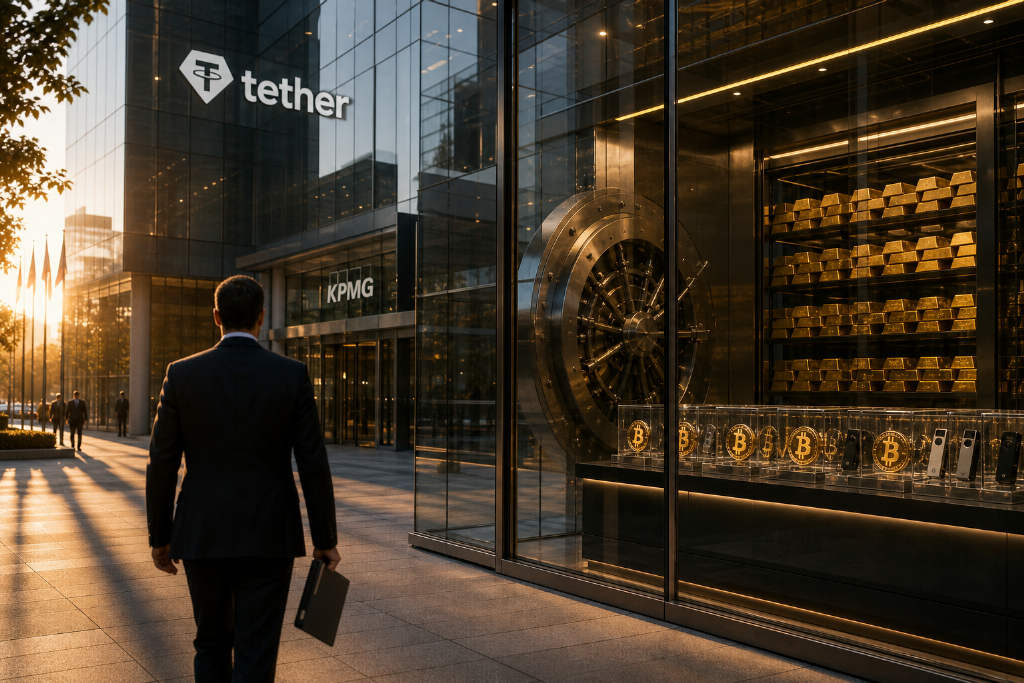
Tether CEO Paolo Ardoino said on Aug. 14 that KPMG U.S. has completed a full independent audit of the financial statements of Tether International, S.A. de C.V., the issuer of USDT, for the year ended Dec. 31, 2025.
Speaking in an interview with The Starting Block, Ardoino said Tether’s balance sheet is not complicated and argued that the company’s long wait for a full audit was tied mainly to the hostile posture of the previous U.S. administration toward the digital asset sector. He said Tether plans to undergo one full financial audit each year and continue issuing quarterly attestation reports.
Ardoino also addressed criticism around Tether’s reserves, ownership transparency and private fundraising. He said Tether does not need outside capital, though there is strong market interest in the company’s shares, and that the firm will be careful in choosing potential shareholders that align with its mission.
He added that Tether has accumulated about 150 tons of gold and more than 100,000 BTC, and said the company is interested in allocating budget to support work that uses artificial intelligence to review Bitcoin code and wallet security.
Why the full audit came only now
Interviewer Gareth Jenkinson said Tether’s announcement of a formal audit by one of the Big Four accounting firms was something critics had demanded for years.
Ardoino described the day as an important one for both Tether and himself. Tether was founded in 2014, he said, and has spent years building what he called strong technology, with traditional financial institutions now paying attention to it. He likened the full audit to "the final cherry on top of this beautiful cake."
Asked why it had been so difficult to complete in earlier years, Ardoino said the audited entity was Tether International, S.A. de C.V. and that, from a technical standpoint, auditing that entity was fairly straightforward because its balance sheet contains only a limited number of asset classes. He said Tether has robust bookkeeping processes, strict management and a risk-averse approach.
He also pointed to the upheaval that hit the digital asset industry in 2022 and 2023. According to Ardoino, Tether’s main competitor came close to crisis because of exposure to several banks and the risks tied to them, while Tether made it through those difficult periods each time.
Still, he said the broader political setting mattered. Ardoino argued that the previous U.S. administration was hostile to the industry and specifically mentioned Elizabeth Warren as one of the figures who publicly criticized Tether and suggested auditors should stay away from the company. That, he said, created uncertainty for accounting firms.
By contrast, Ardoino said the current U.S. administration has made clear that digital assets matter for the future of the United States and the world, and that the U.S. wants to lead in the field. After that shift, he said, Tether quickly resumed talks with several Big Four firms and eventually chose KPMG U.S.
Choosing KPMG U.S. for the strictest level of scrutiny
Ardoino said that even when Tether used BDO, a non-U.S. accounting firm, for attestation reports, the company still faced criticism. For that reason, he said, Tether chose to work with KPMG U.S. and submit itself to what he described as the strictest review possible.
He said the entire team was focused on completing the process and that a full audit had long been the company’s top priority. In his telling, the change in the U.S. government’s attitude allowed accounting firms to return to the table.
For a company such as Tether, Ardoino said, the balance sheet itself is simple: liabilities consist of issued tokens, and assets consist of the reserves backing those tokens. Based on attestation data as of Dec. 31, 2025, he said Tether had more than $6 billion in excess equity, a figure he said was also confirmed by the auditor.
He repeated that Tether will seek a full financial audit every year while continuing to issue quarterly attestation reports. He called that the highest level of transparency the industry can reach.
Ardoino says Tether redeemed about $7 billion in 48 hours
Jenkinson said one of the central questions around Tether over the years has been whether the company might have minted large amounts of USDT without enough collateral behind it, which is why the market viewed a full audit as necessary. Even after the audit, he said, criticism remains, including calls for more disclosure about ownership and participants.
Ardoino replied that many people struggle to admit when they are wrong and keep searching for new excuses instead. He said he had responded that day to the account Bitfinex’ed, which he had not engaged with for a long time, and referenced the character Fonzie from the television show Happy Days, who could not bring himself to say "I was wrong."
He said Tether has already proven itself many times and has handled concentrated redemptions on a scale that, in his view, exceeded anything seen at historical financial institutions over one day, 24 hours or 48 hours.
In 2022, he said, Tether redeemed about $7 billion in 48 hours, equal at the time to roughly 10% of its reserves. Any financial institution or bank facing redemptions of 10% or more in such a short period would fall into crisis, Ardoino said, adding that Tether’s ability to process that wave was unusual.
He said he is willing to stay under pressure and accept criticism because it helps make the company stronger. Ardoino also said that, in some ways, he is comfortable being seen as a "villain" by some people if that means Tether can be a hero to the world’s 650 million users who are not served by the broader financial industry.
No criticism, he said, will discourage Tether or push it away from its mission.
Auditors counted the gold bars one by one
Jenkinson raised a detail from the audit process, asking whether auditors had in fact counted every gold bar in Tether’s reserves one by one.
Ardoino said Tether’s goal was to remove every possible doubt, "except for the stupid ones." He cited a common Bitcoin phrase: "Don’t trust, verify."
Gold, he said, has been an important tool for Tether. Over the past few years, the company has accumulated about 150 tons of gold and also holds what he described as a significant amount of bitcoin, more than 100,000 BTC.
Verifying bitcoin is relatively easy because ownership of a Bitcoin address can be demonstrated, he said. Verifying gold is different and requires manual work. To confirm the existence of the gold and the accuracy of the bar information, auditors had to inspect the bars individually. Ardoino said the process was necessary and that it showed Tether had nothing to hide.
As he put it, "literally and metaphorically, we left no stone unturned."
Tether says it does not need capital
Jenkinson also asked about media reports that Tether had been pursuing a private equity fundraising round and whether those plans had been shelved.
Ardoino said Tether had never formally announced anything and suggested that some media outlets had built their own narrative by posing the questions and then answering them themselves.
He did say there is strong demand for Tether shares. Bitcoin has a fixed supply of 21 million coins, he said, and Tether shares are also scarce because the company has only a small number of shareholders.
People are not knocking on the door every day, Ardoino said, but the company continues to hear from parties interested in buying Tether stock. Even so, he said, Tether does not need capital because it is highly profitable, can decide on its own where to deploy resources and has already built strong technology.
QVAC and AI tools for people outside traditional finance
Ardoino also discussed Tether’s artificial intelligence effort, QVAC. He said that even when people think the AI industry has already settled and the winners have already been decided, Tether still has its own story, plan and technology to bring forward.
That, he said, shows there is still room to build AI tools for about 4 billion people outside the traditional financial system. Those people may also be overlooked by major AI companies because someone who cannot afford the cost of a bank account may also be unable to pay for subscriptions to OpenAI or Anthropic.
Tether, he said, can build tools that run on edge devices and serve those users. Many of them are already part of what he said is the current base of about 650 million USDT users.
Ardoino said this is part of what makes Tether different. Rather than waking up every day to optimize every last cent to satisfy an unhappy shareholder, he said, he wants to spend that time thinking about the company’s mission.
For that reason, he said, anyone joining Tether must be mission-aligned. The company continues to see interest from investors, including some who share that outlook, but it will be careful in deciding who gets added to the shareholder list.
He said execution has been Tether’s defining strength for the past 12 years. The company has chosen to remain private rather than go public, he said, because listed companies are judged every three months on earnings. His focus, he said, is on financial inclusion. Ardoino called Tether "the greatest financial inclusion success case in human history," adding that there is no second place beside it in that sense.
Tether is open to funding Bitcoin code and wallet security work
The interview closed with discussion of recent security problems in the Bitcoin ecosystem, especially the Coldcard security incident and its impact on the industry.
Jenkinson said Bitcoin Red Team has started to emerge, with researchers using frontier AI models to examine Bitcoin’s open-source code base so vulnerabilities can be found, disclosed and fixed as quickly as possible. He asked whether Tether, Ardoino or affiliated companies had an interest in supporting that work.
Ardoino said the industry should be grateful for the work Bitcoin developers have done in recent weeks and that Tether is interested in providing budget to help continue that effort.
He added that, in his view, the risk posed by software bugs is currently greater than the risk posed by quantum computing, and that artificial intelligence may make software vulnerabilities easier to identify. As for Bitcoin, he said a path exists to address quantum risk in the future by introducing new quantum-resistant signature schemes and allowing users to move funds to addresses that use those schemes.
Before that, however, he said it is necessary to make sure Bitcoin’s code base, as well as the tools and wallets people use every day, are secure and reliable. Ardoino said what happened at Coinkite and Coldcard had made many people more aware of the real dangers in this field.
Annual full audits and continued quarterly attestations
In the last question of the interview, Jenkinson asked whether Tether will continue to undergo this kind of audit by KPMG U.S. every year.
Ardoino said yes. Tether will continue down that path, he said, with one full financial audit each year and ongoing quarterly attestation reports, which he said will set the highest transparency standard for the industry.