
Tether Chief Executive Officer Paolo Ardoino said on Oct. 20 that the company has been moving faster than formal sanctions designations in freezing implicated addresses, as he publicly answered a sanctions compliance investigation report released earlier by the U.S. Senate Permanent Subcommittee on Investigations.
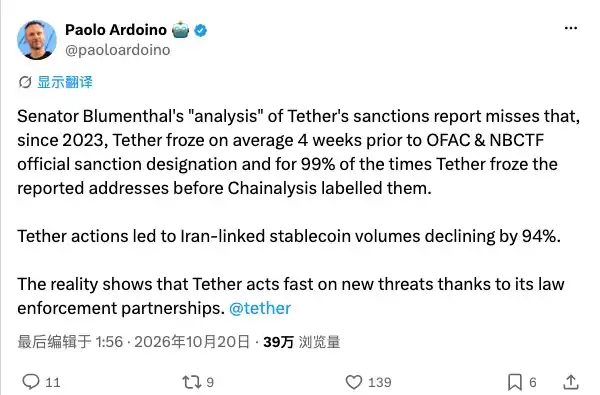
In a post on social media, Ardoino said that since 2023, Tether has frozen implicated addresses an average of four weeks before formal sanctions actions by the Office of Foreign Assets Control, or OFAC, and other regulators. He added that in 99% of cases, Tether acted before official labels from blockchain analytics firm Chainalysis.
Tether cites preemptive enforcement data
Tether framed those numbers as the core of its defense in the dispute over sanctions compliance. Ardoino said the company has built proactive coordination channels with law enforcement agencies around the world, giving it faster response times when new threats appear.
According to figures disclosed by the company, a series of targeted blocking measures led to a 94% drop in Iranian-linked on-chain stablecoin transaction volume, cutting off funding circulation routes used by restricted entities.
Senate report focuses on USDT use in Iranian-linked wallets
The public exchange was triggered by an investigation report led by U.S. Senator Richard Blumenthal. The report said that among 846 Iranian-linked wallets identified by authorities as sanctions or seizure targets, 84% of transactions relied primarily on USDT.
The report examined recent cases involving illicit on-chain settlement activity and argued that illegal networks used highly liquid stablecoins to bypass scrutiny in the traditional banking system through SWIFT. It also accused issuers of failing to fully carry out blacklist screening duties.
Based on those findings, the report called on the U.S. Department of Justice and the Treasury Department to launch a deeper anti-money laundering investigation.
Tether says it helped freeze about $550 million in 2026
Tether later released what it described as a coordination list showing that, in 2026 alone, the company helped law enforcement agencies in multiple countries freeze about $550 million in Iranian-linked assets. It said many of the seized wallets were directly tied to sanctions evasion networks.
Dispute highlights a changing role for offshore stablecoin issuers
The dispute also points to a broader shift in how offshore stablecoin issuers are positioned in the compliance system. The report said the role has moved from passively responding to judicial assistance requests to actively cutting off on-chain activity about a month before official sanctions are announced.
As traditional intelligence labels lag behind high-frequency on-chain money laundering routes, issuers that control blacklist permissions in centralized smart contracts are trying to build their own intelligence networks and claim more authority in defining compliance. That has sharpened questions around the legal status and jurisdictional boundaries of stablecoins.
With Washington politicians and judicial authorities tightening look-through oversight, major issuers are being pushed to find a more defensive balance between preserving global liquidity and avoiding secondary sanctions risk.



