
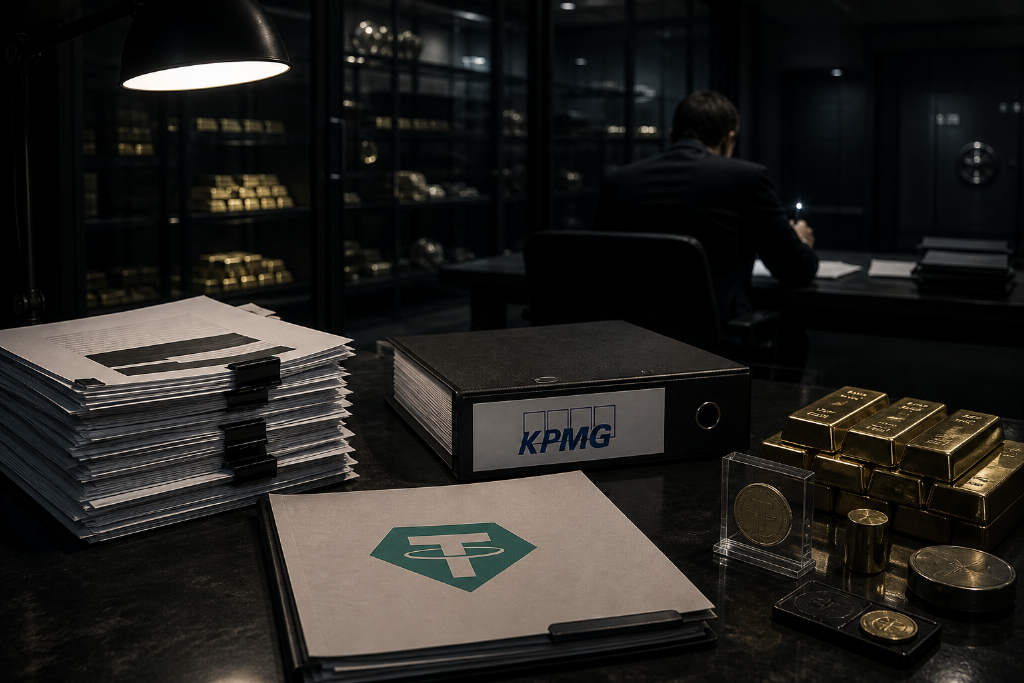
Tether said on Aug. 13 that KPMG U.S. completed the first independent audit of the financial statements of Tether International, S.A. de C.V. for the year ended Dec. 31, 2025, and issued an unqualified opinion. That is the highest level of assurance an independent auditor can give, meaning KPMG concluded that the company’s financial statements fairly present, in all material respects, its financial position, operating results, and cash flows under U.S. GAAP.

The audit covered the balance sheet, income statement, statement of changes in equity, and statement of cash flows. According to the report, auditors physically counted and inspected each gold bar held by Tether and verified underlying evidence tied to transaction records, systems, valuations, counterparties, and asset ownership. The result showed that, as of the end of 2025, Tether’s reserve assets exceeded liabilities by $6.814 billion.
Chief Executive Officer Paolo Ardoino announced the result on X and called it the "largest-ever initial financial audit in history," while pushing back against critics who have questioned Tether for years.
The milestone is significant. It also does not end the discussion around USDT transparency. A closer look at what the audit covers, and what still has not been disclosed, leaves several issues unresolved.
Audit and attestation are not the same thing
For the past several years, Tether has published quarterly reserve attestations issued by BDO Italy. Those reports verify whether, at a specific point in time, reserve assets cover token liabilities in circulation. They amount to a snapshot.
The KPMG engagement was different. A full financial statement audit goes beyond checking whether the money is there and whether it matches liabilities. It examines the source of funds, how assets move through the system, ownership records, valuation methods, and the integrity of the broader financial reporting framework. Auditors also test samples of transactions, evaluate internal controls, assess accounting policies, and review whether related-party transactions are properly disclosed.
That helps explain why it took Tether a decade to get here. The timeline cited in the report runs from the dismissal of Friedman LLP in 2017, to the appointment of MHA Cayman in 2021 for attestation work after that firm later became part of the BDO network, to the completion of a SOC 2 Type 1 information security review in 2024. In March 2026, Tether said it had engaged one of the Big Four for a full audit, while PwC took part in internal system compliance preparation.
Moving from attestation to audit marks a substantive step for Tether. From the standpoint of investors and regulators, though, several questions still need answers.
Five issues that remain open
Where is the full audit report?
As of publication, Tether had announced that the audit was complete and shared KPMG’s unqualified opinion, but it had not provided the full audit report to the public or the media. CoinDesk asked Tether whether it would release the complete KPMG audit file and had not received a response, according to the report.
The value of an audit report does not sit only on the opinion page. It also lies in the footnotes, accounting policy disclosures, key audit matters, detailed reserve classifications, and related-party transaction disclosures. Without the full document, outside analysts cannot independently test the most important details.
What exactly was inside the audit perimeter?
The entity audited by KPMG was Tether International, S.A. de C.V. Ardoino told The Block that this is the issuing entity for USDT and that the audit covered all financial data.
Still, Tether’s corporate structure is more complex than a single entity. The report points to Tether Holdings Limited, registered in the British Virgin Islands, along with Tether Operations Limited, Tether Investments Limited, and entities tied to Tether Gold in a multilayer holding structure. In earlier BDO attestation reports, assets at Tether Investments Limited were explicitly excluded from the definition of reserves.
Whether KPMG’s audit boundary matches the scope used in BDO attestations, and whether intra-group related-party transactions were fully examined, cannot be determined without the complete report.
The reserve buffer has narrowed sharply
KPMG’s audit confirmed that reserves exceeded liabilities by $6.814 billion at the end of 2025. In the first quarter of 2026, BDO attestation data put that figure at roughly $7.1 billion to $8.2 billion, though the report notes differences across data sources.
By the second quarter of 2026, BDO attestation showed the reserve buffer had fallen to $4.11 billion, down about 40% from the level at the KPMG audit date.
Audit does not remove reserve risk
An unqualified opinion means the financial statements are fairly presented. It does not mean the reserve assets are free of credit risk or concentration risk.
As of the first quarter of 2026, about 80% to 83% of Tether’s reserves were in U.S. Treasuries, 5% to 7% in overnight reverse repos, and 3% to 5% in money market funds. The reserves also included gold, Bitcoin, and secured loans. Gold holdings exceeded 146 metric tons.
Secured loans have been one of the market’s long-running concerns. The report says Tether pledged at the end of 2023 to eliminate that asset category, yet it still stood at $5.5 billion by mid-2024. Who borrowed those funds, what collateral backed them, and how concentrated those exposures were remain only lightly disclosed in attestation reports. If the full audit is released, the footnotes should offer a more detailed breakdown.
The timing problem has not gone away
The audit covers financial data from eight months ago. Over that period, USDT circulation rose from about $144 billion to more than $184 billion, an increase of roughly $40 billion, according to the report.
For a financial institution whose balance sheet is expanding at that pace, the usefulness of an annual audit has natural limits. Tether has not directly answered whether KPMG will also audit the company for 2026, or whether the cadence could shift to semiannual or quarterly reviews.
A key move in a larger regulatory game
The strategic weight of the audit becomes clearer in the context of regulation.
In July 2025, the U.S. president signed the GENIUS Act, creating a federal framework for stablecoin oversight. The law requires compliant issuers to hold 1:1 reserves in cash or short-dated U.S. Treasuries, publish monthly reserve attestations, and undergo annual audits. The audit requirement, however, does not automatically apply to offshore issuers. Tether is headquartered in El Salvador and is not a U.S.-registered entity.
The law leaves a path for offshore issuers through a reciprocity determination by the U.S. Treasury Department, which must decide whether the issuer’s home regulatory framework is comparable to that of the United States. As of mid-2026, that determination was still under review, according to the report. Senator Jack Reed also introduced the Foreign Stablecoin Transparency Act to address what the report describes as a regulatory gap left by the GENIUS Act for offshore issuers.
Against that backdrop, Tether’s unqualified opinion from KPMG is a strong card. The signal to U.S. regulators is that, even without a direct legal requirement, Tether is trying to raise its disclosure standard and align itself with more demanding audit expectations. At the same time, Tether launched the USAT token through Anchorage Digital Bank in January 2026 for the U.S. market as a compliance-focused Plan B.
Even so, completing an audit is not the same as achieving regulatory compliance. The GENIUS Act gives digital asset service providers a three-year transition period through July 2028. After that, non-compliant stablecoins will be barred from listing on U.S. trading platforms. On that timeline, this audit is one required step, not the finish line.
What the audit answered, and what it did not
The report argues that, once the noise is stripped away, the audit did establish several important points. At least as of the end of 2025, Tether was able to present financial statements under one of the world’s strictest audit standards and receive the highest opinion. The audit also confirmed a reserve cushion above liabilities, a reserve structure led by U.S. Treasuries, and physical inspection of gold holdings.
For a company that has long faced questions over whether the reserves exist at all, that is its strongest answer so far.
Ardoino said this is not the end but "the beginning of the next leg of the journey." The report’s conclusion is that the real test starts when the full audit report is made public.