
The Standard Reserve is laying out an on-chain monetary experiment that tries to make issuance, buybacks, and exit rules react automatically to capital flows.
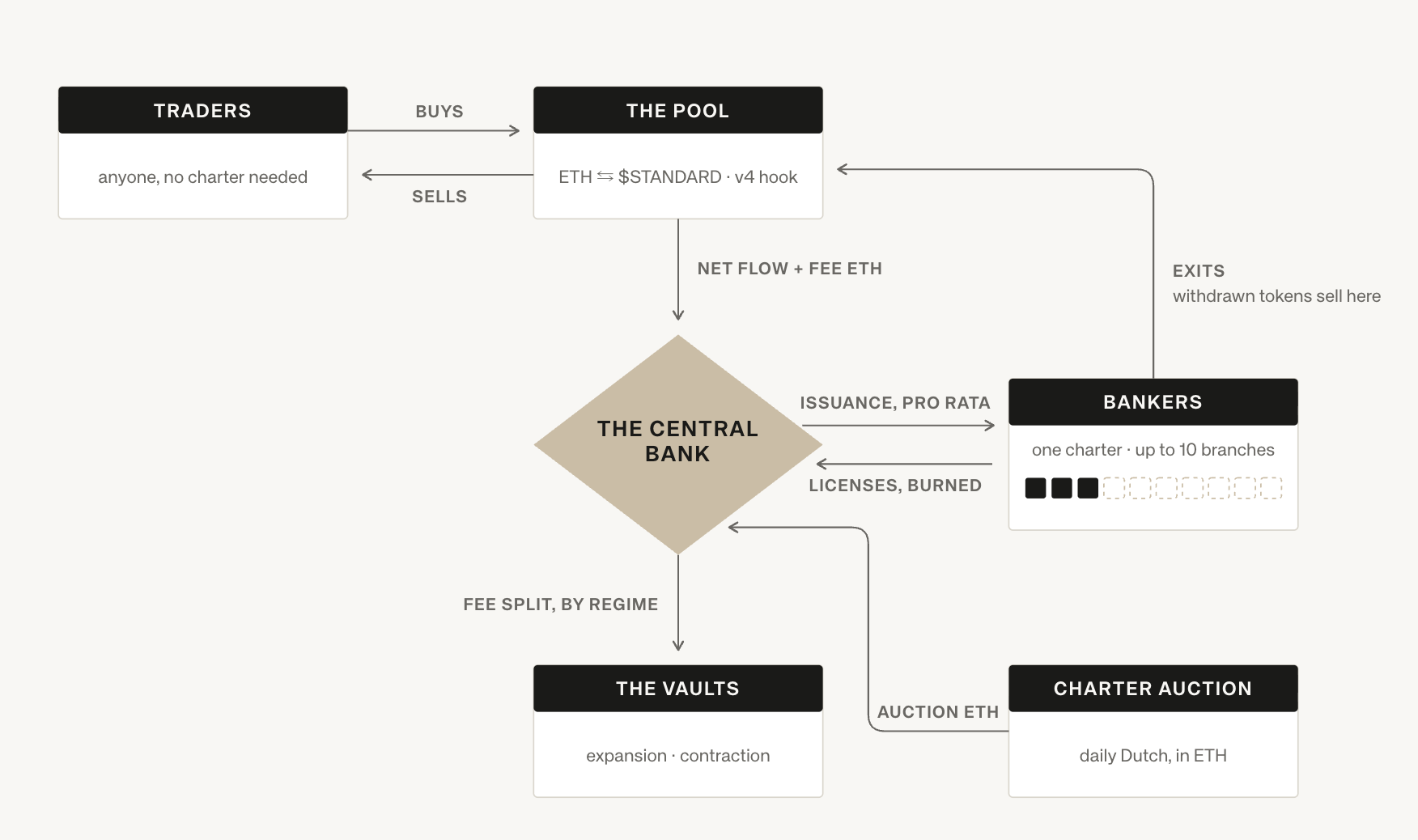
Instead of starting with the usual token launch questions, the project asks what a protocol should do when money starts leaving. Its answer is to reduce issuance, buy back tokens, and compensate those who remain, with those actions written into smart contracts rather than handled manually.
In its materials, The Standard Reserve describes itself as a "sovereign on-chain central bank." The white paper also makes clear that those banking terms apply only inside the protocol. It says STANDARD is an experimental on-chain protocol, not a regulated financial institution, does not provide bank accounts, and does not hold customer funds.
On the team side, @0xbeans has described the mechanism in the voice of a project participant and said the exit design continues parts of the approach used in Bear Bonds in 2023. Bear Bonds, according to the article, was a system designed to transfer value from sellers to holders and was a finalist at ETHOnline 2023. The Standard Reserve website and white paper, however, have not published the names of the founding team or the operating entity.
A monetary policy built around net ETH flow
The Standard Reserve plans to create an ETH-STANDARD pool on Uniswap v4. The protocol would use a Hook in that pool to record capital flows.
In the proposed model, buying STANDARD counts as ETH flowing in, while selling STANDARD counts as ETH flowing out. The protocol subtracts one from the other to get net ETH flow for a period.
That leaves the system in one of two states. If net ETH flow is positive, the protocol enters expansion mode. Token issuance can gradually rise as inflows continue, and 70% of the ETH revenue collected in each epoch, including trading fees and Charter auction proceeds, goes to an expansion treasury. That treasury is meant to accumulate ETH and buy hard reserve assets such as tokenized gold and similar assets.
If net ETH flow is negative or equal to zero, the system switches to contraction mode. Issuance drops immediately. In that state, 70% of the same ETH revenue sources goes to a contraction treasury, which is used to buy STANDARD on the open market and burn it.
According to the white paper, the contraction treasury would buy STANDARD from the public market on an hourly and capped basis, and every token it buys would be burned. The design says this rate limit is intended to keep daily buybacks within about 5% of pool depth, reducing the impact of a single large purchase and limiting concentrated arbitrage in one block.
The remaining ETH revenue is split two ways: 15% goes to increase protocol-owned liquidity, and 15% goes to the team.
The issuance policy looks at the net flows from the two most recently completed epochs, while the decision to direct revenue into reserves or buybacks depends on the direction of flows in the current epoch. In practice, that means one large short-term buy would not suddenly trigger a large wave of new issuance, but outflows could push the system into a defensive posture more quickly.
On the technical side, Uniswap v4 Hooks are smart contract modules that can run custom logic before or after swaps and liquidity actions. The article notes that using Hooks to track flows, adjust fees, or trigger other operations is feasible within that framework.
Charter NFTs serve as internal banking licenses
Ordinary users would not need an NFT to trade STANDARD. But anyone who wants access to newly issued tokens would need to hold a Charter NFT.
In the protocol’s terminology, a Charter is an internal participation license that can be understood as a banking license. Holders are called Bankers. Each Charter starts with one Branch and can expand to as many as 10.
Branch count determines how issuance is divided. STANDARD created in a given epoch would be allocated across all Branches in the system on a proportional basis.
The Standard Reserve plans to open minting for 1,000 free Founding Charters. Part of that allocation would go to a whitelist, and part would be open to the public, with a maximum of one mint per wallet.
After the genesis phase, new Charters would be created through daily Dutch auctions paid in ETH. The auction price starts high and falls throughout the day until someone buys at the live price. ETH raised in those sales would feed into the protocol’s fee system.
At launch, Charter is expected to be a non-transferable Soulbound NFT. The white paper leaves room for a one-way switch that could enable transfers later. If that switch is turned on, the Charter would move together with its Branches and any unclaimed balance.
How STANDARD is issued and burned
The white paper describes STANDARD as an ERC-20 token with a hard cap of 1 billion, but that full amount would not enter circulation at launch.
The supply plan sets aside 100 million STANDARD for genesis liquidity. Those tokens would pair with ETH as protocol-owned full-range liquidity, and the white paper says that liquidity position would be held by the protocol and could not be withdrawn.
The remaining 900 million tokens form the future issuance budget. Once cumulative issuance reaches 900 million, base issuance stops permanently.
Another key feature is how Banker rewards are recorded. At first, those rewards exist only as internal protocol balances rather than wallet tokens. STANDARD is only minted when a Banker closes Branches and withdraws earnings.
The white paper lists three main burn paths:
- all STANDARD spent by Bankers to buy Expansion Licenses is burned;
- all STANDARD repurchased by the protocol in the market is burned;
- half of the fee charged when a Banker exits is burned.
Expansion burns tokens, and exits require closing Branches
If a Banker wants a larger share of future issuance, that participant has to add Branches to a Charter. New Branches are not free. They require the purchase of Expansion Licenses.
Expansion Licenses are sold in one Dutch auction each day. In the initial stage, each round offers 100 licenses. The price begins at a higher level and declines over 24 hours until someone buys at the current price. Each Charter can buy no more than three licenses per day.
A round ends when all 100 licenses are sold or when the 24-hour auction window expires. Unsold licenses do not roll into the next round. The result of the final trade determines the next day’s opening price.
Expansion Licenses must be bought with STANDARD, and every token used to pay is burned. So when Bankers increase Branch count, they also remove some STANDARD from circulating supply on a permanent basis. Even so, adding Branches does not guarantee positive returns. The amount each Branch receives still depends on the issuance rate and the total number of Branches across the entire system.
Withdrawals work in the opposite direction. A Banker must permanently close Branches to realize accrued rewards. If a Charter has 10 Branches and one of them is closed, only one-tenth of that Charter’s accumulated balance can be withdrawn. The full balance can be taken only if all Branches are closed. Once the last Branch is closed, the Charter itself is destroyed.
At that point, the internal balance being withdrawn is actually minted as STANDARD and transferred to the Banker’s wallet, but only after deducting the Resolution Fee. That means a Banker cannot withdraw the full accumulated rewards and still keep the original Branch count and future issuance share.
The Resolution Fee depends on exit pressure over the most recent seven days. The larger the amount of tokens requested for withdrawal relative to the system’s remaining internal balances, the higher the fee. Half of that fee is burned, while the other half is distributed to Bankers who do not exit. The white paper has not disclosed the lower bound, upper bound, or trigger ranges for the fee.
The paper also says that even if exit pressure rises to a high level, withdrawals would not be paused and no queue would be imposed. The protocol’s response to concentrated exits would be to increase the cost of leaving rather than close the withdrawal path.
White paper is public, but key parameters are still missing
As of Aug. 24, The Standard Reserve had published its website, application page, and white paper v0.1, but neither STANDARD nor Charter NFTs had launched. The official position, according to the article, is that there will be no surprise token or NFT launch, and the mint page still shows a coming soon status.
Based on what has been published, The Standard Reserve is trying to build an on-chain monetary system around issuance rights, reserve accumulation, buybacks, token burns, and exit constraints. Charter NFTs determine who can become a Banker. Branch count sets each participant’s relative share of newly issued STANDARD. New Charters and Expansion Licenses are sold through Dutch auctions, while reserves, buybacks, exit fees, and Branch closures are used to manage supply and outflows.
What remains unclear is whether the model can run as described over the long term. The Standard Reserve has not published a production contract address or a full audit report. It also has not fully disclosed key parameters, including the base issuance rate, policy cycle length, trading fee levels, and the lower and upper bounds for exit fees. The article adds that participants may still face risks tied to smart contract vulnerabilities, thin market liquidity, higher exit fees, and the permanent loss of the closed Branches and their future issuance rights after withdrawing rewards.